
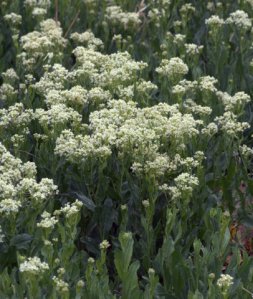
 Spring flowers are finally filling the fields. Milk vetch, penstemons, wild onions and marsh marigolds all caught my eye as I hiked though the towering cottonwoods along Fountain Creek, at the base of the Rockies here in central Colorado. I was particularly impressed by huge swaths of a foamy white flower I didn’t immediately recognize.
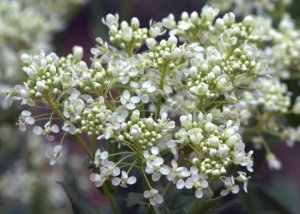
Counting the petals—each tiny flower had four—and examining the foliage led us to conclude the plants were Crucifers, members of the mustard family. Sure enough, we were enjoying the pretty flower heads of Whitetop (Cardaria draba), an aggressive import from Europe and Asia that is listed as a noxious weed here in Colorado (List B). Oh dear.
A bulletin from Colorado State University states:
 Whitetop is a deep rooted creeping perennial mustard plant that grows up to 2 feet tall, reproducing from root segments and seeds. Leaves are blue-green in color with the lower leaves being stalked and the upper leaves having two lobes clasping the stem. Plants have many white flowers with four petals, giving the plant a white, flat-topped appearance. Plants emerge in very early spring and have bloomed and set seed by early to mid-summer.
The bulletin then goes on to explain how incredibly invasive this plant is, how livestock refuse to eat it, and suggests ways to control it with herbicides.
Pulling the plant generally doesn’t work because the rhizomatous roots penetrate deeply (29-32 inches) into the soil. (One plant in the Pacific Northwest had roots growing 30 feet deep—try pulling that!)
You can try “frustrating” the weed by repeated mowing. The idea is to exhaust the food supply in the roots, until the plant literally starves to death. The problem with this method is that the first one to become frustrated is usually the gardener.
The only time the plant can be easily controlled by cultivation is at the seedling stage, but don’t wait. It only takes three weeks for a seedling to start producing root buds. These buds become creeping roots that quickly overwhelm adjacent plants, until all you have is a large patch of Whitetop.
Whatever you do, don’t let the plants go to seed. In just one season, a single plant can produce between 1,200 to 4,800 seeds!
 Whitetop arrived in the U.S. many years ago, its seeds hiding in a bale of hay. Since then it has spread throughout most of the country. Here in Colorado it usually grows at elevations between 3,500 and 8,500 feet—i.e., most of the state. It prefers disturbed soil, full sun, and moderate moisture, especially at this time of year. In other words, it loves our yards.
It’s important to learn to recognize the noxious weeds in your region (just Google “noxious weed list” and the name of your state). If ignored, they will overpower the landscape, starting with your yard. Besides, it’s illegal to have them growing on your property. We all need to pitch in and help control these aggressive invaders.
Further reading:
http://parks.state.co.us/SiteCollectionImages/parks/Programs/ParksResourceStewardship/Whitetop.pdf
 Mountain Plover
Excellent goods from you, man. I have consider your stuff
previous to and you’re just extremely magnificent.
I actually like what you have received right here, really like
what you are stating and the way through which you say it.
You are making it entertaining and you continue to care for to stay it sensible.
I cant wait to read much more from you. This is really a wonderful website.