
 It’s a common question. You’ve just planted a new tree. In the process, the plant has lost a significant portion of its roots—sometimes up to 95 per cent! Should you prune back the crown to compensate?
The intuitive answer would be yes. We assume that with fewer roots, there’s no way the plant will be able to sustain all that foliage on top—and that’s the advice I see on website after website. But if you do decide to prune, you’ll be doing the tree a disservice. You might even kill it! How can this be?
 The tree had clearly expired. What leaves remained had turned a sickly yellow-brown, and hung limply on the branches—in mid-August! Yet, when our neighbors planted it last year it had been perfectly healthy. Something was obviously wrong, and I had a hunch I knew what. (I’ve often said that master gardeners kill just as many plants, we just know why they died.)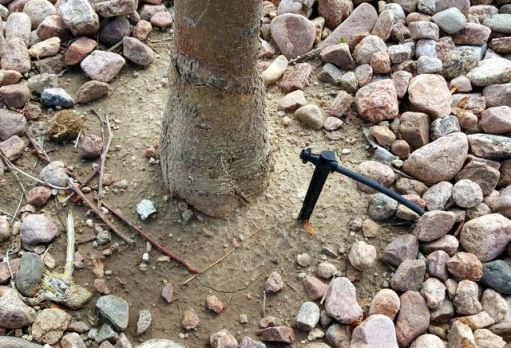
 You’ve read the instructions; I’ve used them frequently here in my posts. “Drought resistant once established.” Sounds good—we’re always trying to save water—but how should you water these plants to start with? And what does “established” mean?
 How do you plant a new tree? Most people know to dig a hole “twice as wide and deep as the root ball” (according to the label I found hanging from the branches), then stick in the tree, making sure the roots are well buried. Amend the backfill with plenty of compost, pile it over the roots and tamp it down firmly. Finally, securely stake the thin trunk so it won’t wiggle in the wind. Right?
 We all know what roots are—they’re the part of the plant that’s usually underground. If we have a mental image, it’s probably a mass of wiggly, white strings poking their way through the soil. We should pay more attention to roots. After all, they’re an essential part of a plant (as well as the only part remaining after some hail storms!). Knowing a little about how roots work will make us more successful gardeners.
 Mountain Plover