
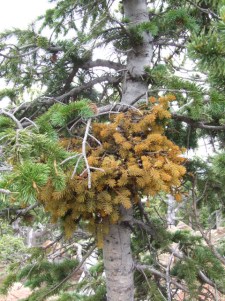
 You won’t see them being ridden on Halloween, they’re no good for sweeping, and they aren’t caused by witches. Instead, witches’ broom is the term for a dense cluster of leaves or twigs growing haphazardly among the branches of a plant, usually a shrub or tree. At times, the appearance of the broom is strikingly different from normal growth, as in the example shown at left.
Any plant can grow a witches’ broom, from deciduous trees such as willow or cherry, to conifers including pines, firs and spruces. Hackberry is especially susceptible. Aster Yellows is an example of a damaging broom that affects non-woody plants.
Many factors can cause broom formation, including viruses and other microorganisms, fungi, mites and insects, nematodes, mistletoes, and even random genetic mutations. An environmental stress that affects the growth point of a branch will also result in a witches’ broom. Sometimes, two of more factors are involved. Often, the cause cannot be determined. In most cases, the best way to control a witches’ broom is to simply prune it out.
 Mountain Plover