The Ubiquitous Canada Goose

canada-goose-fcnc-2009-01-21-lah-649Canada Geese are everywhere. They blanket golf courses, leave droppings on city park lawns, and foul ponds. They are a significant agricultural pest, especially of winter wheat. They’re even implicated in plane crashes, such as US Airways Flight 1549’s emergency “splash down” in the Hudson River last January.

You can find them on any body of water, even transient wetlands devoid of food. You hear honking and look up to see them flying east or west as well as north and south, arranged in their ragged v-formations. They seem so abundant that it’s hard to imagine they were ever endangered, but at one time the “Giant” subspecies (Branta canadensis maxima) was thought to be extinct!

(more…)

Talking Turkey

turkey-gleneyrie-lahThere are turkeys, and then there are turkeys. One dictionary’s definitions include:
“A person considered inept or undesirable,” and “A failure, especially a failed theatrical production or movie.”Then there’s “talking turkey,” “cold turkey,” and “turkey trot.” Of course, as birders, we think of turkeys as yet another species to be found while out birding. But even this avian sort of turkey comes in two varieties. The birds we commonly consume at Thanksgiving have little in common with their noble ancestors.

Wild Turkeys are well adapted to life in North America. They have plumage that blends perfectly with the oranges and browns of autumn leaves. This makes them hard to spot as they forage for seeds and grubs in the underbrush. Additionally, their hearing and eyesight are both very sharp, alerting flocks to potential predators—and birders. Finally, if you do manage to spot a turkey, don’t scare it. When alarmed, they can flee at 25 mph, leaving us in the dust.

(more…)

Hamerkop

hammerkop_denverzoo_200901007_lah_3535x2c5x7-1

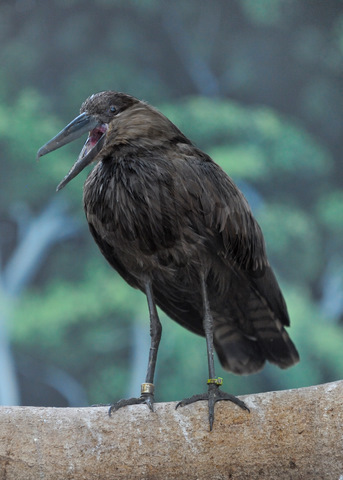
In case you’re wondering, this is a Hamerkop (also known as a Hammerhead, Anvil Bird, and Umber Bird, among other aliases). I found him at the Denver Zoo. He was making quite the racket. Apparently this is somewhat unusual, as they are usually pretty quiet.

These are really strange birds. According to Wikipedia, my favorite source of potentially correct information, “One unusual feature is that up to ten birds join in ‘ceremonies’ in which they run circles around each other, all calling loudly, raising their crests, [and] fluttering their wings.” Reminds me of my high school football team.

(more…)

Brown Ducks

mallards-lake-pueblo-20090523-lah-134
This mallard really is a female.

“They’re all females! Where did the males go?”

My friend and I were newbie birders; I’d started keeping a “Life List” only two months earlier. August found us at our favorite spot—the local nature center’s ponds. As usual, the water was covered with ducks and other waterfowl. But the more we stared through our binoculars, the more confused we got. All the ducks were brown! What had happened to the familiar green heads of the mallards? We figured that some of the “females” must be immature males, but where were the adults? (more…)

Rufous Hummingbirds: August Fireworks

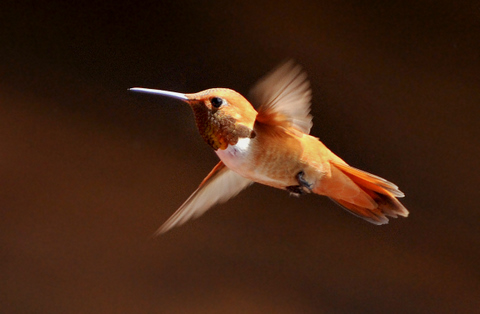
plh_6895rLike animated jewelry, the bright copper hummingbirds have been rocketing through our yard for the past few weeks. I’m constantly amazed at how something that small can go that fast. Rufous Hummingbirds are our special treat this time of year. In spring they migrate northward along the Pacific flyway, making the enormous trek from Mexico to Oregon, Idaho, or even all the way to southern Alaska, in order to nest and raise their young. Now that they’re empty nesters, it’s time for the return trip.

Some Rufous hummers go home the way they came, flying through California. Others head for the Rockies. No one knows why—maybe they just want a change of scenery. The upshot of their wanderlust is that those of us who live in Colorado get a late summer fireworks display. Starting in mid-July and running until Labor Day, these feisty birds dominate the feeders.

(more…)

Broad-tailed Hummingbirds

dsc_5382-1

Is that a hummingbird nest? I had to look carefully to find the tiny cup nestled among the ponderosa branches. Sure enough—a female Broad-tailed Hummingbird stared pointedly back at me, as she dutifully sat on what I could only assume were a couple of pea-sized eggs.

What really impressed me was the way the secretive bird had camouflaged her home. Lichens grew on the tree branches, and covered the outer surface of the nest. It looked like just one more bump on the bark, although with a diminutive bird sitting on top.

(more…)

House Sparrows

You see them everywhere… singing outside your bedroom window, eating squashed bugs off your car windshield, cleaning up spilled crumbs at sidewalk cafes. They mob bird feeders full of millet and take up space in nest boxes intended for other species. I’ve even found them in a tiny town in the middle of the Utah desert, miles from anything wet or green. One would think that House Sparrows are one of the most successful species ever to populate planet Earth.

house-sparrow-denverzoo-20090527-lah-093
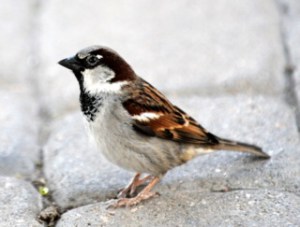
Male House Sparrow

Not closely related to North American sparrows, House Sparrows are relative newcomers to the Western Hemisphere. They were deliberately introduced during the latter half of the 19th century in repeated attempts to establish a breeding population in the U.S.

While the story is a bit foggy, apparently the birds were imported to eat insects that were damaging crops. If so, it was an egregious error. House Sparrows are primarily seed eaters, and according to one study, 78% of those seeds come from agricultural crops intended for livestock or human consumption.

(more…)

Foiling Flickers

BAM BAM BAM BAM BAM! My story about flickers was fictionalized, but based on personal experience. Last spring, flickers really did invade our home.

By August, my husband and I realized we’d nailed scraps of wood across 15 large flicker-sized holes. Piles of fluffy insulation littered the ground beneath each one. That fall we replaced much of the cedar siding on our house, to the tune of over a thousand dollars. The question became critical: What could we do to prevent the birds from drilling into our new wood?

A lot of people must be having the same problem. A quick web search turned up plenty of suggestions, but not much in the way of success stories. Inflatable owls don’t work—the birds are smarter than that. Flickers quickly become accustomed to hanging strips of aluminum, Mylar balloons, and small colored windmills. What else could we do?

(more…)

What’s that bird that’s driving me crazy?

BAM BAM BAM BAM BAM. I was awakened early this morning by insistently loud hammering on the metal chimney guard on our roof. Yup, it’s that time again. Our resident Northern Flicker is announcing his ownership of our property. This year we’re ready. But last year we had a major issue with these woodpeckers. They drove my husband crazy, and inspired me to write the following story:

Not even the cat is awake before 5 am. Soft snoring comes from the bedroom, darkened by shades against the early appearance of the sun this time of year. It’s a lazy Saturday morning in mid-March. Nothing important is scheduled for hours. Later there will be errands to run, chores to catch up on, phones ringing and dishes. Right now, all is peaceful, all is calm.

BAM BAM BAM BAM BAM

Like a staccato burst of machine gun fire, the noise reverberates off the metal gutters directly outside our bedroom window.

(more…)