Encouraging Bluebirds

western-bluebird-home-2008jun03-lah-015rIf the birds held a popularity contest, Bluebirds would probably win. Everyone loves them. Perhaps that’s because they’re so well mannered. They help us by eating the bugs that bug us. They take good care of their families, with the males defending their territories while the females fuss over the nestlings. And when the sun hits their feathers, just so, they shine with the most amazing sky blue.

It’s a good thing many people like bluebirds, because they could use our help. All three bluebird species have declined in numbers since the early 1800s. There are several reasons.

(more…)

The Ubiquitous Canada Goose

canada-goose-fcnc-2009-01-21-lah-649Canada Geese are everywhere. They blanket golf courses, leave droppings on city park lawns, and foul ponds. They are a significant agricultural pest, especially of winter wheat. They’re even implicated in plane crashes, such as US Airways Flight 1549’s emergency “splash down” in the Hudson River last January.

You can find them on any body of water, even transient wetlands devoid of food. You hear honking and look up to see them flying east or west as well as north and south, arranged in their ragged v-formations. They seem so abundant that it’s hard to imagine they were ever endangered, but at one time the “Giant” subspecies (Branta canadensis maxima) was thought to be extinct!

(more…)

Christmas is for Counting Birds

2008dec20-cbc-392rThis Saturday I’m heading out on Audubon’s annual Christmas Bird Count (CBC). I’ll be joining tens of thousands of other birders around the world in a tradition that is in its 110th year.

December isn’t exactly the best time to be outside birding. A few years ago, our group experienced blizzard conditions and a toasty high of six degrees F. (Amazingly, we saw over 200 American Robins in our count area that year! I kept expecting penguins.) Other years have been somewhat milder, but December in Colorado Springs is never for sissies. Why do we bundle into multiple layers of clothing and get up in the dark to spend most of the day outside counting birds?

The holiday season is also incredibly busy. Shopping, decorating, baking, parties—who has time to tally birds? Why use up a precious Saturday right before Christmas in order to take a bird census?

(more…)

Recycled “Greenscapes”

continer-whimsy-dbg-2008jun26-lah-461“Don’t throw that away!”

My family is used to my exhortations by now. Mom, the recycling nut. It’s true—I have a bin for metals and one for plastics, 1 through 7. Glass has its own container, next to the compost bucket. Worms eat my garbage. Paper and cardboard pile up in old laundry baskets (I’m recycling the baskets too). Still-usable discards go to the thrift stores, worn out clothes get used as rags. Not much ends up in the small trash can we lug to the curb every week.

As a gardener, I want to extend my recycling efforts to my yard. How can I avoid making new purchases for my garden?

(more…)

Digging Up Dirt

shoveling-manure-home-plh-sI keep talking about dirt. That is, I seem to have a soil fixation. Perhaps that’s because gardens begin with the soil. Properly prepared soil produces healthier plants, reducing the need for chemical sprays and fertilizer, and making more efficient use of water. Last May I discussed what soil is, and how to amend it. Today I want to expound a bit on the various types of amendments. I’ll also repeat myself a bit. That sort of thing happens as one gets older.

While living along the Front Range has many benefits, our soils are really pretty pitiful. Unless you are content growing a limited number of native plants adapted to this area, you’re going to have to improve on nature. What’s an environmentally responsible gardener to do?

In new plantings, it is worth spending a little time and money for a soil test. Knowing what your soil has, and what it lacks, helps you avoid many time-consuming and expensive mistakes. Follow the test result directions to maximize fertility and soil health. There are natural materials available to raise your levels of nitrogen, potassium, and phosphorous.

(more…)

Preserve Wetlands—Buy a Duck Stamp!

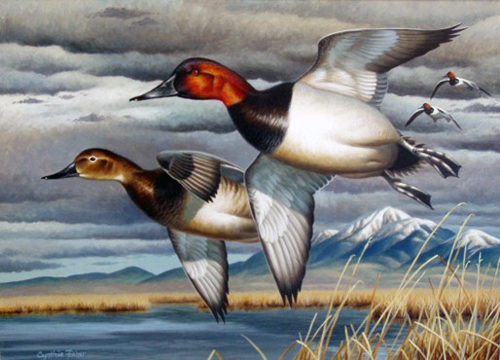
2003 CO Duck Stamp c Cynthie FisherThe purchase of a Federal Migratory Bird Hunting and Conservation Stamp, more simply known as a “Duck Stamp,” is one of the best ways you can promote wetlands conservation. Since its inception in 1934 as a federal license for hunting migratory waterfowl, this program has generated over $670,000,000 that has been used to purchase or lease 5.2 million acres of waterfowl habitat that is now included in the National Wildlife Refuge System.

The stamps are only $15, and 98% of that is used for habitat preservation! With a decline in the number of hunters, it is more important than ever that conservationists, and especially birders, purchase Duck Stamps. As a bonus, having the current year’s stamp allows you free access to any National Wildlife Refuge, many of which now charge admission fees.

(more…)

Support Sustainable Forests

Migration has died down. The birds have arrived at their destinations, and are spending their time and energy raising a new generation. But where were all those birds headed, anyway? Most went north, far north.  The Boreal Forest in the Northern U.S. and Canada is essential breeding territory for many species of birds.

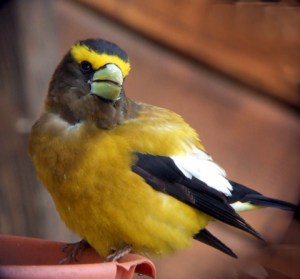
evening-grosbeak-home-2008jun05-lah-033cOne familiar bird impacted by the fate of our forests is the Evening Grosbeak. Evening Grosbeaks are birds of boreal and montane forests and are therefore susceptible to all the incursions into those habitats. Chemical control of spruce budworm and other tree pests lowers this species’ food supply and may also cause secondary poisoning. Competition and the spread of disease among house finches, goldfinches, and other feeder birds may also be playing a role in the decline. Finally, populations are affected by fluctuations in insect populations and the frequency and intensity of forest fires.
Federal and state legislations promoting sustainable forest management will help fight habitat loss from inappropriate logging, mining, and drilling. Become educated about the issues and write those legislators who are most likely to make critical decisions. The informative article in the Sept./Oct.,2008 issue of Aikorns is a good place to start.

House Sparrows

You see them everywhere… singing outside your bedroom window, eating squashed bugs off your car windshield, cleaning up spilled crumbs at sidewalk cafes. They mob bird feeders full of millet and take up space in nest boxes intended for other species. I’ve even found them in a tiny town in the middle of the Utah desert, miles from anything wet or green. One would think that House Sparrows are one of the most successful species ever to populate planet Earth.

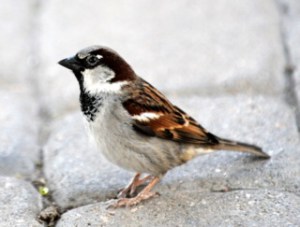
house-sparrow-denverzoo-20090527-lah-093
Male House Sparrow

Not closely related to North American sparrows, House Sparrows are relative newcomers to the Western Hemisphere. They were deliberately introduced during the latter half of the 19th century in repeated attempts to establish a breeding population in the U.S.

While the story is a bit foggy, apparently the birds were imported to eat insects that were damaging crops. If so, it was an egregious error. House Sparrows are primarily seed eaters, and according to one study, 78% of those seeds come from agricultural crops intended for livestock or human consumption.

(more…)