
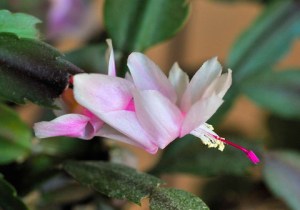
 Small succulent-looking plants covered with huge, florescent red, pink or white flowers are featured prominently in many stores right now. Go ahead get one. You won’t regret it.
Christmas (or Thanksgiving) cactus are both beautiful and easy to grow.
Yes, they’re cactus, but these plants are native to tropical rain forests in the mountains of Brazil, where they grow on tree branches as epiphytes. That should tell you that they like to be kept somewhat moist, but never soggy. This is particularly important while the plants are in bloom. In fact, uneven watering is a main cause of blossom drop. (Another is an abrupt decrease in humidity, such as comes when you move a plant from the greenhouse to your home.) The rest of the year, they are a bit more forgiving, and will tolerate a bit of drying out. It’s always best to let the top inch of soil dry out between waterings.
 There’s “only” 55 more days until Christmas. Catalogs are pouring into our mailbox. Most go straight into the recycling pile, but a few I set aside, saving them for a break in the holiday frenzy. I don’t keep the gift catalogs, or the home décor catalogs. I only save the important catalogs… the seed catalogs.
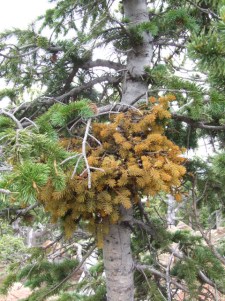 You won’t see them being ridden on Halloween, they’re no good for sweeping, and they aren’t caused by witches. Instead, witches’ broom is the term for a dense cluster of leaves or twigs growing haphazardly among the branches of a plant, usually a shrub or tree. At times, the appearance of the broom is strikingly different from normal growth, as in the example shown at left.
 Cold-resistant flowering cabbage takes the stage after tender annuals have succumbed to Fall’s first frosts. Flowering cabbage isn’t really a flower, but a loose head of large ruffled, fringed, or smooth leaves in vibrant combinations of cream rose, purple, and green. Although grown as an ornamental, flowering cabbage, also known as ornamental or flowering kale, is completely edible.
 “Mom, can you fix it?”
 “Don’t throw that away!”
 As summer’s flowers fade, plants that produce berries take center stage. Branches covered with bright red berries make cotoneasters especially attractive now, but they offer year-round interest. In spring, tiny but abundant white to pink flowers may be obscured by the shiny round green leaves. Foliage turns orange-red in fall. Finally, the berries persist into winter, or until the birds pick them clean.
 The hardest part of growing cotoneaster is pronouncing it correctly (it’s “ko-TON-ee-AS-ter”). These shrubs thrive with little attention, handling poor soils, full sun to afternoon shade, and moderately low amounts of water. New shrubs should be coddled a bit until vigorous growth begins. Give plants room to spread, pruning only to remove oldest wood and enhance appearance. As with all members of the rose family, cotoneasters are occasionally susceptible to fire blight; some new varieties are tolerant of this disease. The many different species in cultivation vary in hardiness. Most will survive zone 4 or 5 winters, but check the label for the variety you are purchasing.
 Mountain Plover