
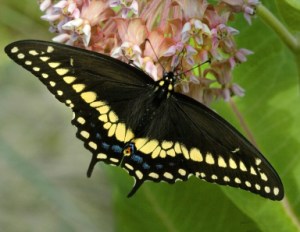
Like an bejeweled flower, the butterfly fluttered around my garden, never stopping to rest, moving from blossom to blossom until it gently drifted over the fence. I love watching butterflies flutter by, but feeding their caterpillars is another matter. I don’t want to sacrifice any of my garden plants to hungry mandibles. In at least one case, at least, I’ve discovered a compromise.
Black Swallowtails are some of the most beautiful butterflies found in Colorado. They’re large and black with a double row of yellow spots delineating their wings, and sapphire-blue sequins at the base of their long, pointed tails. They’re the kind of butterfly that everyone oohs and aahs over. I’m no exception.


 More charmingly known as Butter-and-Eggs, the common name “Toadflax” applies to several similar species. All sport cheerful yellow flowers resembling snapdragons, to which they are related. Two-foot tall clumps of smooth green stems are covered with narrow, pointy leaves two and a half inches long. The flowers appear whenever growing conditions permit.
 Appearance
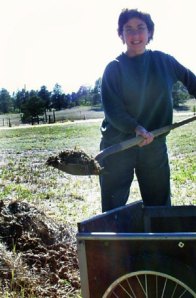 You can easily increase the percentage of organic matter in your soil by adding compost or another organic amendment. This added humus will act as a sponge, increasing water retention in sandy soils. On the other hand, in clay it acts to improve drainage by increasing the size of air and water spaces. Plus, organic matter works with your fertilizer by holding nutrients in a form that is available for absorption by roots. As you can see, organic matter is an important component of healthy soil.
 Actually, dirt is just one component of what gardeners prefer to call “soil.” Rocks weather and break down into smaller rocks, pebbles, gravel, and finally sand and silt. These tiny particles mix with organic matter—decomposing plants and animals—called “humus.” Then there’s air, and water. Add in weed seeds, worms, bugs, and a huge variety of microorganisms, and you have the living stuff in which we plant our gardens.
 Carrots, on the other hand, are usually planted a week or two before the average last frost date. The cool temperatures and snow-damp soil help keep the seeds from drying out during the three weeks it takes them to germinate.
 Mountain Plover