The Perfect Purple Pea Plant

Baptisia australis_Flase Indigo_HAS-CoSpgsCO_LAH_0247I fell in love with Baptisia australis (aka Blue False Indigo) the first time I saw it in full bloom at the Denver Botanic Gardens. Then again, I do have a “thing” for purple flowers (which probably explains the profusion of cat mint, May Queen sage, and Veronica growing in front of our house).

Baptisia is a perennial; the plants die back to the roots after the first freeze. However, come spring the plants quickly grow into attractive mounded shrubs about three to four feet in diameter. If that is too large for your space, there’s a dwarf form that only reaches half that size. (more…)
A November Garden Beauty

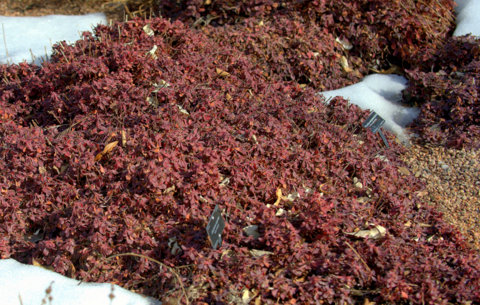
Eriogonum umbellatum var aureum - Sulfur Flower Buckwheat_DBG_10200118_LAH_7145My daughter was staring at the planters surrounding her patio, full of bedraggled and wilted plants. “I know it’s November, but is there something I can plant that will look nice now?”

Of course we’re not going to get the delicate flowers or green abundance of late spring or summer, but dead doesn’t have to mean ugly. Some plants manage to look good even after freezing nights and the season’s first snowstorm.

(more…)

Stop Fighting Mother Nature

Penstemon 'Red Rocks' @ExtDemoGarden 2008sept25 LAH 264Alkaline soils, sparse rainfall, extreme temperatures, low fertility. Colorado doesn’t exactly sound like a gardener’s paradise. Few places do. Lamenting the current drought and expected summer water restrictions, I often dream of gardening in a place with ample rainfall. Wouldn’t it be wonderful?

Then I visited my daughter in western Washington. She and her husband live in Everett, north of Seattle. They have a view (on a rare clear day) looking east to the Cascades. These impressive mountains form a barrier blocking clouds that would otherwise move on into eastern Washington and Idaho. As a result, my daughter’s area gets a lot of rain.

(more…)

My Favorite Plant for Colorado Gardens

Prunus virginiana - Chokecherry@BoulderCO 2006may12 LAH 003If I could create one perfect plant for the Pikes Peak region, what would it be like?

Of course, I’d want it to be attractive. It should adorn itself with cheerful spring flowers, good-looking foliage, and intense fall color. I’d add persistent fruit or berries to feed the birds and provide winter interest.

My perfect plant should be easy to grow; I’d want it to thrive in our native soils with little or no supplemental water. It must be hardy to at least 8,000 feet, and still handle summer heat waves.

(more…)

Basket of Gold (Aurinia saxatilis)

Appearance
aurinia-saxatilis-basket-of-gold-dbg-lah-017Basket of Gold is a long-lived, low maintenance ground cover for small spaces. Gray, slightly fuzzy leaves are present year round, forming clumps 6 to 18 inches tall and 6 to 12 inches wide. In early Spring the plants are totally covered with masses of tiny cross-shaped flowers. Eye-catching colors range from soft yellow ‘Citrina’ or ‘Dudley Neville’ to the blindingly intense golden yellow of ‘Gold Dust.’ A similar species, Mountain Gold (Aurinia montanum) is more compact, with smaller leaves. Mountain Gold is also a bit harder to find at a garden center.

(more…)

A Garden Catalog for Colorado

high-country-gardens-catalogLast week I was complaining about catalogs full of tempting, desirable plants that simply will not grow here in Colorado. Today I want to introduce you to a catalog full of tempting, desirable plants that love it here.

Most experienced local gardeners already know about High Country Gardens, but if you don’t, you should. Based in Santa Fe and Albuquerque, New Mexico, this company specializes in perennials suited for the high, dry gardens of the western U.S. In fact, a lot of their stock won’t do well in “average garden conditions” (a phrase that means “conditions in gardens that are not in Colorado”).

(more…)

Grow Veggies, Save Water

community-gardens-bearcreek-lah-003According to a recent report from the U.S. Dept. of Agriculture, “Extreme drought conditions exist from Colorado Springs and Pueblo to the San Luis Valley and over most of the plains to the southeast of the big metro areas.”

If you live here, this isn’t exactly news. The fields are turning brown months early, wildflowers are small and sparse, and even the most aggressive weeds are wilting.

Living in the low-rainfall west, we’re used to gardening with minimal water. Xeriscaping is a household word, and basic principles of low-water gardening are widely available. (I’ve written several posts on it too—just type “xeriscape” into the search bar.)

(more…)

Golden Currant (Ribes aureum)

ribes-aureum-golden-currant_se-co_20100414_lah_2401-1Appearance
Aptly named Golden Currant blooms in early spring with showy clusters of small but fragrant trumpet-shaped bright yellow flowers. The blossoms are followed in summer by edible fruit that ripens from green through red to black. In fall, green leaves turn to amber or scarlet before falling. The arching branches can reach anywhere from three to nine feet in height, depending on age and habitat.

(more…)

Cottonwood Creek’s Xeriscape Garden

cottonwoodxg_lah_2470Successful gardening in Colorado means choosing plants well suited for our arid climate. Colorado Springs Utilities (CSU) maintains two demonstration gardens, featuring beautiful perennials, grasses, shrubs and trees that are adapted to limited irrigation. Many people are aware of the large garden at the CSU headquarters on Mesa Road, overlooking Garden of the Gods. I wrote about it in April. But very few people are aware that there’s a second, smaller garden in front of the Cottonwood Creek Recreation Center at 3920  Dublin Blvd., just west of Rangewood Drive.

iris_cottonwoodxg_lah_2504While much more limited in scope, this garden provides plenty of inspiration for a homeowner seeking to conserve water and still enjoy a beautiful landscape. When I visited in mid-June, a large swath of Stella ’d Oro daylilies were in full bloom, their bright golden yellow accented by the soft lavender of the surrounding Walker’s Low Catmint. The colors were repeated in lovely deep blue irises, purple Jerusalem Sage, and pastel yellow Moonshine Yarrows and Pineleaf Penstemon.

(more…)