
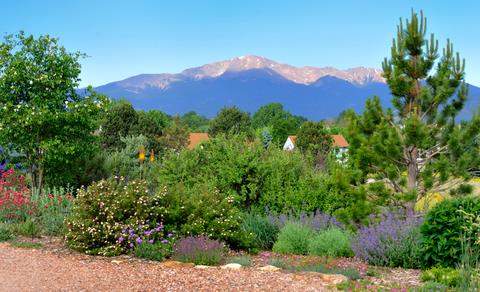
 Successful gardening in Colorado means choosing plants well suited for our arid climate. Colorado Springs Utilities (CSU) maintains two demonstration gardens, featuring beautiful perennials, grasses, shrubs and trees that are adapted to limited irrigation. Many people are aware of the large garden at the CSU headquarters on Mesa Road, overlooking Garden of the Gods. I wrote about it in April. But very few people are aware that there’s a second, smaller garden in front of the Cottonwood Creek Recreation Center at 3920 Dublin Blvd., just west of Rangewood Drive.
 While much more limited in scope, this garden provides plenty of inspiration for a homeowner seeking to conserve water and still enjoy a beautiful landscape. When I visited in mid-June, a large swath of Stella ’d Oro daylilies were in full bloom, their bright golden yellow accented by the soft lavender of the surrounding Walker’s Low Catmint. The colors were repeated in lovely deep blue irises, purple Jerusalem Sage, and pastel yellow Moonshine Yarrows and Pineleaf Penstemon.

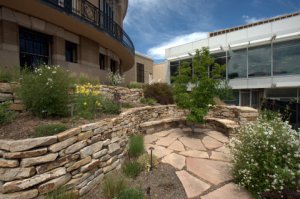 The Carnegie Library Garden may be one of downtown Colorado Springs’ best kept secrets. That’s a shame, because it is truly a gem. This is one of several public gardens featuring water-wise plants especially suited for our climate and soils. It was designed by landscape architect and master gardener Carla Anderson, and is maintained by a team of dedicated volunteers.
 Blossoms abound throughout the growing season. When I visited last month, red and yellow ‘Lena’ broom was beginning to fade, while several types of Mockorange were in full bloom. Rosettes of huge, fuzzy, silver Salvia leaves were topped with tall white or purple flower stalks, and brilliant Colorado Gold hardy gazanias were everywhere. An arbor with a built-in bench supports a beautiful pink climbing rose, while honeysuckle grows on up a nearby trellis. By the time you read this, new plants will be in bloom; it’s worth coming back for repeat visits.
 I heard this the other day and thought it was funny enough to bear repeating. I hope I don’t offend any Italians—that surely isn’t my intent! I would love to give credit to the person who write this, but I have no idea who that might be.

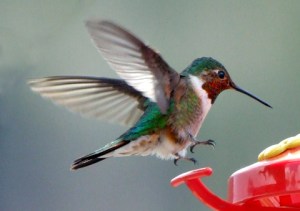 A brightly colored hummingbird zooms past on its way to a feeder. A finch fills the air with music. Birds provide us with hours of entertainment. How can you welcome more wild birds into your yard?
 Mountain Plover