Fabulous Fernbush

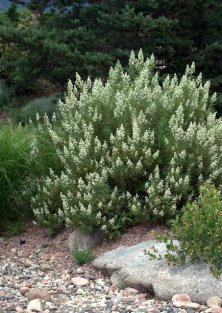
Chamaebatiania millefolium - Fernbush_XG_20090720_LAH_7320From a distance, a blooming fernbush (Chamaebatiaria millefolium)  resembles a lovely white lilac bush, but no lilac would be in bloom at this time of year. Growing to seven feet high and wide, these shapely shrubs are covered in upright sprays of showy white flowers from June through August. Individual blossoms are reminiscent of single roses, and attract bees and butterflies. Come autumn, the flowers are replaced by russet seed heads.

A closer inspection reveals reddish peeling bark and the aromatic, finely dissected leaves that give Fernbush its common name. Even in our cold climate, these leaves stay on the bush for most of the year; branches are bare for a mere three to four months each winter. Fall foliage is an attractive copper color.

(more…)

A Garden for Good Bugs

Monarch Butterfly_ChicoBasinRanch-CO_LAH_8874Why would I want to invite insects into my garden? Don’t most homeowners want to get rid of the bugs? It’s true that some insects cause major problems in a landscape, chewing indiscriminately and leaving behind a trail of devastation. But don’t let a few bad guys ruin it for everyone—there are plenty of insects who can live harmoniously among our plants. Some, such as bees, more than earn their keep. And who doesn’t enjoy a garden full of butterflies?

(more…)

Sweet, Sweet Honeysuckles

I sat me down to watch upon a bank
With ivy canopied and interwove
With flaunting honeysuckle. (John Milton)

Lonicera sempervirens_Honeysuckle_DBG_LAH_6903Mention honeysuckle, and we think of green hedgerows, sultry summer days, and childhoods spent picking the flowers and putting them in our mouths to suck out the sweet nectar. There are around 180 species in the genus Lonicera. Fast growing and tolerant of inhospitable conditions, honeysuckles have much to recommend them. Many are valuable landscape plants able to withstand Colorado’s challenging conditions while presenting us with beautiful flowers and berries adored by birds.

(more…)

Finally, Manzanitas for Colorado!

Arctostaphylos x coloradensis_Mock Bearberry Manzanita_CarnegieLib-CoSpgsCO_LAH_9993Finally, manzanitas for Colorado gardeners! When we first moved to Colorado, back in 1993, I wanted to add some manzanitas to our ponderosa forest landscape, but the cultivars available weren’t deemed hardy enough for our 7000 foot elevation. I gave up and settled for Mahonia—not at all the same thing, but about the only broad-leafed evergreen I could get to grow in my yard.

(more…)

Presenting Autumn, Starring Rabbitbrush!

Chrysothamnus nauseosus_Rabbitbrush_Cylindropuntia_Cholla_ChicoBasinRanch-CO_LAH_2989-001With intense sulfur-yellow flowers covering its gray-green foliage, blooming Rabbitbrush demands to be noticed. In fact, the prairies of eastern Colorado are almost blanketed with it—something we never notice until it blooms. Interspersed with prickly cholla cactus and some perennial range grasses, it forms the essence of western landscapes. But it’s not just for the wide open spaces. Rabbitbrush is an excellent performer in the garden as well.

(more…)

A November Garden Beauty

Eriogonum umbellatum var aureum - Sulfur Flower Buckwheat_DBG_10200118_LAH_7145My daughter was staring at the planters surrounding her patio, full of bedraggled and wilted plants. “I know it’s November, but is there something I can plant that will look nice now?”

Of course we’re not going to get the delicate flowers or green abundance of late spring or summer, but dead doesn’t have to mean ugly. Some plants manage to look good even after freezing nights and the season’s first snowstorm.

(more…)

My Favorite Plant for Colorado Gardens

Prunus virginiana - Chokecherry@BoulderCO 2006may12 LAH 003If I could create one perfect plant for the Pikes Peak region, what would it be like?

Of course, I’d want it to be attractive. It should adorn itself with cheerful spring flowers, good-looking foliage, and intense fall color. I’d add persistent fruit or berries to feed the birds and provide winter interest.

My perfect plant should be easy to grow; I’d want it to thrive in our native soils with little or no supplemental water. It must be hardy to at least 8,000 feet, and still handle summer heat waves.

(more…)

‘Red Rocks’ Penstemon

penstemon-red-rocks-xg-2008jul18-lah-4656r

An inconspicuous, low-growing mound of evergreen leaves for most of the year, ‘Red Rocks’ takes center stage in mid-summer, with 18-inch spikes of bright pink, bell-shaped flowers. The first penstemon chosen for inclusion in the PlantSelect® program, ‘Red Rocks’ was added in 1999. It’s a cross between a showy Mexican species and a hardy Colorado native, combining the best features of both its parents. ‘Red Rocks’ is named after the park west of Denver.

(more…)

Paper Wasps and Butterflies

eruopean-paper-wasp__butterflypavilion-co_lah_9129Aliens have invaded Colorado. Once again, a non-native species has moved into our territory and established a thriving population. In this case, it’s the European Paper Wasp (left). You can read all about it at the Colorado State University Extension website.

In this case, having this new insect in town is a mixed blessing. Although they look a lot like a yellow-jacket, European Paper Wasps aren’t aggressive; they can sting, but they seldom do. On the down side, they’ve been known to go after the sweet juices of ripe fruit such as cherries, and pose a threat to the orchards on the Western Slope.

(more…)

Golden Currant (Ribes aureum)

ribes-aureum-golden-currant_se-co_20100414_lah_2401-1Appearance
Aptly named Golden Currant blooms in early spring with showy clusters of small but fragrant trumpet-shaped bright yellow flowers. The blossoms are followed in summer by edible fruit that ripens from green through red to black. In fall, green leaves turn to amber or scarlet before falling. The arching branches can reach anywhere from three to nine feet in height, depending on age and habitat.

(more…)