
 With intense sulfur-yellow flowers covering its gray-green foliage, blooming Rabbitbrush demands to be noticed. In fact, the prairies of eastern Colorado are almost blanketed with it—something we never notice until it blooms. Interspersed with prickly cholla cactus and some perennial range grasses, it forms the essence of western landscapes. But it’s not just for the wide open spaces. Rabbitbrush is an excellent performer in the garden as well.
Tag: shrub
Blue Mist Spiraea
 Spring flowers have turned into berries and seed pods. Without their blossoms peonies are mere green bushes, and even the annuals are looking a bit peaked. Don’t despair, however. The show isn’t over yet. One of the best perennials (or small shrubs) for Colorado gardens is Caryopteris x clandoensis, more familiarly known as Bluebeard or Blue Mist Spiraea.
The latter common name can cause some confusion. Caryopteris isn’t a true spiraea. The “Blue Mist” part is spot on. The airy flowers in periwinkle blue really do seem to hover over the tips of the stems in a lovely cloud. The plants can reach two to three feet wide and tall. Foliage is a bluish gray-green, with long, soft, serrated leaves.
Planting Done Right: Part 1
Shrubs, Perennials and Ornamental Grasses
 It’s spring. I’ve been digging in the garden—at least between snow storms. My back muscles (and knees and shoulders) ache, there’s dirt under my broken fingernails, and a huge smile on my face. In fact, there’s dirt in my teeth—I’ve been pulling weeds and shaking the soil off their roots before piling them into the compost bucket, and I keep forgetting to close my lips.
One of the joys of spring is adding new plants to our garden. What gardener can resist the dazzling displays at the garden center? Forgetting about budgets and the size of our yards, we load up the cart. Then we get home and the work begins. It’s time to start digging holes.
Burning Bush (Euonymus alatus)
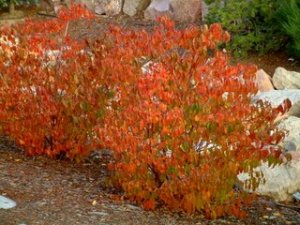 You’ve never noticed the shrub before. Its rounded green leaves and vase shape let it lurk unobtrusively in the background, where it may eventually grow to 15 feet tall and wide. Then, seemingly overnight, there’s a neon-fuchsia beacon glowing in the landscape. Fall has arrived, and the Burning Bush is on fire.
Also known as Winged Euonymus, both the species and a variety of named cultivars are widely available in garden centers. (Most of these cultivars are significantly more compact than the parent shrubs.) Deciduous leaves appear in mid-spring, accompanied by inconspicuous yellow flowers. Orange seeds are borne in orange-red capsules that mature at the same time as the spectacular fall foliage display.
Snowberry – Symphoricarpos albus
 While most fall and winter berries are red, or perhaps dark blue, snowberries sport showy clusters of pristine white, berry-like fruit. If not eaten by the birds, the fruit will adorn the bare branches in winter. The upright, finely-branched shrubs are about three feet tall. Moderate growers, they are long-lived, with tiny pink, bell-shaped flowers that appear in early summer.
A Colorado native, snowberry is well adapted to our growing conditions, and is hardy to zone 3. Soil type doesn’t matter, so long as it’s moderately fertile and reasonably well-drained. Plant in full sun, and water until established. While mature plants are highly drought tolerant, they also survive once-a-week watering, which also results in heavier fruit crops. Prune only to remove old, dead wood.


 While the slightly toxic berries are considered inedible by people, deer will browse on the plants. With its dense foliage, snowberry makes a good foundation shrub. For a woodland feel, plant with other natives such as Oregon grape and ponderosa pines.
Boulder Raspberry (Oreobatus deliciosus)
Appearance
 With its ostentatious white flowers clamoring for your attention, Boulder Raspberry impresses like a hybridized cultivar, rather than a native shrub. Growing three to five feet tall and six feet wide, arching, sprawling stems carry bright green, lobed leaves that turn yellow in fall before dropping for the winter. Spring’s blooms develop into small reddish purple fruit resembling cultivated raspberries. While edible, the berries are generally considered unpalatable. However, they will attract birds and other wildlife to your garden. Unlike other raspberries, the stems are thornless.
Cotoneaster Offers Berries, Fall Color
 As summer’s flowers fade, plants that produce berries take center stage. Branches covered with bright red berries make cotoneasters especially attractive now, but they offer year-round interest. In spring, tiny but abundant white to pink flowers may be obscured by the shiny round green leaves. Foliage turns orange-red in fall. Finally, the berries persist into winter, or until the birds pick them clean.
 The hardest part of growing cotoneaster is pronouncing it correctly (it’s “ko-TON-ee-AS-ter”). These shrubs thrive with little attention, handling poor soils, full sun to afternoon shade, and moderately low amounts of water. New shrubs should be coddled a bit until vigorous growth begins. Give plants room to spread, pruning only to remove oldest wood and enhance appearance. As with all members of the rose family, cotoneasters are occasionally susceptible to fire blight; some new varieties are tolerant of this disease. The many different species in cultivation vary in hardiness. Most will survive zone 4 or 5 winters, but check the label for the variety you are purchasing.
There is a size and shape for every use. Spreading plants under three feet high make good groundcovers. Try planting them where their arching branches can spill over a wall. Small, stiffly erect shrubs may be used as informal hedges. Tall, fountain-shaped growers form good screens.
 Mountain Plover