
 With intense sulfur-yellow flowers covering its gray-green foliage, blooming Rabbitbrush demands to be noticed. In fact, the prairies of eastern Colorado are almost blanketed with it—something we never notice until it blooms. Interspersed with prickly cholla cactus and some perennial range grasses, it forms the essence of western landscapes. But it’s not just for the wide open spaces. Rabbitbrush is an excellent performer in the garden as well.
Tag: xeric
Blue Mist Spiraea
 Spring flowers have turned into berries and seed pods. Without their blossoms peonies are mere green bushes, and even the annuals are looking a bit peaked. Don’t despair, however. The show isn’t over yet. One of the best perennials (or small shrubs) for Colorado gardens is Caryopteris x clandoensis, more familiarly known as Bluebeard or Blue Mist Spiraea.
The latter common name can cause some confusion. Caryopteris isn’t a true spiraea. The “Blue Mist” part is spot on. The airy flowers in periwinkle blue really do seem to hover over the tips of the stems in a lovely cloud. The plants can reach two to three feet wide and tall. Foliage is a bluish gray-green, with long, soft, serrated leaves.
The Perfect Purple Pea Plant
 I fell in love with Baptisia australis (aka Blue False Indigo) the first time I saw it in full bloom at the Denver Botanic Gardens. Then again, I do have a “thing” for purple flowers (which probably explains the profusion of cat mint, May Queen sage, and Veronica growing in front of our house).
Baptisia is a perennial; the plants die back to the roots after the first freeze. However, come spring the plants quickly grow into attractive mounded shrubs about three to four feet in diameter. If that is too large for your space, there’s a dwarf form that only reaches half that size. (more…)
My Favorite Plant for Colorado Gardens
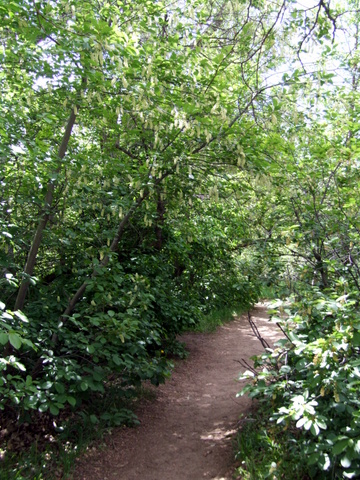 If I could create one perfect plant for the Pikes Peak region, what would it be like?
Of course, I’d want it to be attractive. It should adorn itself with cheerful spring flowers, good-looking foliage, and intense fall color. I’d add persistent fruit or berries to feed the birds and provide winter interest.
My perfect plant should be easy to grow; I’d want it to thrive in our native soils with little or no supplemental water. It must be hardy to at least 8,000 feet, and still handle summer heat waves.
‘Red Rocks’ Penstemon

An inconspicuous, low-growing mound of evergreen leaves for most of the year, ‘Red Rocks’ takes center stage in mid-summer, with 18-inch spikes of bright pink, bell-shaped flowers. The first penstemon chosen for inclusion in the PlantSelect® program, ‘Red Rocks’ was added in 1999. It’s a cross between a showy Mexican species and a hardy Colorado native, combining the best features of both its parents. ‘Red Rocks’ is named after the park west of Denver.
Another Easter Flower
 Can you name a plant that has short stems and showy purple flowers at this time of year? Now add eye-catching seed heads, and the fact that it’s native to Colorado (and other cold-winter areas in both North America and Europe). This cultivated wildflower is Pasque Flower (or), named after its Easter time bloom.
Appearance
Besides the lilac wildflowers, other purple shades are available in cultivated strains, from a deep purple-red to, rarely, white. Gray-green leaves appear after the flower buds, and may be more or less finely divided. They’re covered with silvery fuzz, giving a soft appearance that makes you want to pet them.
A Garden Catalog for Colorado
 Last week I was complaining about catalogs full of tempting, desirable plants that simply will not grow here in Colorado. Today I want to introduce you to a catalog full of tempting, desirable plants that love it here.
Most experienced local gardeners already know about High Country Gardens, but if you don’t, you should. Based in Santa Fe and Albuquerque, New Mexico, this company specializes in perennials suited for the high, dry gardens of the western U.S. In fact, a lot of their stock won’t do well in “average garden conditions” (a phrase that means “conditions in gardens that are not in Colorado”).
Trumpet Vine – Campsis radicans
 Appearance
Tropical vines with huge, brilliantly colored flowers don’t normally grow in Colorado, but Trumpet Vine is an enjoyable exception. A vigorous grower, Trumpet Vine can reach 30 feet, with dark green compound leaves that drop in fall to reveal the vine’s light brown papery bark. From mid-summer to frost, three-inch long vase-shaped flowers of fiery orange-red grow in clusters of four or more. In fall, hundreds of papery seeds develop in five-inch long capsules.
Grow Veggies, Save Water
 According to a recent report from the U.S. Dept. of Agriculture, “Extreme drought conditions exist from Colorado Springs and Pueblo to the San Luis Valley and over most of the plains to the southeast of the big metro areas.”
If you live here, this isn’t exactly news. The fields are turning brown months early, wildflowers are small and sparse, and even the most aggressive weeds are wilting.
Living in the low-rainfall west, we’re used to gardening with minimal water. Xeriscaping is a household word, and basic principles of low-water gardening are widely available. (I’ve written several posts on it too—just type “xeriscape” into the search bar.)
Golden Currant (Ribes aureum)
 Appearance
Aptly named Golden Currant blooms in early spring with showy clusters of small but fragrant trumpet-shaped bright yellow flowers. The blossoms are followed in summer by edible fruit that ripens from green through red to black. In fall, green leaves turn to amber or scarlet before falling. The arching branches can reach anywhere from three to nine feet in height, depending on age and habitat.
 Mountain Plover