Snowberry – Symphoricarpos albus

Symphoricarpos albus_Snowberry_XG-CO_LAH_3119While most fall and winter berries are red, or perhaps dark blue, snowberries sport showy clusters of pristine white, berry-like fruit. If not eaten by the birds, the fruit will adorn the bare branches in winter. The upright, finely-branched shrubs are about three feet tall. Moderate growers, they are long-lived, with tiny pink, bell-shaped flowers that appear in early summer.

A Colorado native, snowberry is well adapted to our growing conditions, and is hardy to zone 3. Soil type doesn’t matter, so long as it’s moderately fertile and reasonably well-drained. Plant in full sun, and water until established. While mature plants are highly drought tolerant, they also survive once-a-week watering, which also results in heavier fruit crops. Prune only to remove old, dead wood.

symphoricarpos-albus-snowberry-dbg-lah-263While the slightly toxic berries are considered inedible by people, deer will browse on the plants. With its dense foliage, snowberry makes a good foundation shrub. For a woodland feel, plant with other natives such as Oregon grape and ponderosa pines.
Cottonwood Creek’s Xeriscape Garden

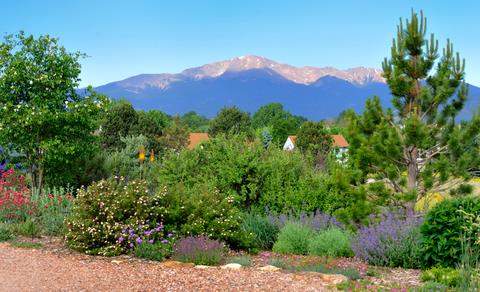
cottonwoodxg_lah_2470Successful gardening in Colorado means choosing plants well suited for our arid climate. Colorado Springs Utilities (CSU) maintains two demonstration gardens, featuring beautiful perennials, grasses, shrubs and trees that are adapted to limited irrigation. Many people are aware of the large garden at the CSU headquarters on Mesa Road, overlooking Garden of the Gods. I wrote about it in April. But very few people are aware that there’s a second, smaller garden in front of the Cottonwood Creek Recreation Center at 3920  Dublin Blvd., just west of Rangewood Drive.

iris_cottonwoodxg_lah_2504While much more limited in scope, this garden provides plenty of inspiration for a homeowner seeking to conserve water and still enjoy a beautiful landscape. When I visited in mid-June, a large swath of Stella ’d Oro daylilies were in full bloom, their bright golden yellow accented by the soft lavender of the surrounding Walker’s Low Catmint. The colors were repeated in lovely deep blue irises, purple Jerusalem Sage, and pastel yellow Moonshine Yarrows and Pineleaf Penstemon.

(more…)

Perennial Sweetpea – Lathyrus latifolius

lathyrus-latifolius-perennial-sweetpea-home-lah_5796Perennial sweetpea is a lovely, old-fashioned flower—one that grandmother might have grown. The keeled pea blossoms, ranging from a blushed white to a deep rose pink, form a clump atop long stems. Lanky vines sport sparse foliage. Bloom will continue from now until early fall if spent flowers are removed. If left to mature, the round, spiral pods will suddenly twist open, flinging their seeds several feet into the air, and sowing plenty of new vines in your garden.

lathyrus-latifolius-perennial-sweet-pea-home-lah-010While the more familiar annual sweet peas don’t do well with Colorado’s wild weather gyrations, this perennial form thrives here. The plants are long-lived, growing six feet long by the end of summer and then dying back to the roots in winter. They cling with tendrils, so some supportive netting is helpful.

Difficult to find as plants in nurseries, perennial pea is easily started from seed. Soak the seeds overnight to hasten germination and then plant in average garden soil in full sun to part shade. Go light on the watering.

With their cottage garden appeal, the vines combine well with clematis and roses, or you can grow them on a fence. They are also suitable as cut flowers. The only drawback is that the blossoms lack the wonderful fragrance of the annual sweet peas.