This bird was photographed in Colorado in May. Can you name it? I will post the uncropped photo on Saturday, giving you one more chance to identify the bird. The answer will appear at the end of next Monday’s post.


This bird was photographed in Colorado in May. Can you name it? I will post the uncropped photo on Saturday, giving you one more chance to identify the bird. The answer will appear at the end of next Monday’s post.


Campanulaceae is a family of plants with members ranging from the towering palm-lobelias of Africa to cottage garden flowers with names from a child’s book of fairytales: Canterbury bells, Cup and Saucer Vine, Harebells, and Fairy’s Thimbles. Two familiar genera, Campanula and Lobelia, are members of this family.
Reproducibility is one of the foundations of science. If something is true, it should be true every time. While it’s exciting to create new studies with new results, it is equally important to recreate studies done by others.
It may come as a surprise to many that science never proves something to be true. We can falsify a hypothesis, but there is always a chance that our positive results are due to chance. Reproducing studies is one way to reduce that possibility.

I just spent two weeks in the Pacific Northwest. Since our daughter and her family live there, we visit frequently, but typically at Thanksgiving or in mid-winter. This time we managed to arrive in July. What a treat! With blue skies, light breezes, and puffy white clouds, the weather was (mostly) perfect. All that rain during the fall, winter, and spring results in stunning summer gardens, with emerald green lawns and towering trees. And the flowers! Yes, the rhodies and azaleas were done, but the hydrangeas were in full bloom. Everywhere we looked, we saw huge flower clusters of bright pink, magenta, white, and most noticeably, pure sky blue.

Home to birds, mammals, reptiles, and very nice people—Audubon’s Corkscrew Swamp Sanctuary has it all. Last winter I made my second visit there, five years after the first. It may have been snowing at home in Colorado, but southern Florida was supposed to be warm—wasn’t it? The day before had been lovely, but this morning dawned damp and gray, with tendrils of fog creeping over the wetlands. I arrived at 7, just as the admissions office opened, knowing I had to be done to meet Pete for lunch. Well, a late lunch, at least! I wanted to make the most of my time as I walked the 2.25 mile boardwalk.
 I was reading an article about purslane (a weed). The author scolded anyone who would pull it up and toss it. She recommended eating it because it offers “amazing health benefits.” The article had a long list of these nutritional benefits (it was a little too good to be true, so I intend to verify them at some point), but the one that caught my eye was “It is GMO free, ….”
Of course it is.
 Every year, the American Ornithological Society (AOU) reviews a number of proposed changes to the classification of North American birds. This affects the definitive list on which we birders base our life lists. Species may be added or deleted. Sometimes, a species is divided into two or more new species, such as the split of the Western Scrub-Jay a few years ago. (I gained a new life species as a result, as I have seen and photographed both the California Scrub-Jay and Woodhouse’s Scrub-Jay.)
Other times, species may be lumped together—what was once considered two species is now thought to be only one, with various subspecies. Sometimes, entire genera are moved into new families. Or, a species remains unchanged, but the name is updated, as when the Gray Jay became officially known as a Canada Jay.


Broccoli and cabbage, mustard and turnips. Radishes, Brussels sprouts, and cauliflower. Kale and kohlrabi. Asian vegetables such as daikon radishes, bok choy, and gai lan (Chinese broccoli). Never has a plant family had so many tasty members.


Brown-headed Cowbirds have a bad reputation. A lot of birders don’t like them because they seem to be shirking their parental duties. Because they are obligate brood parasites—they don’t build their own nests, and only lay their eggs in the nests of other species—we accuse them of taking advantage of other species by forcing them into doing all the work of feeding a hungry nestling. It’s unfair. We’re indignant.
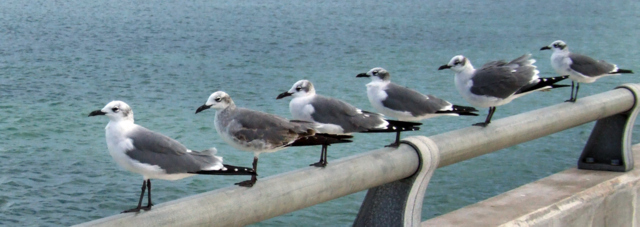
If you were stymied on Monday, now can you name this bird? The photo was taken in Florida in January. The answer will appear in Monday’s post.

 Mountain Plover