
Fac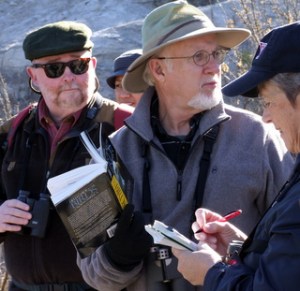 e it, you’re hooked. You didn’t think it would happen to you. All you wanted was to know the name of one bird. You naively picked up that field guide. Was that bird at the feeder a Black-headed Grosbeak? Or perhaps it’s a Spotted Towhee? Hmmm… there are so many birds in here. And they all look so interesting! You’re familiar with a few—Robins and Pigeons, House Finches and House Sparrows. But wait! Is that really a House Sparrow? Perhaps it’s a Black-throated Sparrow instead! And there are two kinds of goldfinches at your feeder? Better look more closely.
Then you realize that lots of those birds in the field guide never come to your backyard feeder. Where are they all? Maybe it would be fun to plan an outing to the local nature center. Better bring those binos, just in case.
One day you wake up and realize that what all began so innocently is now a full-fledged addiction. You’re a birder. Now what?
Once you have started finding and identifying birds, the natural next step is to want to keep a record of what you have seen. While not all birders keep lists, most do. Many keep more than one list. It all depends on your personality.

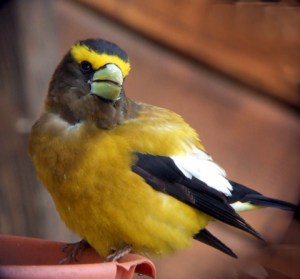 One familiar bird impacted by the fate of our forests is the Evening Grosbeak. Evening Grosbeaks are birds of boreal and montane forests and are therefore susceptible to all the incursions into those habitats. Chemical control of spruce budworm and other tree pests lowers this species’ food supply and may also cause secondary poisoning. Competition and the spread of disease among house finches, goldfinches, and other feeder birds may also be playing a role in the decline. Finally, populations are affected by fluctuations in insect populations and the frequency and intensity of forest fires.
 I recently read a book that I just have to recommend.
 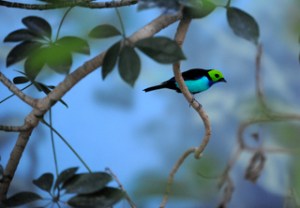 I’d like to highlight my two new photo galleries, featuring my favorite photographic subjects: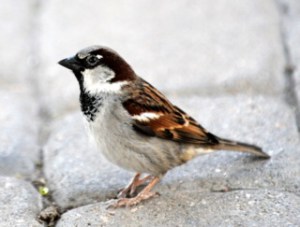
 More charmingly known as Butter-and-Eggs, the common name “Toadflax” applies to several similar species. All sport cheerful yellow flowers resembling snapdragons, to which they are related. Two-foot tall clumps of smooth green stems are covered with narrow, pointy leaves two and a half inches long. The flowers appear whenever growing conditions permit.
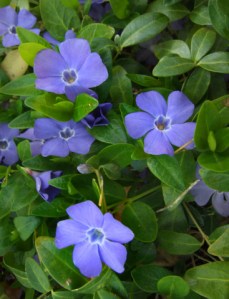 Appearance
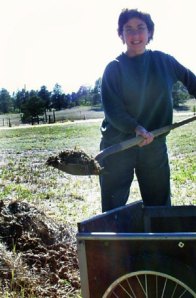 You can easily increase the percentage of organic matter in your soil by adding compost or another organic amendment. This added humus will act as a sponge, increasing water retention in sandy soils. On the other hand, in clay it acts to improve drainage by increasing the size of air and water spaces. Plus, organic matter works with your fertilizer by holding nutrients in a form that is available for absorption by roots. As you can see, organic matter is an important component of healthy soil.
 Mountain Plover