You Know You’re a Birding Fanatic if…

hike-cuchara-pass-co-12jul05-plh-575Lately, my husband has taken to calling me a “Beak Geek.” I’m not sure whether or not to be insulted at this or take it as a compliment. I thought I’d ask a few other friends if the label fits. They hedged a lot. Hmmm. So I did an internet search and found the following:

You know you are a Birding Fanatic if…

… There is a strange, but distinct correlation between the last time your house was thoroughly cleaned and the development of your birding interest.

… you’re hopeless at remembering people’s names, yet you know the scientific names of all birds ever seen in North America.

… someone is trying to sell you some swamp land in a 3rd world country and you actually are interested! —Bill Kossack

… you have a trip list from your honeymoon.

… for your wedding anniversary he takes you to the Brownsville City Dump to see the Mexican crow! —Keri Dawkins

[At this point I’d like to point out that, while I’ve never been to the Brownsville City Dump (because we’d heard that the Mexican crows aren’t there any more), my loving sweetie did take me to the Ft. Lauderdale dump to look for birds. In addition, we spent our 25th wedding anniversary at a dumpy motel near Alamosa because it was near two wildlife refuges… and he’s not even a birder!]

(more…)

Spittlebugs

spittle-bug-dbg-lah-001rHas someone been spitting on your flowers? What is that collection of tiny bubbles surrounding that stem? If you probe beneath the goop, you’ll find one of a number of leafhopper species called spittlebugs. All leafhoppers resemble stocky, miniature grasshoppers about a quarter-inch long. They have sucking mouthparts used to puncture plant stems. Then they feed on the juices and sugars found inside.

Spittlebugs use a special pore on tip of their abdomen to bubble air though some of those juices. The result is a frothy mass that protects them from predators.

(more…)

Perennial Sweetpea – Lathyrus latifolius

lathyrus-latifolius-perennial-sweetpea-home-lah_5796Perennial sweetpea is a lovely, old-fashioned flower—one that grandmother might have grown. The keeled pea blossoms, ranging from a blushed white to a deep rose pink, form a clump atop long stems. Lanky vines sport sparse foliage. Bloom will continue from now until early fall if spent flowers are removed. If left to mature, the round, spiral pods will suddenly twist open, flinging their seeds several feet into the air, and sowing plenty of new vines in your garden.

lathyrus-latifolius-perennial-sweet-pea-home-lah-010While the more familiar annual sweet peas don’t do well with Colorado’s wild weather gyrations, this perennial form thrives here. The plants are long-lived, growing six feet long by the end of summer and then dying back to the roots in winter. They cling with tendrils, so some supportive netting is helpful.

Difficult to find as plants in nurseries, perennial pea is easily started from seed. Soak the seeds overnight to hasten germination and then plant in average garden soil in full sun to part shade. Go light on the watering.

With their cottage garden appeal, the vines combine well with clematis and roses, or you can grow them on a fence. They are also suitable as cut flowers. The only drawback is that the blossoms lack the wonderful fragrance of the annual sweet peas.

Hotspots: Where the Birds Hang Out

You’ve got your binoculars in hand, ID book in one pocket, notebook and pen in another, and your resolutions to be a responsible, ethical birder firmly in place—you are ready to go birding. But, where will you go?

Birding Ramah SWA_LAH_015
Birders at Ramah SWA

While birds may be found virtually anywhere, they are not evenly distributed across the landscape. When birders discover a place with lots of birds (both in numbers and variety of species) that location is called, in birder-speech, a “hotspot.”

Just as people tend to congregate in places with housing and markets or restaurants, birds have their own favorite hangouts, and for the same reasons. Birds need water, food, and shelter. Any site providing all three is bound to have great birding.

(more…)

Grow a Garden of Eatin’

264-wheelbarrow-of-veggies-closeupDo all the fresh veggies appearing in the local farmers’ markets have you inspired? Victory gardens are back in style. Maybe it’s the economy. Growing your own can save you money, although your initial investment may take several years to pay off. Or perhaps you want to plant crops that are normally expensive at the market.

Gardening is good for you. You control which chemicals (if any) you use in your garden. Plus, it provides a great excuse to go outside and get some exercise.

(more…)

Book Review: Good Birders Don’t Wear White

goodbirderscoverLooking for some good advice on how to be a better birder? This book is a lot of fun to read, and provides valuable insights from 50 noted birders such as Kenn Kaufman, David Sibley, and Pete Dunne.

Each contributor has written a short article, about four pages long, imparting one nugget of birding wisdom. Examples include “Bird by Impression,” by Kevin Karlson, “Go Birding in Bad Weather,” by Bill Schmoker, and “Go Birding at Night,” by Ted Floyd.

(more…)

Broad-tailed Hummingbirds

dsc_5382-1

Is that a hummingbird nest? I had to look carefully to find the tiny cup nestled among the ponderosa branches. Sure enough—a female Broad-tailed Hummingbird stared pointedly back at me, as she dutifully sat on what I could only assume were a couple of pea-sized eggs.

What really impressed me was the way the secretive bird had camouflaged her home. Lichens grew on the tree branches, and covered the outer surface of the nest. It looked like just one more bump on the bark, although with a diminutive bird sitting on top.

(more…)

Swallowtail Butterflies—and Parsley, Too

black-swallowtail_david-cappaert-michigan-state-university_5255023
Photo: David Cappaert, Michigan State University

Like an bejeweled flower, the butterfly fluttered around my garden, never stopping to rest, moving from blossom to blossom until it gently drifted over the fence. I love watching butterflies flutter by, but feeding their caterpillars is another matter. I don’t want to sacrifice any of my garden plants to hungry mandibles. In at least one case, at least, I’ve discovered a compromise.

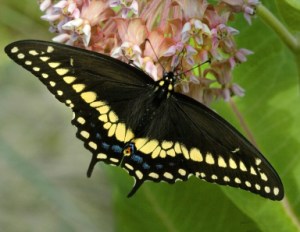
Black Swallowtails are some of the most beautiful butterflies found in Colorado. They’re large and black with a double row of yellow spots delineating their wings, and sapphire-blue sequins at the base of  their long, pointed tails. They’re the kind of butterfly that everyone oohs and aahs over. I’m no exception.

(more…)

Japanese Beetle Invasion

Photo: David Cappaert, Michigan State University, Bugwood.org

Stunning in their metallic shades of vibrant copper and emerald green, Japanese Beetles might seem like welcome immigrants to our state. However, anyone who has lived in other parts of the country knows how destructive these voracious scourges can be. Until recently, Japanese beetles were unknown in Colorado. Unfortunately, they are now prevalent both in southern Denver and in locations along the Western Slope. It is only a matter of time before they spread southward to El Paso county. Gardeners here can prepare by learning how to identify these beetles and protect their landscapes.

(more…)

Preserve Wetlands—Buy a Duck Stamp!

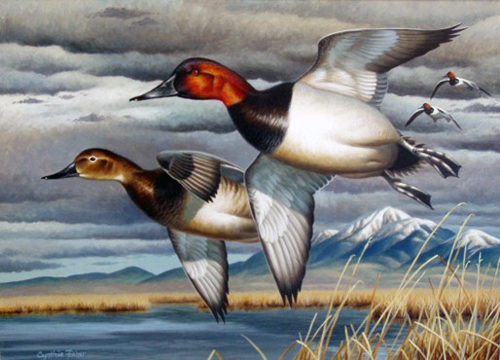
2003 CO Duck Stamp c Cynthie FisherThe purchase of a Federal Migratory Bird Hunting and Conservation Stamp, more simply known as a “Duck Stamp,” is one of the best ways you can promote wetlands conservation. Since its inception in 1934 as a federal license for hunting migratory waterfowl, this program has generated over $670,000,000 that has been used to purchase or lease 5.2 million acres of waterfowl habitat that is now included in the National Wildlife Refuge System.

The stamps are only $15, and 98% of that is used for habitat preservation! With a decline in the number of hunters, it is more important than ever that conservationists, and especially birders, purchase Duck Stamps. As a bonus, having the current year’s stamp allows you free access to any National Wildlife Refuge, many of which now charge admission fees.

(more…)