
 One of my perverse pleasures is perusing Pintrest to find bad garden advice. There’s certainly no lack of misinformation on the web, and Pintrest seems to collect it all. Most advice is simply a waste of time and money—sprinkling Epsom salts on your plants, spraying weeds with vinegar, pouring beer on your lawn. They don’t help, but they won’t kill your plants either. However, yesterday I came across a recommendation that will seriously damage your garden. I was so horrified that I immediately sat down to write this post.
Category: Weeds
Delinquent Daisies
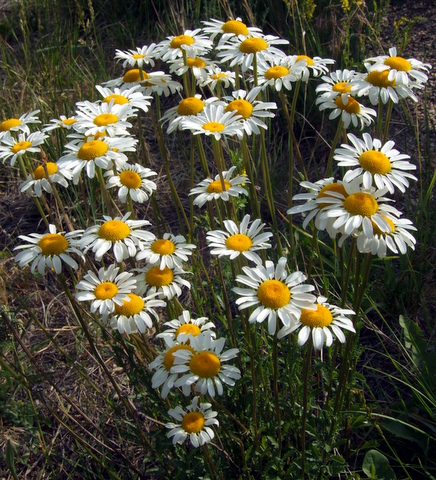 They sound pretty good— perennial plants that:
- Are hardy in Colorado, even in the mountains
- Grow a compact one to two feet tall
- Are covered with eye-catching white daisies in mid-summer
- Grow in almost any soil
- Bloom in full sun or partial shade
Ditch this Dame
Worth growing for its delicious fragrance alone, dame’s rocket also offers showy, long-lasting flowers and is as trouble-free an herb as you could ask for. Its multitude of common names attests to centuries of cultivation in gardens and to the high regard in which it has been held. (Mother Earth Living)
 How can you resist such a glowing recommendation? It’s true that dame’s rocket is all these things, but it is also an invasive outlaw, wanted dead, not alive. Like any most-wanted suspect, Hesperis matronalis hides under a plethora of aliases: damask violet, dame’s-violet, dames-wort, dame’s gilliflower, night-scented gilliflower, queen’s gilliflower, rogue’s gilliflower, summer lilac, sweet rocket, mother-of-the-evening, vesper flower and winter gilliflower, to name a few. But not matter what you call it, it’s against the law to grow this plant in Colorado.*
Answers: Weed? Or Wonderful?
If you’ve ever pulled out the lettuce and left the chickweed, you’re in good company. Last week I admitted my failure to recognize ragweed, one of the most irritating plants in my yard (especially to my nose!). It takes practice to recognize plants in their infancy. After all, how much do you look like your newborn photos?
If you missed last week’s quiz, you can try your hand at some seedling ID by clicking here. If you’re ready for the answers, keep reading.
Weed? Or Wonderful?
 Everything is growing. Buds are bursting, early flowers are in bloom, and millions of tiny seeds are breaking through the soil into eager growth. It’s a wonderful time of year, and a busy one for gardeners. As we sow seeds and pull weeds, the question arises—which is which? Should we dig out that clump of green, or is it a desirable plant?
This is especially difficult if it’s a new yard, and this is our first chance to see what’s growing in it. Let me tell you a short story illustrating my gardening ineptitude.
Putting Your Garden to Bed
I first posted this back in 2009, but (with one exception, below) my advice hasn’t changed. While I‘m off looking for migrating warblers today, you should be out in your garden. Here’s why:
 Spending time now on chores such as weeding and garden cleanup will reward you many times over when spring arrives.
- Amending your soil this fall will give you a head start on next year’s garden.
- Fall is also a great time to build a new patio or raised bed.
- Protecting your less-hardy plants will increase the odds of them surviving a Colorado winter.
- Winter’s cold weather is a great time to read articles, take classes, and prowl the Internet to become a more knowledgeable gardener.
- And the most pressing issue? The weather gurus are predicting snow tonight and/or tomorrow!
Covering Your Dirt
 I’m out of town—very, very out of town. In fact, I’m in Swaziland, in southeastern Africa, almost 10,000 miles from home. If you want to know what my trip is all about, you can read the details on my other blog. Start here. If you want to read more, enter Swaziland in the search box at the top right of that page.
While I’m gone I’d like to direct you to this post my friend Carey wrote on landscape fabric, and why it’s probably not a good idea to use it in your garden.
Landscape Fabric – Why You Probably
Don’t Need or Want It
Carey is another former Colorado Master Gardener, and she is full of garden wisdom. In addition to her posts to Pikes Peak Gardening Help, she has her personal blog at Carey Moonbeam. You can see my links to both these sites at right.
See you next week.
Teasel Isn’t Teasing
 Most of us are familiar with teasel. It grows in most states, including Colorado where it is designated a “List B” species in the Colorado Noxious Weed Act. That means that, if you live in Colorado (or several other states), you need to declare war on any plants on your property. Good luck.
Teasels are easily identified by the spiny flower head left behind after the petals have fallen, as you can see in these photos. There are two species listed as noxious weeds in Colorado—the Common Teasel (Dipsacus fullonum), shown, and its lookalike cousin Cutleaf Teasel (Dipsacus laciniatus).
Annihilating Weeds
 First the rain, then the heat. Throw in a few mosquitoes for good measure. It seems like forever since I’ve actually wanted to be out in my garden. Unfortunately, my garden reflects my neglect. Squash plants languish, beans droop, and those tomatoes are taking forever to ripen. Worst of all, the beds and paths that I so carefully weeded in June are now overgrown with flowering weeds.
In spite of its current state, this year’s garden has been an unqualified success, and I would call it a summer except for one urgent task remaining. I have to get rid of those weeds before the flowers turn to seeds! If I ignore them now, the problem will be a thousand times worse in the spring.
Bad Daisies
Fresh as a daisy. Daisy chains. “The daisy’s for simplicity and unaffected air.”*
Symbols of simple charm, it’s hard to imagine that daisies could be anything but pure and innocent. Yet, the familiar Oxeye daisy has a dark side. Under that attractive and cheerful guise lurks… a noxious weed!
Take a trip to the mountains to see the wildflowers, and you’re bound to see Oxeye daisies as well. They’re all over the Rockies, preferring the higher elevations. Unfortunately, they don’t belong here. They’re native to Europe, and we heartily wish they had stayed there!
 Mountain Plover