Do weeks of staring at snowy white landscapes have your eyes screaming for color? Winter gardens don’t have to be drab, lifeless affairs. Flowers may not be in bloom, but many plants have leaves, stems, or berries in shades of bright red, golden orange, or silver-blue and plum. Put them together and your winter garden springs to life.
 Mahonia repens (also known as Oregon Grape Holly) is an attractive groundcover year-round, but it really shines in winter. While other plants shed their leaves, Mahonia’s foliage turns a stunning bright red.
Yellow flowers in spring and showy blue berries in early fall add to this native’s year-round interest. Mahonia repens is drought tolerant, and handles full sun to part shade.
 Juniper horizontalis ‘Blue Chip’ is another groundcover that remains attractive all year. While many junipers grow much too large for our small yards, Blue Chip stays under a foot high. Its feathery foliage is a beautiful steel-blue all year, with the addition of silver-plum tips in winter. Plant it in full sun, where it will quickly spread up to ten feet in diameter. Junipers are very xeric once established.
(more…)


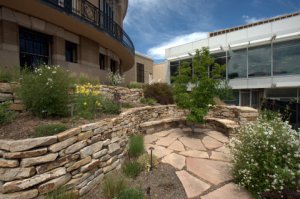 The Carnegie Library Garden may be one of downtown Colorado Springs’ best kept secrets. That’s a shame, because it is truly a gem. This is one of several public gardens featuring water-wise plants especially suited for our climate and soils. It was designed by landscape architect and master gardener Carla Anderson, and is maintained by a team of dedicated volunteers.
 Blossoms abound throughout the growing season. When I visited last month, red and yellow ‘Lena’ broom was beginning to fade, while several types of Mockorange were in full bloom. Rosettes of huge, fuzzy, silver Salvia leaves were topped with tall white or purple flower stalks, and brilliant Colorado Gold hardy gazanias were everywhere. An arbor with a built-in bench supports a beautiful pink climbing rose, while honeysuckle grows on up a nearby trellis. By the time you read this, new plants will be in bloom; it’s worth coming back for repeat visits.
 Common Yarrow might be common, but it’s still a worthy plant for Colorado gardens. Plants form spreading clumps of dark green, finely cut leaves about one foot tall. Flat-topped clusters of tiny flowers that rise above the greenery provide landing places for butterflies, which are attracted in large numbers. Blooms may be white, pale to golden yellow, or various pastel shades; ‘Paprika’ is a cultivar with red flowers the color of their namesake.


 As summer’s flowers fade, plants that produce berries take center stage. Branches covered with bright red berries make cotoneasters especially attractive now, but they offer year-round interest. In spring, tiny but abundant white to pink flowers may be obscured by the shiny round green leaves. Foliage turns orange-red in fall. Finally, the berries persist into winter, or until the birds pick them clean.
 The hardest part of growing cotoneaster is pronouncing it correctly (it’s “ko-TON-ee-AS-ter”). These shrubs thrive with little attention, handling poor soils, full sun to afternoon shade, and moderately low amounts of water. New shrubs should be coddled a bit until vigorous growth begins. Give plants room to spread, pruning only to remove oldest wood and enhance appearance. As with all members of the rose family, cotoneasters are occasionally susceptible to fire blight; some new varieties are tolerant of this disease. The many different species in cultivation vary in hardiness. Most will survive zone 4 or 5 winters, but check the label for the variety you are purchasing.
 Mountain Plover