
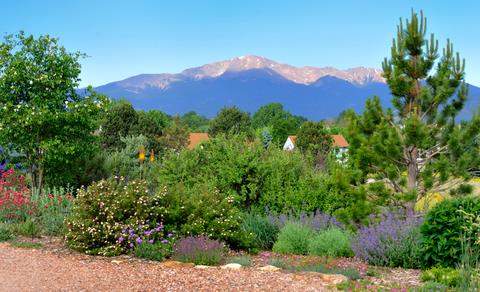
 Successful gardening in Colorado means choosing plants well suited for our arid climate. Colorado Springs Utilities (CSU) maintains two demonstration gardens, featuring beautiful perennials, grasses, shrubs and trees that are adapted to limited irrigation. Many people are aware of the large garden at the CSU headquarters on Mesa Road, overlooking Garden of the Gods. I wrote about it in April. But very few people are aware that there’s a second, smaller garden in front of the Cottonwood Creek Recreation Center at 3920 Dublin Blvd., just west of Rangewood Drive.
 While much more limited in scope, this garden provides plenty of inspiration for a homeowner seeking to conserve water and still enjoy a beautiful landscape. When I visited in mid-June, a large swath of Stella ’d Oro daylilies were in full bloom, their bright golden yellow accented by the soft lavender of the surrounding Walker’s Low Catmint. The colors were repeated in lovely deep blue irises, purple Jerusalem Sage, and pastel yellow Moonshine Yarrows and Pineleaf Penstemon.

 Summer birding can be somewhat unproductive, but that doesn’t mean you should stay home in front of the air conditioning. So what if the birds are busy nesting and raising young? Birds aren’t the only attraction in the great outdoors.
 With the Gulf oil spill continuing to dominate the news, many conservation organizations are soliciting funds, ostensibly to help wild birds caught up in the environmental disaster. That is certainly implied by the (extremely misleading) picture to the left, gleaned from a well-known non-profit’s website. However, if you read the fine print on the donation page, it becomes clear that rather than being specifically targeted to the rescue of oiled birds, all these donations are simply being added to an organization’s general fund. As another website truthfully states:
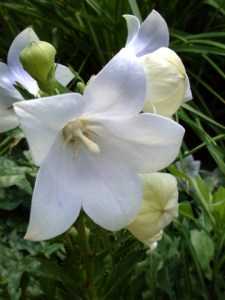 We may not be able to grow real balloons in our gardens, but Balloon Flower comes pretty close. Large buds shaped like inflated balls give Platycodon its common name, Balloon Flower. These buds open into showy blue, pink or white blossoms shaped like plump, five-pointed stars. The flowers adorn one- to two-foot tall vase-shaped clumps of oval green leaves.
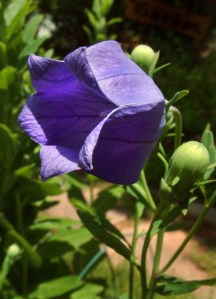 Grow Balloon Flower in well-drained garden soil amended with several inches of compost. Mark the spot so you remember where the plants will reappear in late spring. These perennials take several years to look their best, but your patience is rewarded with plants that live for twenty years or more. Because they stay neat and well-behaved, dividing is unnecessary; in fact, the roots hate to be disturbed. Established plants survive some dry periods, but prefer regular watering.
 Temperatures are climbing into the 90s, your spring-planted crops are reaching maturity, and you’re excited about garden fresh salads and new potatoes. Besides harvesting your bounty, there are millions of weeds to be pulled, poisoned, or decapitated. The last thing on your mind is planting more seeds.
 Spring migration is over, and the birds are all focused on mating and raising their families. The weather is too darn hot outside to be enjoyable, especially when one is hauling binos, field guide, water, scope with tripod, notebook, lunch, and possibly a camera. Then, to top things off, the sun is coming up at an hour when even birders would prefer to catch a few extra zzz’s. The early birds can have their worms.
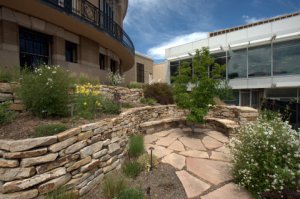 The Carnegie Library Garden may be one of downtown Colorado Springs’ best kept secrets. That’s a shame, because it is truly a gem. This is one of several public gardens featuring water-wise plants especially suited for our climate and soils. It was designed by landscape architect and master gardener Carla Anderson, and is maintained by a team of dedicated volunteers.
 Blossoms abound throughout the growing season. When I visited last month, red and yellow ‘Lena’ broom was beginning to fade, while several types of Mockorange were in full bloom. Rosettes of huge, fuzzy, silver Salvia leaves were topped with tall white or purple flower stalks, and brilliant Colorado Gold hardy gazanias were everywhere. An arbor with a built-in bench supports a beautiful pink climbing rose, while honeysuckle grows on up a nearby trellis. By the time you read this, new plants will be in bloom; it’s worth coming back for repeat visits.
 June isn’t a great time to go birding. In most parts of the country, territories are established, nests are built, eggs are laid, and the birds are either busy incubating those eggs or are run ragged trying to satisfy the insatiable appetites of their demanding offspring. Either way, the parents are being especially careful to hide the whereabouts of their progeny, making it very difficult for us birders.
