Winter Color

Do weeks of staring at snowy white landscapes have your eyes screaming for color? Winter gardens don’t have to be drab, lifeless affairs. Flowers may not be in bloom, but many plants have leaves, stems, or berries in shades of bright red, golden orange, or silver-blue and plum. Put them together and your winter garden springs to life.

Mahonia repens (also known as Oregon Grape Holly)  is an attractive groundcover year-round, but it really shines in winter. While other plants shed their leaves, Mahonia’s foliage turns a stunning bright red.

Yellow flowers in spring and showy blue berries in early fall add to this native’s year-round interest. Mahonia repens is drought tolerant, and handles full sun to part shade.

Juniper horizontalis ‘Blue Chip’ is another groundcover that remains attractive all year. While many junipers grow much too large for our small yards, Blue Chip stays under a foot high. Its feathery foliage is a beautiful steel-blue all year, with the addition of silver-plum tips in winter. Plant it in full sun, where it will quickly spread up to ten feet in diameter. Junipers are very xeric once established.
(more…)

A Birder’s New Year’s Resolutions

Once again it’s January, time for making a list of all the things you would like to do differently in the new year. If you’re at all like me, you’ll resolve to finally lose that extra weight, walk at least two miles a day, and empty the accumulation of credit card receipts out of your wallet at least once a week.  You promise to, in general, exhibit more self control over all those accumulated habits that stand between you and perfection.

But we’re not just ordinary people. We’re Birders. So it seems appropriate that we make some New Year’s resolutions specific to our particular passions. How about if we resolve to…

(more…)

A Gardener’s New Year’s Resolutions

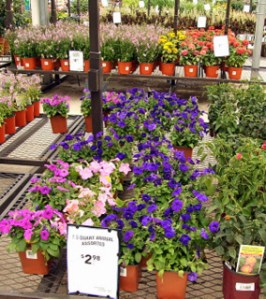
plants-for-sale-lowes-cs_2008aug02_lah_5106-1Lots of people like to make New Year’s resolutions. Gardeners are no exception. A quick web search turned up plenty of lists, with gardeners around the country vowing to stay ahead of the weeds, thin their carrots, and learn the Latin names of all their favorite plants. If you like to garden, you probably have your own list of good intentions. And if you’re like me, you’ll struggle to keep even one of them.

This year, I’d like to propose a list of gardening resolutions that any enthusiastic gardener can keep. Your garden may not be perfect, but at least you’ll have the satisfaction of knowing you achieved your New Year’s goals.

(more…)

Blogs I Like

Today I’d like to highlight two of my favorite blogs, one about birding and one about gardening. There are lots of other great birding and gardening blogs, so please check out the list of links to the right. I’d also love to hear about your favorites. I look for reliable information, interesting stories, great pictures. What do you recommend?

Birding

brdpics-logoBill Schmoker is a Colorado birder who teaches junior high science full time, and still somehow manages to get out and take incredible bird photographs. His pictures have appeared in a number of publications, and the American Birding Association just released Ted Floyd’s Let’s Go Birding, which Bill’s photographs illustrate.

Recently, Bill’s blog, Brdpics, displayed a remarkable series of photographs of a roadrunner and a coyote. Yes, the real thing! One picture even contained both of them at the same time! Since I will probably only get photos like that in my wildest dreams, please go look at his.

(more…)

How to Grow a Houseplant: Containers & Repotting

pots-for-sale-santafegreenhouses-20089jun28-lah-132Note: This is Part 3 of a three-part series on How to Grow a Houseplant. Part 1 covered light & temperature requirements, Part 2 was about feeding and watering.

Containers
A bird has a cage and a gecko has a terrarium. Plants need a special places to live too.

You have a lot of latitude in choosing a container for your plant. Consider not only made-for-plants pots, but other bowls, cans, and even shoes. However, there are a few requisites. Drainage is paramount. If your chosen pot doesn’t have a drain hole, add one.

(more…)

Christmas is for Counting Birds

2008dec20-cbc-392rThis Saturday I’m heading out on Audubon’s annual Christmas Bird Count (CBC). I’ll be joining tens of thousands of other birders around the world in a tradition that is in its 110th year.

December isn’t exactly the best time to be outside birding. A few years ago, our group experienced blizzard conditions and a toasty high of six degrees F. (Amazingly, we saw over 200 American Robins in our count area that year! I kept expecting penguins.) Other years have been somewhat milder, but December in Colorado Springs is never for sissies. Why do we bundle into multiple layers of clothing and get up in the dark to spend most of the day outside counting birds?

The holiday season is also incredibly busy. Shopping, decorating, baking, parties—who has time to tally birds? Why use up a precious Saturday right before Christmas in order to take a bird census?

(more…)

What to Give a Gardener

tool-bucket-carnegielib-16apr07-lah-982Last time I wrote about what to give a birder for Christmas (or any time, for that matter). This time I’m focusing on gifts that will delight the gardener on your list.

Again, I’m not going to pick out the latest in gardening accouterments. Unlike birdwatching, gardening does require a pile of tools, seeds, gloves, compost, and the like, but there are already long lists of “perfect gardening gifts” in magazines and on websites.  Instead of finding places for you to spend your money, I’m suggesting ways you can give the gift of time.

(more…)

What to Give a Birder

dscf0371This is not another list of what to buy your favorite birder for Christmas. There are plenty of lists like that already; every birding magazine and website seems to have one. Most suggestions seem more helpful to the makers of the products featured than they are to the gift giver… or the recipient.
See, the problem is that birding doesn’t really require a lot of stuff. Sure, you spend your wad on good optics, and you need a field guide or two. But one of benefits of birdwatching is that you don’t need a lot of gear. Once you’re set, you can get on about the business of watching birds, which is really the point. Birders do not collect birds—they collect sightings of birds.

Not to miss an opportunity, many manufacturers have come up with “birding accessories”—things like special tote bags for your book and binos, many-pocketed vests, volumes on where to go birding, and journals with bird drawings on the cover. I’m sure all those are useful, but they’re certainly not regarded as must-haves. An old fanny pack, internet access, and a 99¢ notepad work just as well.

Instead of telling you what to buy for your gift list birder, I’m going to make a suggestion for a gift you can’t buy. No one ever said that gifts have to cost a lot of money.

(more…)

Dwarf Mistletoe is not for kissing

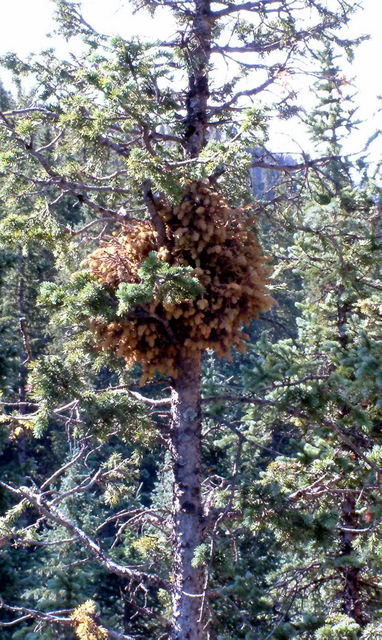
Sparse foliage and a witches' broom indicate a mistletoe infection.
Sparse foliage and a witches’ broom indicate a mistletoe infection.

Mistletoe is a holiday tradition. We decorate our doorways with it, where tarrying under a spring might bring you a kiss. Unfortunately, the kind of mistletoe growing along Colorado’s Front Range isn’t so romantic. Five different species of dwarf mistletoe infest pines, spruces and firs. Given enough time, an infected tree will eventually die.

All mistletoes are flowering plants that have given up a life of self-sufficiency to become harmful parasites. Dwarf mistletoes lack leaves, so they have little ability to make their own food from sunlight. Instead of extending their roots into the soil, they have root-like structures that penetrate under the bark, where they siphon off both water and nutrients from the host tree.

The female mistletoe plant produces sticky seeds. When the seed capsules are ripe, usually in late summer, they explode, expelling their contents at speeds up to 60 mph! The seeds can travel up to 60 feet, although 30 feet is more common. Wherever the seeds hit, there they stick.

(more…)