 I just came back from an exciting day of birding and photography. Our local Audubon chapter organized a field trip to Mt. Evans, which reaches 14,265 feet above sea level. Our target birds included White-tailed Ptarmigan and Brown-capped Rosy-finches. We were also looking forward to some alpine relief from the hot summer weather.
The morning was clear and sunny as we climbed into the Rockies along I-70. Taking the turnoff at Idaho Springs, we headed back south toward the mountain. First stop: Echo Lake, just before the toll road entrance.
 A variety of chirping birds greeted us as we piled out of our cars for a quick look-see. Goldeneyes floated on the lake, we got a quick glimpse of a Lincoln’s Sparrow (right) in the willows, and a male Pine Grosbeak (above) posed for us in a tall spruce. It was going to be a great day! Wasn’t it?
Our next stop was misnamed Summit Lake, nestled against the cliffs at “only” 12,830 feet. Although it was a week day, the place was busy, with hikers, photographers, and even some nuns in their habits. Kids were running around on the tundra, right past the signs telling us to stay on the trails, while their parents shrugged and looked the other way.
 A few patches of snow still remained on the north side of the mountain, perfect habitat for Rosy-finches. And, sure enough, there it was—a single Brown-capped Rosy-finch singing far across the lake. We tried to get closer, but it remained a tiny speck in my binoculars. Please close your eyes and imagine the lovely photo I wasn’t able to take.
Back in our cars, we climbed higher. The switchbacks meant we alternated between hugging the inside lane against the cliff and teetering on the outside lane next to the sheer drop-off. The asphalt was crumbling from the extreme climate at this altitude. I tried to focus on looking for birds.
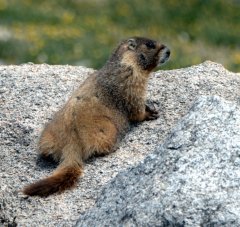 Reaching a pull-off that could accommodate all three cars, we stopped by the side of the road to look for ptarmigan. Pikas chirped at us from atop the orange granite boulders, then disappeared underneath when I approached to photograph them. Yellow-bellied Marmots lazily warmed themselves in the morning sun (left). A few Common Ravens soared overhead, and American Pipits hopped over the rocks far below. Please imagine the White-tailed Ptarmigan we didn’t see.
After searching for perhaps 20 minutes, we noticed the sun disappearing behind some menacing clouds. Lightning flashed across the valley, thunder rumbled. Yikes. If we wanted to reach the summit, we had better hurry!
Once again we scurried back to the cars, and this time headed straight up the steep road. A herd of Bighorn Sheep stared as we motored past, but we couldn’t stop for photos. Mountain Goats munched the alpine flowers, their kids frisking from rock to rock, but we had to reach the summit—because it was there.
Finally, we crested the final rise and found ourselves in a crowded parking lot. The sky grew black. Lightning flashed, followed immediately by deafening thunder. Big drops started to fall, then more, and more. The heavens opened and we were deluged by a waterfall of pounding rain, quickly followed by graupel, then sleet. Well, we wanted to escape the heat….
 Eventually, the storm began to abate as the clouds moved east. We cautiously opened the car doors and climbed out. The sheep and goats were long gone; they were smart enough to avoid a 14,000 foot mountaintop in a thunderstorm! Wind whipped through our summer jackets and numbed our noses. We didn’t stay long. Please imagine the lovely wildlife photos I didn’t get.
Back down we went, and again I tried to ignore the crumbling pavement along the precipitous cliffs. We stopped once more to look for ptarmigan, but had no luck.
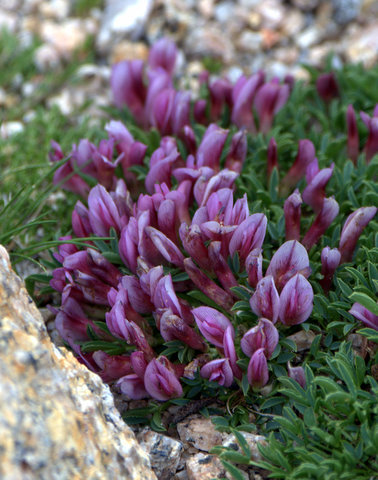
 We had passed the gardens at Mt. Goliath (part of the Denver Botanic Gardens) on our way up, so we stopped on our way back. The wildflowers were gorgeous, but it started to rain again, so we didn’t stay long. It was also too wet to linger at the hummingbird feeders at the bottom of the toll road.
We did make a final stop at a bridge to look for American Dippers in the stream below. It took a while, but we finally spotted the bird wading in the rushing water. It was hard to see with all the riparian foliage in the way, and the eleven of us crowded along the guard rail, trying to get a peek. Please pretend that I got my turn in front in time to take a photo before the bird flew away.
Not all trips produce the birds and photos we hope to find. Still, it’s hard to beat a day in the Rockies, no matter what we don’t see.

 What’s a birder to do, once we’ve checked off all the easily seen local birds? I, for one, can’t afford endless trips to exotic places. I don’t have time to chase rarities (which is why I missed the Red-necked Rail at Bosque last month). And I don’t keep year lists, or county lists (or even state lists).




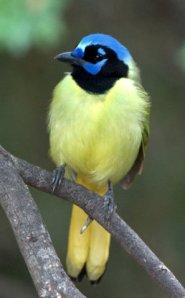 Did you hear? There’s a Golden-crowned Warbler at Fontera! And there’s a Rose-throated Becard at Estero Llano… and an Anna’s Hummingbird at Sabal Palms, a Rufous Hummingbird at Estero… a Crimson-collared Grosbeak at Fontera… a Black-vented Oriole at Bentsen…
 In an attempt to improve my skills, I’ve signed up for a Wildlife Photography class at our neighboring community college. I have starry-eyed visions of rutting elk, growing grizzlies and other impressively large mammals adorning the paneled walls of our family room, not to mention the pages of Outdoor Photographer or National Geographic.
 I love living outside the city limits, but sometimes sharing our five acres with nature can have its challenges. I currently maintain seven bird feeders and a bird bath. Not only do we have lots of birds, but the availability of food and water brings in some unintended visitors as well.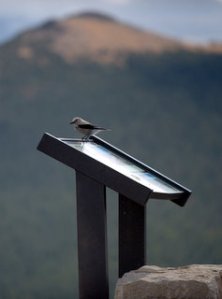
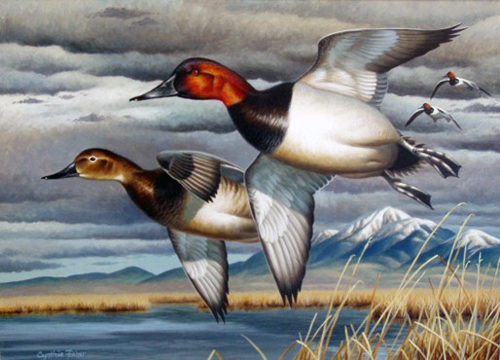

 Mountain Plover