
 For the first time in recent memory a flock of Lewis’s Woodpeckers has taken up residence near Colorado Springs. Only 11 miles south of Colorado Springs, they are busy harvesting acorns in the picnic area at Fort Carson’s Turkey Creek Recreation Area. These uncommon (at least along the Front Range) woodpeckers are attracting every birder in town. A couple of friends and I made our migration at dawn two weeks ago, hauling binoculars, spotting scopes, and at least 50 pounds of camera gear. We weren’t disappointed.
Category: Bird Profiles
Species descriptions
Starlings Not Welcome Here
 Birders in the U.S. are supposed to hate European Starlings (Sturnus vulgaris), and there are plenty of reasons to do so.
The species originated in Europe, North Africa, and western-to-central Asia. While mostly abundant there as well, the species has been red-listed in England after populations plummeted by more than 80% over the last 40 years [1]. Other northern European countries have witnessed a similar decline [2]. We can only wish that would happen here.
North American populations have exploded since their introduction in the early 1890s. According to the USDA, starlings cost our country $1.5 million in damage to agricultural crops, the consumption of feed intended for livestock, and in property damage. In one winter, a million starlings can down 27,500 tons of livestock feed, not to mention what is ruined by their accumulated droppings—and latest estimates put the US population at over 200 million birds.
Old (and young) Coots
 When you call someone an “old coot,” just what exactly are you implying? Perhaps we should take such name-calling as a compliment. In many ways, coots are pretty respectable birds.
Although they share habitat with ducks, and superficially resemble them, coots have lobed toes and a beak instead of webbed feet and a bill. They are members of the rail family, and are related to cranes and limpkins. Their other common name, marsh hen, comes from their chicken-like head bobbing as they walk and feed.
Far from being weaklings, coots display considerable stamina. American Coots have managed to fly across the Atlantic Ocean at least 23 times. Even more remarkable, in 2003 two birds were sighted in Tasmania, a whopping 8,000 miles from home!
Everyone Likes American Robins
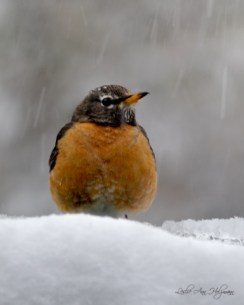 Robins are often considered harbingers of spring, and in some places they are, but here in Colorado they hang out year round. In fact, on the 2006 Christmas Bird Count, in the middle of a blizzard—with the thermometer registering a whopping 6 degrees—we tallied over 200 American Robins in our sector alone… and those were just the ones we could see in white-out conditions.
What spring actually brings is singing robins. For some reason, they have no sense of decent timing, and will start in at 4 am with their cheerful cheery-o, cheery-o. The last thing I feel at that hour is cheery.
Three-toed Beetle-eaters
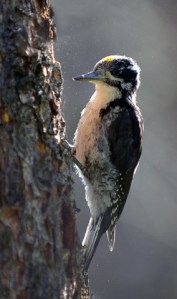
A couple of weeks ago I described the devastation being caused by the Mountain Pine Beetle. Happily, there is one bright spot in the middle of the dead trees. Stands of beetle-killed pines create an ideal habitat for the American Three-toed Woodpecker.
This species isn’t rare, but it lives in the boreal forest, out of reach of most birders. This far south it is only found at higher altitudes, and prefers to nest in areas of old-growth spruce, larch, fir and pine.
Encouraging Bluebirds
 If the birds held a popularity contest, Bluebirds would probably win. Everyone loves them. Perhaps that’s because they’re so well mannered. They help us by eating the bugs that bug us. They take good care of their families, with the males defending their territories while the females fuss over the nestlings. And when the sun hits their feathers, just so, they shine with the most amazing sky blue.
It’s a good thing many people like bluebirds, because they could use our help. All three bluebird species have declined in numbers since the early 1800s. There are several reasons.
A Welcome Mat for Bluebirds
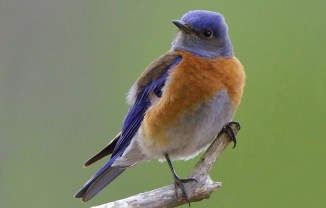 Everyone loves bluebirds, and for good reason. They are beautiful to look at, faithfully provide for their families, and eat thousands of insects that might otherwise damage our gardens. However, a lack of nest sites for these cavity-nesting birds has caused a serious decline in their numbers. If you, like me, would love to have a pair of bluebirds sharing your yard, it helps to know a little about what the birds prefer. How can you make your yard more bluebird-friendly?
Bluebirds prefer to live in trees next to open fields. They perch and nest in the trees, and search for insects in the grass nearby. You can find Eastern and Western Bluebirds in orchards or forests next to meadows, farm fields, or grasslands.
The Bluebirds are Coming
 While we’re still shoveling snow and scraping windshields, bluebirds are thinking about spring. Colorado has three species of bluebirds, Eastern, Western (seen here) and Mountain, and all of them are what birders call “early nesters.”
Why do they arrive here so early in the year? Maybe it’s because they don’t travel very far for the winter. While other kinds of thrushes migrate to central America, bluebirds tend to stick closer to home.
Bluebirds living in the southern parts of the United States stay there year-round. Western Bluebirds from harsher climates winter along the Pacific coast or in the dry scrubland of the Southwest and Mexico. A few stay in Colorado.
In Praise of Ducks
 “Oh, it’s just another Mallard.”
How many times have I said that? As a birder, I’m always looking for the rare bird, the unusual find that will add to my life list. Last month’s Snowy Owl fit the bill—getting such a great view of that magnificent predator was truly a once-in-a-lifetime experience.
I just got home from a week in northern Oregon and southern Washington. While I did pick up a couple of new species for my list, I mostly saw ducks. Lots of ducks. Hundreds of ducks. (Did I mention I was in Oregon?)
So—I looked at ducks. Really looked. And you know, ducks are pretty cool!
I Love Magpies
 You can’t miss them. Black-billed Magpies are big, noisy, and distinctive in their black, navy, and white plumage. Their elegant long tails add to the tuxedo effect. They’re basically crows in formal attire.
In addition to the mixed scrub, woodlands, and fields of their native habitat, Magpies have adapted to life in urban areas. They’ve done well, and are common in most of the western U.S. Here in Colorado, they’re frequently considered “trash birds.”
Why do many people look at magpies with such disdain? Maybe it’s their tendency to dine on road kill and other carrion, or their occasional habit of killing and eating the eggs and nestlings of other birds, that draws so much criticism. But magpies have their endearing qualities as well. Maybe we don’t like them because we don’t know them well enough.
 Mountain Plover