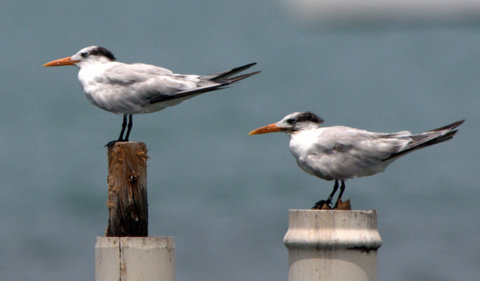
Can you identify these birds? The photo was taken in Colorado during the month of May. The answer will appear next week.


Can you identify these birds? The photo was taken in Colorado during the month of May. The answer will appear next week.
 When you want to see a Cave Swallow, the logical thing to do is head for a cave. Since I wanted to see a Cave Swallow very much, we decided to visit the granddaddy of all caves, Carlsbad Caverns National Park. At this time of year there are supposed to be lots of Cave Swallows nesting just inside the cave entrance. Besides, I’d visited there as a child, but Pete had never been.
 A few years back I wrote an article about the Duck Stamp, formerly known as the Migratory Bird Hunting and Conservation Stamp. (I like “duck stamp” a lot better!) Hunters need to buy the stamp to hunt ducks, and the money goes to purchase and maintain ducky sorts of habitats, with lots of water, good cover, and nice slimy plants to munch. You may know these places as National Wildlife Refuges (NWRs).
 It’s 4:30, still dark, and the alarm clock rouses me from a deep sleep. Wha…?? Oh, right, I’m going birding. There’s lots of talk about the “early bird” for a good reason. Birds get up early. Even as I’m fumbling around trying to find some jeans and a t-shirt, I can hear a robin singing outside my bedroom window.
Last week, I went on a field trip that didn’t start until 9 am. Nine! No setting the alarm clock. No downing cup after cup of caffeine (and then realizing all the bushes are much too small to hide behind). I could have a leisurely breakfast and drive off in the daylight—and we still saw plenty of wildlife. How did we manage to see so much so late in the day? Easy. We were bugwatching.
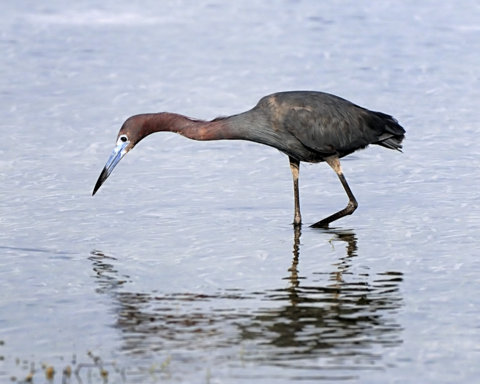
To refresh your memory, here is the photo from June’s Bird Quiz. It was taken in Puerto Rico during the month of May, but you can also see these all along the Gulf coast. Don’t read any further if you want one last chance to identify this bird.
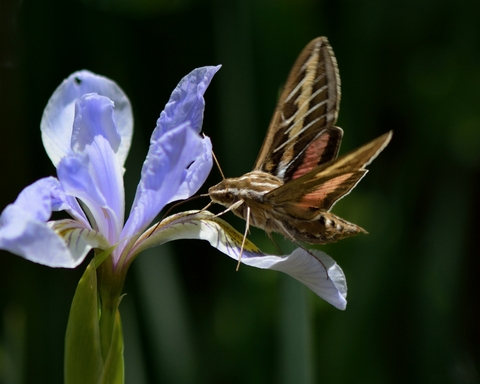 I was happily taking pictures of the flowers at Hudson Gardens last weekend when I noticed a huge moth siphoning nectar from the lilacs nearby. Looking up, I realized that there were dozens of these moths, fluttering around the catmint, hovering in front of the Red Feathers (below), and flocking (what do you call groups of moths, anyway?) around the lilac blooms. I started photographing them instead of the flowers.
Can you identify this bird? The photo was taken in Puerto Rico during the month of May. The answer will appear next week.
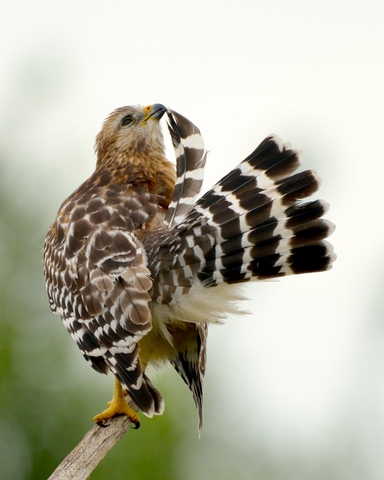 My camera was aimed at a Red-shouldered Hawk perched high in a tree, diligently preening its tail feathers. The angle was awkward—too far and the bird was a mere speck in the picture, too close and I was looking at the bird from below. I slowly backed up, trying to fill the frame and still capture the action. Intent on getting the shot, I stumbled over something behind me, and turned to see what was blocking my way. Oops! I’d tripped over an alligator!
Lucky for me, it was a relatively small alligator, perhaps six or seven feet long, and sound asleep in the warm sunshine. As my adrenalin levels receded, I made a mental note to pay more attention to my surroundings. After all, I was birding in the Everglades!
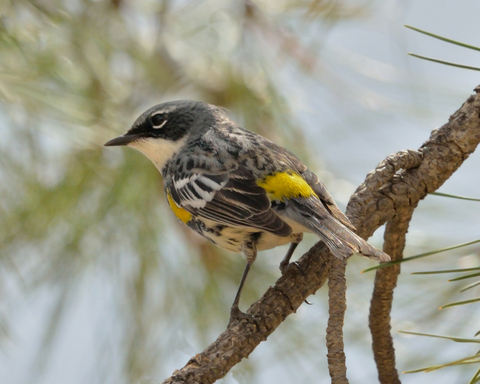 I will always remember this May as the month the warblers came. My Facebook feed is full of sightings. My friends are texting me from the field, wanting to share their excitement. The rare-bird lists are overflowing. It seems that warblers are everywhere.
Living along the Front Range of Colorado, we don’t normally experience quite the same seasonal torrent of these Neotropical migrant as states east of the plains. We can expect to see some species—Yellow, Wilson’s, Common Yellowthroat, perhaps an Orange-crowned, Virginia’s, or Yellow-breasted Chat, and it’s a rare summer field trip that doesn’t turn up plenty of Yellow-rumped Warblers, mostly the yellow-throated Audubon’s subspecies. (The above photo is the white-throated Myrtle’s subspecies, showing off his yellow rump.) We’re too far east (or not desert-y enough) for truly western birds—Black-throated Gray, Townsend’s, Hermit, Grace’s, or MacGillivray’s.
To refresh your memory, here is the photo from May’s Bird Quiz. It was taken in Puerto Rico during the month of May. Don’t read any further if you want one last chance to identify these birds.