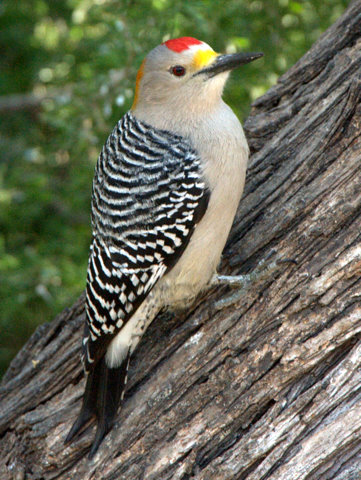
 Time was running out. I had one more day of birding paradise, and too many options remaining. Should I go to Santa Ana National Wildlife Refuge? Salineno, a 90 minute drive up the valley, was reporting Brown Jays. Maybe we should head there. Then I overheard someone mention that a Black-vented Oriole was hanging around the feeding station at Bentsen-Rio Grande Valley State Park, just 20 minutes from our motel. The decision was made—I’d be chasing another lifer.
Category: Vertebrates
Ick—Ticks
 One lovely afternoon many years ago, Pete and I were enjoying an outing to the slough at the mouth of the Salinas River, in central California. The trail was somewhat overgrown, and we were pushing through tall weeds looking for birds and other wildlife, when I suddenly realized there was a large, red tick crawling up his shirt.
Knowing that ticks are arachnids (fascinating creatures that nonetheless give me the willies), and having heard about all the diseases they carry, I calmly alerted shrieked at my husband and started flailing at his back. As that tick was dislodged, I noticed another one on his thigh… and another, and another… when I suddenly realized that if he was covered with ticks, then I was probably covered with ticks….
Good Birds
 “Have you seen any good birds?”
It’s the expected question when you meet another birder on the trail. We’ve all heard it, and probably asked it ourselves.
The first time I heard this I was a bit confused. What’s a “good” bird? Does that mean there are bad birds? Since that time I’ve learned that the question actually means, “Have you seen any unusual birds?” This makes a lot more sense. We all want to catch the rarity. But if seeing a rare bird is the only reason to go birding, we’d get bored pretty quickly.
Bird Quiz #3: Answer
To refresh your memory, here again is the photo for Bird Quiz #3. Read no further if you still want to have a shot at identifying this bird.
 As I mentioned in the quiz, I saw this bird in Tucson, Arizona in March. We also know it enters cavities and, at least in this case, that cavity is in a large cactus. Since the bird was doing this in the spring, it was probably building a nest or feeding young.
Bird Quiz #3
(Make sure you also see the previous months’ Bird Quizzes!)
Can you identify this bird? The photo was taken Tucson, Arizona in March. And yes, this is exactly how I saw it! My answer will appear next Monday.

Birder Heaven: A Large, Plain Estuary
“Have you seen the Rose-throated Becard? It’s at Estero Llano.”
“You still haven’t seen a Pauraque? You’ve got to go to Estero Llano Grande.”
“The birding here is good, but the best birding is at Estero Llano Grande State Park.”
After hearing all the comment, we just had to go check it all out for ourselves.
 Estero Llano Grande State Park (which means “large plain estuary”) didn’t exist when I was in Texas five years ago—it was still a sorghum field and dry lake bed. Since habitat takes time to return to its natural state, I wasn’t sure that reality could possibly live up to all the hype. I forget that plants grow faster in south Texas than they do in high, dry Colorado!
And Then There Were Five
 Last week we had nine hens. Six were young, prolific layers less than a year old. Three were old biddies past their prime. I’d been meaning to cull the three unproductive hens for a long time, but just couldn’t bring myself to actually follow through. Then I went to the feed store yet again, and realized that we were supporting three hens that were eating one third of my feed bill. That sealed their fate. So earlier this week I humanely dispatched three hens in their sleep and fed the local wildlife. I guess the local wildlife enjoyed the feast, because…
We got home late last night, and I headed out after dark to collect my half-dozen eggs. But instead of six, I found only five eggs—and five chickens. Alarmed, I searched the coop, but I couldn’t really see much in the moonlight. The five hens were perched on their roost, asleep, so I secured the coop and headed for bed.
Avian Imports
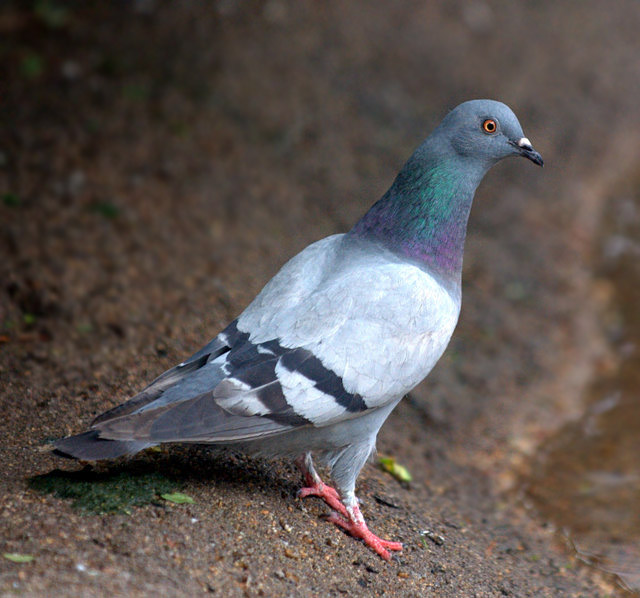 When we think of non-native birds, the Big Three usually come to mind: Rock Pigeons, European Starlings, and House Sparrows. All three are major nuisances, threatening native species, eating our harvests, and causing millions of dollars in property damage every year. But these aren’t the only aliens among us. In fact, there are nearly one hundred imported bird species that have established breeding populations here in the United States.*
Bird Quiz #2: Answer
To refresh your memory, here again is the photo for Bird Quiz #2. Read no further if you still want to have a shot at identifying this bird.
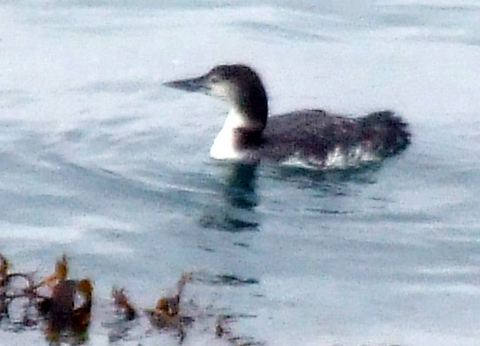
 I saw this bird in Santa Cruz, California in February. We were standing on the sea wall north of the pier, scanning the ocean for anything interesting. I took the photo through my scope in hopes of getting a better look, then pulled out the field guide.
Bird Quiz #2
(Make sure you also saw Bird Quiz #1 last month!)
Can you identify this bird? The photo was taken in Santa Cruz, California in February. This is exactly how I saw it from shore though my binoculars. The lower photo is cropped and enlarged in hopes of showing more detail. Sorry for the poor quality, but this is what I had to work with. My answer will appear next Monday.