Sprouting a Harvest

sprouts_lah_5506pThe snowflakes are flying, but you can still have fresh crunchy greens for your salad and sandwiches. How? Homegrown sprouts are easy to produce right there on your kitchen counter.

Alfalfa sprouts have been popular for decades, and are a good place to start, but there are many other options. Clover sprouts are delicious, reminding you of spring. Mung bean and lentil sprouts may be eaten raw or added to stir-frys. Broccoli and radish seeds have a decided zing to them, while onions will wake up your taste buds. Among the grains, wheat berries and rye are your best choices.
(more…)

How to Grow a Houseplant: Water & Food

Note: This is Part 2 of a three-part series on How to Grow a Houseplant. Part 1 covered light & temperature requirements, Part 3 will discuss containers and repotting.

aloe-vera-bf-2008aug01-lah-057

Water
The biggest problem most people have with growing container plants is watering. Ideally, the potting soil for your plant should have equal amounts of air and water trapped between its particles. It should be moist but not soggy.

Most people realize that letting plants dry out is a bad idea (unless you’re growing cactus). However, too much water can also cause wilting. Frequently, a novice gardener will interpret the limp leaves to mean the plant is thirsty, and water more. This nearly always proves fatal. What has actually happened is that the roots have suffocated from a lack of air. Dead roots can’t absorb water, so the plant wilts. More houseplants die from overwatering than from drought. Always check the soil first.

You can stick your finger into the potting mix, or buy a simple water meter that indicates how wet your plant is. Or, if it isn’t too big and heavy, you can simply lift the pot. A well-watered pot is heavy. If your plant feels like a light-weight, it’s time to water.

(more…)

Christmas Cactus (Schlumbergera sp.)

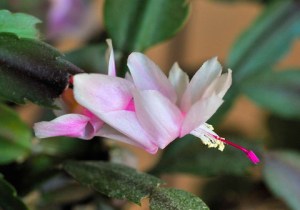
christmas-cactus_home_20091103_lah_5353x-1Small succulent-looking plants covered with huge, florescent  red, pink or white flowers are featured prominently in many stores right now. Go ahead get one. You won’t regret it.

Christmas (or Thanksgiving) cactus are both beautiful and easy to grow.

Yes, they’re cactus, but these plants are native to tropical rain forests in the mountains of Brazil, where they grow on tree branches as epiphytes. That should tell you that they like to be kept somewhat moist, but never soggy. This is particularly important while the plants are in bloom. In fact, uneven watering is a main cause of blossom drop. (Another is an abrupt decrease in humidity, such as comes when you move a plant from the greenhouse to your home.) The rest of the year, they are a bit more forgiving, and will tolerate a bit of drying out. It’s always best to let the top inch of soil dry out between waterings.

(more…)

Seed Catalogs

catalogs LAHThere’s “only” 55 more days until Christmas. Catalogs are pouring into our mailbox. Most go straight into the recycling pile, but a few I set aside, saving them for a break in the holiday frenzy. I don’t keep the gift catalogs, or the home décor catalogs. I only save the important catalogs… the seed catalogs.

The gardening season is over for the year, but next season’s garden is already germinating in my mind. Regimented rows of bush beans spread their leaves toward the spring sun, lettuce forms tight rosettes and huge broccoli plants are crowned with enormous heads of perfect buds. No hail has punched holes in the leaves; hungry cutworms have yet to fell a single stalk.

(more…)

Witches’ Brooms

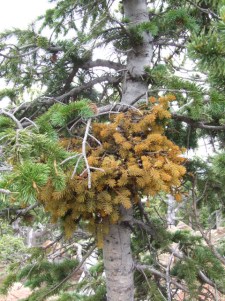
witches-broom-mtalmagreco-2007aug07-lah-dscf8204You won’t see them being ridden on Halloween, they’re no good for sweeping, and they aren’t caused by witches. Instead, witches’ broom is the term for a dense cluster of leaves or twigs growing haphazardly among the branches of a plant, usually a shrub or tree. At times, the appearance of the broom is strikingly different from normal growth, as in the example shown at left.

Any plant can grow a witches’ broom, from deciduous trees such as willow or cherry, to conifers including pines, firs and spruces. Hackberry is especially susceptible. Aster Yellows is an example of a damaging broom that affects non-woody plants.

Many factors can cause broom formation, including viruses and other microorganisms, fungi, mites and insects, nematodes, mistletoes, and even random genetic mutations. An environmental stress that affects the growth point of a branch will also result in a witches’ broom. Sometimes, two of more factors are involved. Often, the cause cannot be determined. In most cases, the best way to control a witches’ broom is to simply prune it out.

(more…)

Flowering Cabbage (Brassica oleracea)

_dbg_20090915_lah_0651Cold-resistant flowering cabbage takes the stage after tender annuals have succumbed to Fall’s first frosts. Flowering cabbage isn’t really a flower, but a loose head of large ruffled, fringed, or smooth leaves in vibrant combinations of cream rose, purple, and green. Although grown as an ornamental, flowering cabbage, also known as ornamental or flowering kale, is completely edible.

Technically a biennial, these cabbages are grown for the open rosettes that forms the first season. Summer heat results in stunted or leggy plants that are often attacked by cabbage loopers; plants are at their best in cool fall weather. Frosty nights intensify the colors. In late August or September, set seedlings out 15 – 18 inches apart in full sun. All cabbages prefer rich, moist soil.

Ornamental cabbages are most typically massed as bedding plants. Plants continue to look attractive for a while after the ground freezes. Use for fall/winter color, contrasted with dormant perennial grasses in shades of tan and gold, or harmonizing with groundcovers, such as some junipers, that turn purple in winter.

Taking Stock of the Garden

The gardening season is over, at least for us here in Colorado. Our September snowfall put an early end to beans,  tomatoes, and summer squash. Hardier veggies (and, unfortunately, most weeds) survived, but haven’t grown since the weather turned cool. Carrots are waiting under their mulch layer for winter harvesting; garlic has been harvested and next year’s crop replanted.

With much shoveling and sneezing (I’m allergic to chickens), the broken-down, soiled straw in the chicken coop has been distributed over my garden beds and dug in, adding nutrients and organic matter to enrich my soil. A thicker layer of newer straw mulch keeps my earthworms happy and protects against insect pests that are waiting lay their eggs underground.

It’s finally time to lay down the shovel, step back and take stock. How did the garden do this year? What did we have too much of (not zucchini, for once)? What were we lacking? How did the new varieties I trialed compare to my tried-and-true favorites? What should I do the same next year? What should I change?

(more…)

How to Grow a Houseplant: Light & Temperature

spider-plant_home_20090908_lah_0280“Mom, can you fix it?”

My college freshman was looking at me with a dejected, mournful expression, holding the spider plant I had sent to school with her. It looked awful. Wilted, brown leaves hung limply over the edge of the plastic pot. There were no signs of life.

“Well, that one looks kind of done, but I can give you another one. I’ve got plenty of spider plants. What happened?”

The story unfolded… it was well below freezing outside, but the central heating in the dorms was turned way up. Suffocating in her room, she’d opened the window a crack. No one thought to move the plant on the windowsill. Unfortunately, tropical spider plants aren’t equipped to survive 6ºF drafts. The poor plant had succumbed during the night.

As I potted up another victim, er, spider plant, I explained to my daughter that the primary thing to remember is that plants are alive. I know this seems obvious, but too many people treat them as decorations rather than living organisms. It’s better to think of them as pets—sort of like green hamsters without the exercise wheel. They need food and water, shelter and room to grow. If you meet their needs, they’ll not only survive, they’ll grow and perhaps even bloom. It’s really not that hard.

(more…)

R.I.P.: Colorado’s El Paso County Master Gardener Program

cmg_plant_swap_20090606_-339
Master Gardeners making selections at the annual plant swap.

Last month I learned that, as of October 1, I would no longer be a Colorado Master Gardener. Due to extreme budget deficits, our county can no longer fund their portion of the “cooperative” extension program, and the Master Gardener program is being put on furlough. The long-term prospects remain unclear, but for the present, I’m going to have some extra time on my hands.

On one hand, I’m sad. Volunteering as a master gardener for the past nine years has benefited me in many ways. I’ve improved my writing and photography skills, gained confidence as a public speaker, and learned a huge amount about horticulture. I also had a lot of fun. After focusing primarily on raising our kids for so many years, it was good to get back into the bigger world out there.

(more…)

Recycled “Greenscapes”

continer-whimsy-dbg-2008jun26-lah-461“Don’t throw that away!”

My family is used to my exhortations by now. Mom, the recycling nut. It’s true—I have a bin for metals and one for plastics, 1 through 7. Glass has its own container, next to the compost bucket. Worms eat my garbage. Paper and cardboard pile up in old laundry baskets (I’m recycling the baskets too). Still-usable discards go to the thrift stores, worn out clothes get used as rags. Not much ends up in the small trash can we lug to the curb every week.

As a gardener, I want to extend my recycling efforts to my yard. How can I avoid making new purchases for my garden?

(more…)