

After the storm earlier this week, snow blankets the fields, hiding most signs that anything ever grew there. But interspersed with the even white blanket and occasional dried grass leaves are spikes, sticking up like posts in the empty landscape. We’re finally noticing the dead and dried flower/seed stalks of Common Mullein (Verbascum thapsus).

 The flowers could be considered somewhat pretty—a white or lavender tuft reminding me of cornflowers (aka bachelor’s buttons). The somewhat pretty flowers are probably the only positive aspect of these plants. A common noxious weed, knapweed is the bane of my garden.
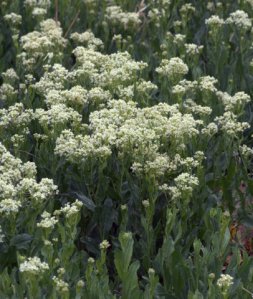 Spring flowers are finally filling the fields. Milk vetch, penstemons, wild onions and marsh marigolds all caught my eye as I hiked though the towering cottonwoods along Fountain Creek, at the base of the Rockies here in central Colorado. I was particularly impressed by huge swaths of a foamy white flower I didn’t immediately recognize.
 Aliens have invaded Colorado. Once again, a non-native species has moved into our territory and established a thriving population. In this case, it’s the European Paper Wasp (left). You can read all about it at the Colorado State University Extension
  Specifically, a Penn State biologist named Tomas Carlo studied Japanese Honeysuckle (considered a noxious weed in much of the eastern US) and found that its presence increased the biodiversity of bird species as well as the number of individual birds. In fact, the fall berries are a major source of food for fruit-eating birds.
 More charmingly known as Butter-and-Eggs, the common name “Toadflax” applies to several similar species. All sport cheerful yellow flowers resembling snapdragons, to which they are related. Two-foot tall clumps of smooth green stems are covered with narrow, pointy leaves two and a half inches long. The flowers appear whenever growing conditions permit.
 Mountain Plover