
 When you want to see a Cave Swallow, the logical thing to do is head for a cave. Since I wanted to see a Cave Swallow very much, we decided to visit the granddaddy of all caves, Carlsbad Caverns National Park. At this time of year there are supposed to be lots of Cave Swallows nesting just inside the cave entrance. Besides, I’d visited there as a child, but Pete had never been.
Month: June 2014
Delphiniums
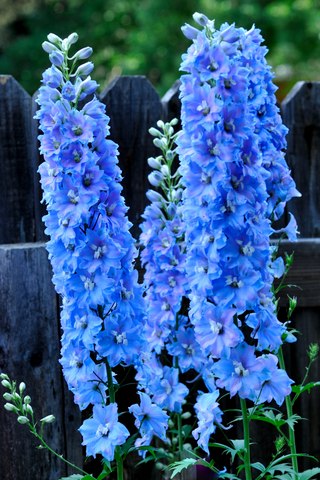 Most people recognize Delphiniums in the cottage garden. With their tall spikes of vibrant blue (or red, pink, rose, white, orange, or purple) flowers, nothing else is quite like them. Huge delphiniums are a staple in England, where cool temperatures and fog provide a perfect environment. But I despaired of having these heavenly blue blossoms in my Colorado garden. It’s just too hot and dry.
Colorado gardeners do manage to grow spectacular hybrid Delphiniums, but as one Colorado master gardener put it, a delphinium is
“… one of the neediest perennials ever. It likes sun but not in the hottest part of the day. It needs even moisture, mulching and careful watering. It reacts poorly to extremes of heat and cold, and requires a lot of fertilizer. To top all that, it requires its devoted fans to cut it back immediately after early-summer flowering before it will even consider reblooming a full three months later. (Many years, early June bloom is all you get, given the extreme pickiness of this flower.) Finally, unless it really, really likes its location, it may never be seen again after that September curtain call.”
 I’m not that dedicated to fussing over a particular plant, no matter how gorgeous, which is why I was delighted to discover that the familiar, tall Delphinium grandiflorum isn’t the only kid on the block. Other cultivars and species are much better adapted to our challenging conditions.
Blue Butterflies (right) is a cultivar of D. grandiflorum, but you’d never recognize it. Growing only one to one-and-a-half feet high, these bushy plants are covered with purple-blue flowers that are more open than the Giant Pacific Hybrids. Instead of big leaves, the foliage is finely divided, giving it a lacy look. You still need to provide moist, rich soil, and they need to be deadheaded, but at least they survive a windy day much better than the staked varieties. My Blue Butterflies did eventually die, but it lived for several years without any special attention on my part. I was impressed.
 Delphinium exaltatum (left, photo courtesy of Wikicommons) is a perennial species native to the eastern U.S. As you might expect, it must be kept constantly moist, but it tolerates Colorado’s lime soils. Plant in morning sun or bright shade (it needs full sun where skies are often overcast) and provide protection from strong winds. Fertilize regularly. As they fade, remove the flower spikes to encourage additional bloom (maybe). You can buy seedlings or start your own; a cold treatment is needed for germination.
Delphinium x belladonna is another hybrid perennial that is easier to grow. It prefers full sun, well-drained soil with high fertility (amend, amend!), and shelter from strong winds. It’s a good idea to stake the tall flower spikes. This delphinium originated in Europe. It’s best to buy transplants.
 We haven’t mentioned pests and diseases yet, but there are plenty of both. Delphiniums are susceptible to powdery mildew, southern blight, root and crown rot, botrytis blight, fungal and bacterial leaf spots, white rot, rust, white smut, leaf smut, and damping off. Slugs love them, although that’s not a huge problem in Colorado. They also get cyclamen mites, borers, and leaf miners. To top it off, all parts of Delphinium plants are poisonous; even handling the plants can cause skin irritation.
Given the difficulty of growing your own, perhaps a better solution is to enjoy the delphiniums that Mother Nature grows. An easily-recognized wildflower (it’s the tall, blue or purple one), most wild delphinums are annuals, and are referred to as Larkspur. The Colorado Rockies offer several species. One good location is Crested Butte in mid-July, or try Yankee Boy Basin above Ouray (4-wheel drive needed).
National Wildlife (and people) Refuges
 A few years back I wrote an article about the Duck Stamp, formerly known as the Migratory Bird Hunting and Conservation Stamp. (I like “duck stamp” a lot better!) Hunters need to buy the stamp to hunt ducks, and the money goes to purchase and maintain ducky sorts of habitats, with lots of water, good cover, and nice slimy plants to munch. You may know these places as National Wildlife Refuges (NWRs).
Pollen Season
 For the past few weeks, my blue car has been yellow. Drifts of fine mustard-yellow dust cover our patio, our deck, and the floors indoors. I dust, and dust, and dust again; each time the rag comes up yellow. What is this dull yellow layer that covers everything? It’s pollen. More specifically, Ponderosa Pine pollen.
 For those of us who live with pine trees, the pollen season is a yearly event as predictable as the throngs of Miller Moths currently beating themselves to death against our windows, and happening at the same time of year. Because we had a lot of rain at the end of last summer, 2014 is particularly pollen-y. All those trees, once dying from thirst, have a new lease on life, and they’re taking full advantage.
Bugwatching!
 It’s 4:30, still dark, and the alarm clock rouses me from a deep sleep. Wha…?? Oh, right, I’m going birding. There’s lots of talk about the “early bird” for a good reason. Birds get up early. Even as I’m fumbling around trying to find some jeans and a t-shirt, I can hear a robin singing outside my bedroom window.
Last week, I went on a field trip that didn’t start until 9 am. Nine! No setting the alarm clock. No downing cup after cup of caffeine (and then realizing all the bushes are much too small to hide behind). I could have a leisurely breakfast and drive off in the daylight—and we still saw plenty of wildlife. How did we manage to see so much so late in the day? Easy. We were bugwatching.
Not Quite Hail-Proof
 When I first saw the dark clouds building over the mountains to the west, I was elated. My newly-planted perennials were thirsty, and now I could let Mother Nature do the watering. However, as the cloud mass grew and darkened, I quickly realized that rain wasn’t the only precipitation I could expect. The rounded pumps on the undersides of the thunderheads—the bottoms of convection cells—meant hail was on the way.
Sure enough, the storm that day did major damage in much of Colorado Springs. We were fortunate in that we missed the worst hail, but with hailstones up to an inch in diameter, we too took a beating. While my husband stared dejectedly at our pock-marked car, I ran to the window to see how my flowers fared.
Incredibly, I didn’t lose a single plant.
June Quiz: Answer
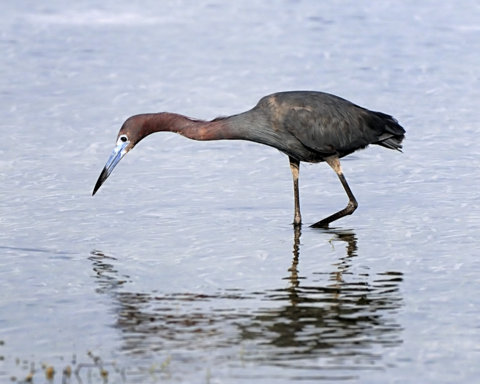
To refresh your memory, here is the photo from June’s Bird Quiz. It was taken in Puerto Rico during the month of May, but you can also see these all along the Gulf coast. Don’t read any further if you want one last chance to identify this bird.
Impressive: White-lined Sphinx Moths
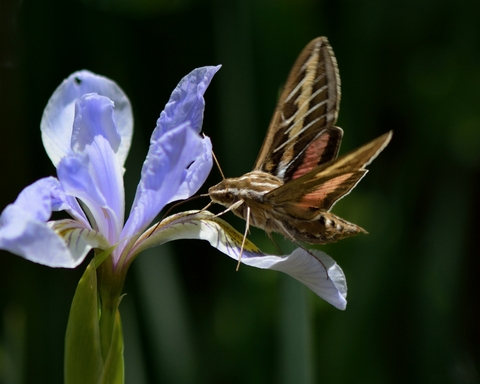 I was happily taking pictures of the flowers at Hudson Gardens last weekend when I noticed a huge moth siphoning nectar from the lilacs nearby. Looking up, I realized that there were dozens of these moths, fluttering around the catmint, hovering in front of the Red Feathers (below), and flocking (what do you call groups of moths, anyway?) around the lilac blooms. I started photographing them instead of the flowers.
June’s Bird Quiz
Can you identify this bird? The photo was taken in Puerto Rico during the month of May. The answer will appear next week.
 Mountain Plover