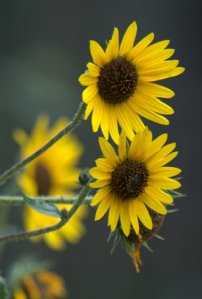
 This year, the birds planted themselves a garden.
I have half a dozen bird feeders scattered around our yard. Some hold millet, others contain suet, and a small feeder near the house is full of tiny, black nyjer seeds specifically for the goldfinches and Pine Siskins. But the most popular feeders are the ones full of black oil sunflower seeds.
House Finches, jays, nuthatches and chickadees, magpies, grosbeaks—all are attracted to the sunflower seeds. (So are squirrels, but they only get the spilled seeds on the ground.) While the finches sit contentedly on the feeder, munching away, the jays, nuthatches and chickadees tend to swoop in, grab a seed (or three, in the case of the jays), and hightail it to the relative safety of a convenient branch. There they open the shell and extract the seed before returning to the feeder for their next bite.
(more…)

 I was rinsing my hands under the faucet downstairs when a huge, aggressive monster suddenly scurried across the bowl of the sink. I screamed. Slamming the faucet lever down, I backed away from the counter, shaking, dripping on the tile floor.
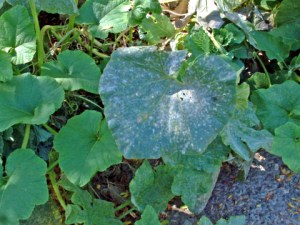 The huge zucchini leaf looked as if it had been dusted with flour. The man holding it was looking at me expectantly, waiting for my diagnosis. I was volunteering at our county’s Master Gardener helpdesk, providing free gardening advice to the general public. Sometimes we get stumped, but this time I immediately knew exactly what the problem was.
 Yesterday morning, I went out to tend my flock, and realized that my new pullets, hatched around June 1, were nearly the same size as my mature hens. When they were mere children, they fit just fine in their twelve square foot cage (above). (For their safety, it’s important to separate young birds from the main flock.) Now, however, it was clear that they needed more room. Although I had planned to wait until next month, I decided this was the time to release them into the main coop.
 Appearance
 In an attempt to improve my skills, I’ve signed up for a Wildlife Photography class at our neighboring community college. I have starry-eyed visions of rutting elk, growing grizzlies and other impressively large mammals adorning the paneled walls of our family room, not to mention the pages of Outdoor Photographer or National Geographic.
 My cucumbers are sick. As far as I can tell (although I’m not 100% certain), they’re suffering from something called Alternaria Leaf Blight. But no matter what the particular fungus is, the leaves have expanding brown spots and are beginning to yellow and die, starting from the roots and working their way upward. New fruit is being aborted. It’s sad—very, very sad.
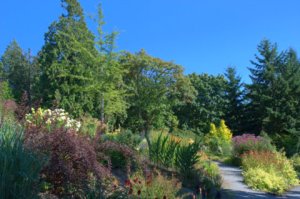 Where does a gardener want to go on vacation? Probably somewhere with a beautiful public garden or two.
 This is the third and last part on how my daughter the anthropologist looks at birders. Don’t miss
  I’ve already mentioned clothing, but in general, wearing white is frowned upon. It scares many birds, thus annoying many birders. The same thing applies to loud noises. Most birders talk in hushed voices, at least while on the trail.
 Mountain Plover