


One of the delights of living near the US Air Force Academy is watching the various ways the cadets get into the air. There are the small training planes, the gliders, and the air mattress-like parachutes. Every so often, most often during football season and at graduation, we’re treated to an old bomber or two. And then there are the incredible Thunderbirds, whose aerial display comes right over our house. What a view!
Of course, you can immediately tell when the Thunderbirds are in town—you can hear their screaming engines echoing off the Front Range mountainsides. (If you want to actually see the jet, look far ahead of the point where the sound seems to be originating.) But let’s eliminate the sound for a moment. How can you identify a single-engine prop plane from a glider from a parachute from a jet? Easy—look at the shape of the wing.



 Every year, the American Ornithological Society (AOU) reviews a number of proposed changes to the classification of North American birds. This affects the definitive list on which we birders base our life lists. Species may be added or deleted. Sometimes, a species is divided into two or more new species, such as the split of the Western Scrub-Jay a few years ago. (I gained a new life species as a result, as I have seen and photographed both the California Scrub-Jay and Woodhouse’s Scrub-Jay.)
 How’d you like to be able to see with your eyes closed? Wouldn’t it be handy? You wouldn’t get grit in your eyes during a dust storm. Your eyes would never turn red from swimming in a pool with too much chlorine. And you’d never get poked in the eye. If only we could see through our eyelids!
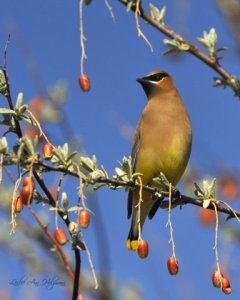 I was wandering through the forest in western Washington when I heard a series of high-pitched, whistling bird calls. As I peered into the foliage, I finally made out the Cedar Waxwings that were making the sound. Another time, I was in southern Texas, along the Rio Grande border. Again, I heard birds singling some very high notes. In this case, they were followed by a series of lower notes and a distinctive two-tone call. I realized that I was surrounded by a number of Ruby-crowned Kinglets.
 One aspect of nature I appreciate is its constancy. No matter who gets elected, a rose is still a rose. Whether I’m happy or sad, a moose remains a moose. The world can fall apart, but a jay is still a jay. Or not.
 Mountain Plover