
 I’ve been down with a nasty stomach virus for the past week, more interested in the distance to the bathroom than in gardening. As a result, I’ve been perusing articles instead of writing them (it takes far less effort!). I’ve also spent considerable time reading bogus gardening advice on Pintrest—it’s an amazingly rich repository of horticultural mythology. One afternoon I focused on the idea that houseplants purify the air in our homes. We’ve all seen the articles…
Category: House Plants
Flowers with Roots, Please

Flowers make me happy. I love gardens full of them. But while I do appreciate pretty bouquets, I prefer to receive flowers that are still attached to their plant. As my husband has learned—to bring a smile to my face, bring me flowers with roots!
Stay Dry, See Tropical Plants
 I love to visit Washington. The state is a gardener’s paradise. All those dreary days translate into brilliant azaleas and rhododendrons, ferny grottoes, and towering evergreens. The trick is enjoying those gorgeous gardens when it’s raining—and it rains a lot. Sure, you can visit in the summer, when days are sunny and the sky is a sapphire blue. But what about right now?
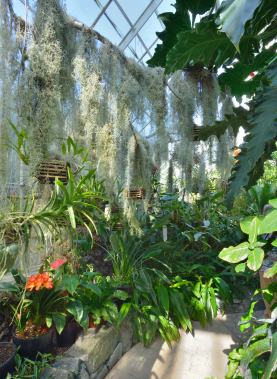
One way to get out of the February cold and wet is to visit a conservatory. (This applies to cold and snowy Colorado, as well.) And one of my favorites is the W. W. Seymour Botanical Conservatory, located in the 27-acre Wright Park Arboretum, Tacoma. This glassed enclosure houses over 250 species of tropical and semi-tropical plant, including 200 different orchids—just the antidote for a gloomy winter day.
Seeds to Start in January
 For an avid gardener, January can be a difficult time of year. Sure, we can dream. The seed catalogs that have been arriving for a month now are filled with post-it notes, dog-eared corners, and bright yellow highlights. At the same time, I’ve decided and re-decided (at least a dozen times) where I’m going to plant each seedling once the weather warms. I love the optimism of dreaming, but sometimes I just want to get my fingers into some soil—even if the “soil” came out of a bag of potting mix.
At this time of year, gardening outside is pretty much impossible. The ground is frozen, and there’s still a layer of snow in the shadows on the north side of the house. Besides, it’s cold out there!
Boozing Your Bulbs
 Your knees were creaking and your back was aching, but your bulbs were now nestled in their holes, safely underground, waiting for spring. All winter, with its bare branches and mono-colored landscape, you dreamed of sunshiny daffodils, pastel hyacinths, an entire palette of tulips. Then, finally, the weather warmed and the first green leaves appeared. With mounting anticipation, you checked the daily progress of those early flowering bulbs. And then—finally!—the buds appeared, the flowers opened… and flopped over.
Gardening Quiz: Answer
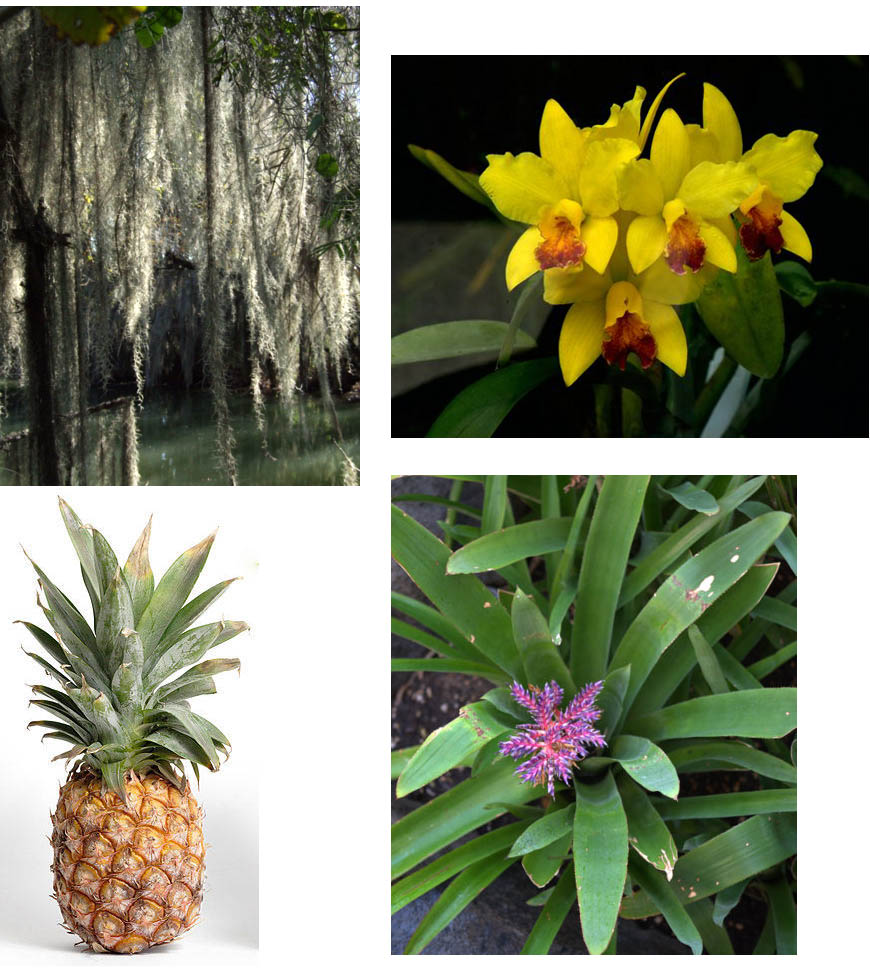 Today’s post is the answer to last week’s post, so if you haven’t yet taken a look at that, I suggest you do so now.
So, did you solve my little botany quiz? The correct answer is…
But wait a minute. Did you recognize all those plants? Going clockwise from the upper left corner, we have Spanish moss, a lovely orchid, a tropical bromeliad, and a pineapple.
Now do you know the answer?
Act Now for Mid-winter Flowers
 Imagine that it’s wintertime. Anything verdant and green has long turned to brown. Limbs lie leafless. A few berries may yet hang on the shrubs. We’re already eager for spring, but the growing season is still months away. Wouldn’t this be the perfect time to enjoy bright red tulips, or the sweet aroma of blooming narcissus? If you want to enjoy these and other mid-winter flowers, now is the time to start forcing bulbs.
Pretty much any spring bulb can be forced. All we have to do is fool them into thinking that spring has arrived—in the middle of January. To do that, we have to plan ahead—up to 15 weeks ahead.
Valentine Cyclamen
 It’s Valentine’s Day, one of the busiest days of the year for your friendly neighborhood florist. My husband knows I like receiving flowers on this most romantic of holidays. He also knows that I appreciate getting a plant that is still alive and growing, as opposed to cut flowers that will soon wilt and be composted.
One popular Valentine plant is the Florist’s Cyclamen. These cyclamen are decidedly beautiful—delicate and romantic—but are difficult plants to keep indoors.
Beautiful Begonias
 Alive and green. At this time of year, all I want is a plant that’s alive and green. I’m desperate for an actual leaf (not a conifer’s needle). Flowers would be nice too.
January is a hard time for gardeners. Planning and ordering seeds and plants, spiffing up the garden tools and flower pots—it’s all necessary, but almost none of it involves actual plants. Sometimes you just want to touch a leaf, admire a flower. It’s for January that I grow so many houseplants.
Cat Grass, or How to Save Your Spider Plant
 It was my daughter on the phone: “Mom! Starla has been chewing on the spider plant again! What can I do?”
No, Starla isn’t our granddaughter—she will know better than to chew on the houseplants. Starla is one of our grand-cats. And like our own pet feline, she loves to chew on foliage.
Our pets are all indoor cats—it’s safer for the birds and other wildlife, and it’s safer for them too. (Did you know that birds may carry diseases that can kill your cat?) While they contentedly preen on the window sill and shed on the sofa, they retain their instinct to munch on leaves. Since the only leaves available are houseplants, that’s what they eat.
 Mountain Plover