
 The bulldozers are at it again. Another swath of short-grass prairie is being turned into houses. I can’t complain—I live in such a house. A mere three years ago, birds and bunnies made their home in what is now my yard. The voles and cottontails are still here and thriving, largely at the expense of my landscaping. The birds—assorted sparrows, hawks, Say’s Phoebes, Horned Larks, Scaled Quail, and Killdeer—decided to go elsewhere.
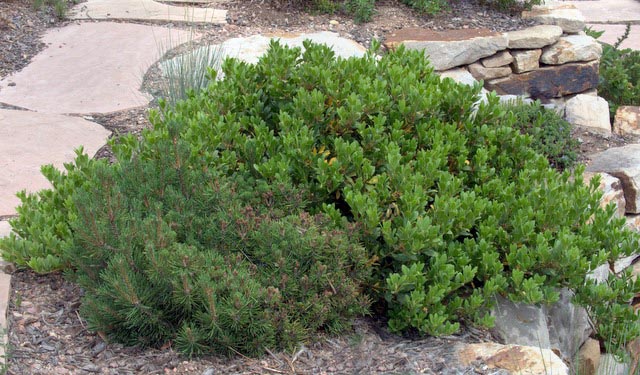
Now I’m trying to lure them back by replacing what nature has lost. Instead of the typical neighborhood rocks-and-grass “zero-scape,” we’ve included shrubs and trees that offer wildlife food and shelter. Native shrubs such as three-leaf sumac, manzanita, Boulder raspberry, buffaloberry, and chokecherry all offer berry-like fruit. Our roadside oak will one day provide acorns, the limber pines have seed-filled cones. Seeds come from native grasses and flowers, too, while dwarf conifers and dense shrubs offer a place to hide from predators and the weather. My nectar garden feeds hummingbirds and other pollinators. Feeders offer additional seeds and suet, and my heated birdbath is a year-round source of water.
 Maybe hemlock has the right idea.
 When you think of container gardens, what comes to mind? Red geraniums in a window box? A hanging pot filled with colorful petunias? How about pots of herbs on the window sill? How about a huge pot overflowing with varied textures, colors, and shapes? When it comes to container gardens, that geranium is only the beginning.

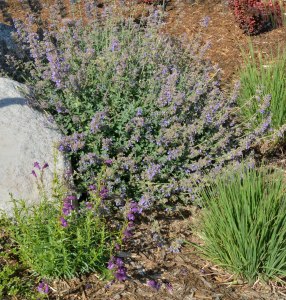 You’ve read the instructions; I’ve used them frequently here in my posts. “Drought resistant once established.” Sounds good—we’re always trying to save water—but how should you water these plants to start with? And what does “established” mean?
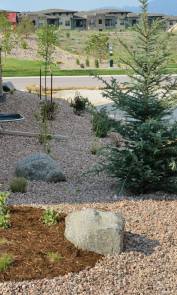 In the year we’ve lived in our new house, the first on the block, we’ve gained a number of neighbors. Now that the growing season is officially underway, these new yards are being landscaped. And I’m reminded all over again of why, back in 2000, I signed up to become a master gardener.
 Most landscapes look terrific in May and June. The leaves are fresh and new. From pink crabapples to purple lilacs, it seems as if everything is in bloom. The contrast with the lifeless browns and grays of winter is enough to send you cavorting across the glowing, emerald green lawn.
 How do you plant a new tree? Most people know to dig a hole “twice as wide and deep as the root ball” (according to the label I found hanging from the branches), then stick in the tree, making sure the roots are well buried. Amend the backfill with plenty of compost, pile it over the roots and tamp it down firmly. Finally, securely stake the thin trunk so it won’t wiggle in the wind. Right?
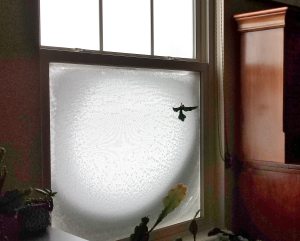 Today (as I write this) is officially the third day of spring, but you’d never know it here in Colorado. I can barely make out the house across the street through the snow hurtling by at up to 70 mph. Cottony clumps of white stuck to the window screen have totally blocked the view from my office (right). Those who can are staying home, businesses are closed, and schools would be too if the kids weren’t already off for spring break. The blizzard warning keeps changing. We can expect a mere 1 to 3 inches of snow. No, we’ll get 6 to 12 inches. And now they’re saying 8 to 16 inches with significantly higher drifts.
 Mountain Plover