Gardening Advice You Can Trust

Growing one’s own food is back in vogue. Community gardens are springing up in cities, suburbanites are trading lawns for lettuce, and even the White House is cultivating everything from arugula to heirloom tomatoes.

If you’ve never grown vegetables before, the task may seem daunting, but it really isn’t that hard. For one thing, there’s plenty of advice available. However, not every suggestion deserves a place in your yard; some sources are more reliable than others. Unfortunately, there’s a lot of plain hogwash being circulated as garden advice.

If you are planning on growing vegetables—or fruit, or any kind of garden, really—I highly recommend you do some research before beginning. It’s a good idea to look for local sources of information, as growing conditions vary so much from place to place. Generalized gardening books and magazines are helpful, but most tend to be slanted toward the eastern part of the country. Growing anything in Colorado is a much different challenge.

(more…)

Tropical Flowers in January?

lah_6081

What plant thrives indoors, shrugs off low humidity, and blooms all winter in bold shades of white to pink to red? Surprise! It’s wax begonias!

Also called fibrous begonias, these familiar bedding plants have large, round succulent leaves in either lime green or a beautiful burgundy- or bronze-red. Flowers have fleshy petals surrounding a bright yellow cluster of stamens. Plants grow to a height of about six to twelve inches. They tend to flop, creating a solid mass of color, and even trailing over walls and container edges.

(more…)

Winter Color

Do weeks of staring at snowy white landscapes have your eyes screaming for color? Winter gardens don’t have to be drab, lifeless affairs. Flowers may not be in bloom, but many plants have leaves, stems, or berries in shades of bright red, golden orange, or silver-blue and plum. Put them together and your winter garden springs to life.

Mahonia repens (also known as Oregon Grape Holly)  is an attractive groundcover year-round, but it really shines in winter. While other plants shed their leaves, Mahonia’s foliage turns a stunning bright red.

Yellow flowers in spring and showy blue berries in early fall add to this native’s year-round interest. Mahonia repens is drought tolerant, and handles full sun to part shade.

Juniper horizontalis ‘Blue Chip’ is another groundcover that remains attractive all year. While many junipers grow much too large for our small yards, Blue Chip stays under a foot high. Its feathery foliage is a beautiful steel-blue all year, with the addition of silver-plum tips in winter. Plant it in full sun, where it will quickly spread up to ten feet in diameter. Junipers are very xeric once established.

(more…)

A Gardener’s New Year’s Resolutions

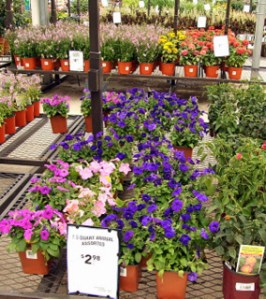
plants-for-sale-lowes-cs_2008aug02_lah_5106-1Lots of people like to make New Year’s resolutions. Gardeners are no exception. A quick web search turned up plenty of lists, with gardeners around the country vowing to stay ahead of the weeds, thin their carrots, and learn the Latin names of all their favorite plants. If you like to garden, you probably have your own list of good intentions. And if you’re like me, you’ll struggle to keep even one of them.

This year, I’d like to propose a list of gardening resolutions that any enthusiastic gardener can keep. Your garden may not be perfect, but at least you’ll have the satisfaction of knowing you achieved your New Year’s goals.

(more…)

Blogs I Like

Today I’d like to highlight two of my favorite blogs, one about birding and one about gardening. There are lots of other great birding and gardening blogs, so please check out the list of links to the right. I’d also love to hear about your favorites. I look for reliable information, interesting stories, great pictures. What do you recommend?

Birding

brdpics-logoBill Schmoker is a Colorado birder who teaches junior high science full time, and still somehow manages to get out and take incredible bird photographs. His pictures have appeared in a number of publications, and the American Birding Association just released Ted Floyd’s Let’s Go Birding, which Bill’s photographs illustrate.

Recently, Bill’s blog, Brdpics, displayed a remarkable series of photographs of a roadrunner and a coyote. Yes, the real thing! One picture even contained both of them at the same time! Since I will probably only get photos like that in my wildest dreams, please go look at his.

(more…)

How to Grow a Houseplant: Containers & Repotting

pots-for-sale-santafegreenhouses-20089jun28-lah-132Note: This is Part 3 of a three-part series on How to Grow a Houseplant. Part 1 covered light & temperature requirements, Part 2 was about feeding and watering.

Containers
A bird has a cage and a gecko has a terrarium. Plants need a special places to live too.

You have a lot of latitude in choosing a container for your plant. Consider not only made-for-plants pots, but other bowls, cans, and even shoes. However, there are a few requisites. Drainage is paramount. If your chosen pot doesn’t have a drain hole, add one.

(more…)

What to Give a Gardener

tool-bucket-carnegielib-16apr07-lah-982Last time I wrote about what to give a birder for Christmas (or any time, for that matter). This time I’m focusing on gifts that will delight the gardener on your list.

Again, I’m not going to pick out the latest in gardening accouterments. Unlike birdwatching, gardening does require a pile of tools, seeds, gloves, compost, and the like, but there are already long lists of “perfect gardening gifts” in magazines and on websites.  Instead of finding places for you to spend your money, I’m suggesting ways you can give the gift of time.

(more…)

Dwarf Mistletoe is not for kissing

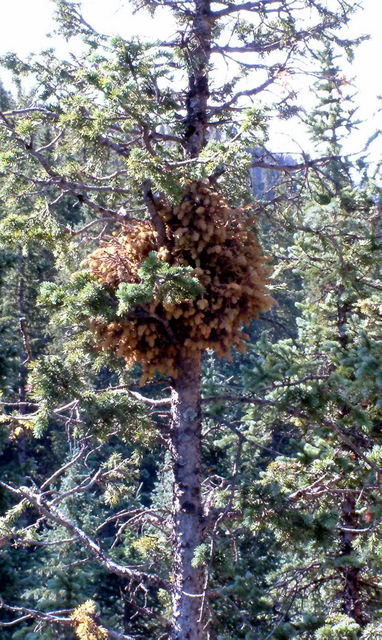
Sparse foliage and a witches' broom indicate a mistletoe infection.
Sparse foliage and a witches’ broom indicate a mistletoe infection.

Mistletoe is a holiday tradition. We decorate our doorways with it, where tarrying under a spring might bring you a kiss. Unfortunately, the kind of mistletoe growing along Colorado’s Front Range isn’t so romantic. Five different species of dwarf mistletoe infest pines, spruces and firs. Given enough time, an infected tree will eventually die.

All mistletoes are flowering plants that have given up a life of self-sufficiency to become harmful parasites. Dwarf mistletoes lack leaves, so they have little ability to make their own food from sunlight. Instead of extending their roots into the soil, they have root-like structures that penetrate under the bark, where they siphon off both water and nutrients from the host tree.

The female mistletoe plant produces sticky seeds. When the seed capsules are ripe, usually in late summer, they explode, expelling their contents at speeds up to 60 mph! The seeds can travel up to 60 feet, although 30 feet is more common. Wherever the seeds hit, there they stick.

(more…)

Living Christmas Trees

Photo: Judy Sedbrook, CSU Extension

With the surge in environmentalism, many people are trying to decide which is “greener,” a real Christmas tree or an artificial one. Both have their pros and cons. There is, however, a third alternative. You can decorate a still-living tree this year.

Most nurseries and garden centers sell potted Christmas trees. You bring them indoors for a brief spell (a week at most) during the holidays, then plant them permanently in the ground.

Still-living trees cost more. No one wants to pay a premium for a tree that still has roots, only to have it die after moving it outside. While planting a Christmas tree isn’t difficult, you should do the same research and preparation that you would do when choosing any tree for your yard.

First of all, make sure you have the right tree for the right place. Consider how the tree will fit into your overall landscape plan. Most evergreen trees get very large. That cute three-foot fir may have a mature height of 70 feet or more! Instead of trying to cram a giant into a small suburban yard, choose a dwarf specimen instead—or arrange to plant it elsewhere so it will have room to grow.

(more…)