Peas & Carrots

Peas and carrots are a classic couple in the kitchen, but what about the garden?

Normally, peas are sown in early spring. The traditional date is St. Patrick’s Day. While that may work in gentler climes, at 7,000 ft. elevation I would need a drill to create holes in my frozen ground. I usually plant a month later, on Tax Day. At least it gives me something to enjoy on that date.

This year, weekly snowstorms have delayed all my gardening chores. I finally got my peas into the ground on May 6. I don’t have great expectations for the harvest. Maybe we’ll have a cool start to the summer, and my husband will get to enjoy his Sugar Snaps. Maybe not. That’s the gamble of gardening in Colorado.

carrots-csu-lah-058Carrots, on the other hand, are usually planted a week or two before the average last frost date. The cool temperatures and snow-damp soil help keep the seeds from drying out during the three weeks it takes them to germinate.

This year, I sowed carrots on the same day as the peas. At least they’re right on schedule. I took the time to arrange the seeds in blocks of 16 per square foot, so I won’t have much thinning to do later. In my 4 x 4 foot carrot bed, that gives me 256 carrots—plenty for our needs.

(more…)

Xeriscape: Which Grass?

Now that you know why you want a lawn, and how big it should be, it’s time to consider what type of grass to grow.

Bluegrass
Lawn_UplandIN_20090615_LAH_3607Kentucky Bluegrass still reigns supreme for a turf that can stand up to hard use. It spreads via runners, so it quickly fills in holes. (But beware. Those same runners have a tendency to wind up in the adjacent flower beds.) If you have children and/or dogs, this is probably your best choice.

(more…)

Flowering Crabapples

Malus Crabapple
The very cold nights we had last month, coupled with recent snowstorms, have badly damaged flower buds on crabapples and other popular spring bloomers.

Flowering crabapple trees, with single to double blooms of white, pink, or carmine, are a beautiful symbol of springtime. Varying widely in form, cultivars range from small upright trees 15 feet tall to umbrella-like specimens more than 30 feet across. Some form narrow columns; some are weeping. Many produce small, ornamental fruit that lasts all winter, in shades of yellow, orange, or red. The simple green leaves of some varieties may have a reddish cast, especially in the spring. ‘Indian Summer’ is an example having orange fall foliage. ‘Molten Lava’ has attractive yellow bark. With over 200 cultivars available, you can choose a tree that matches your site and provides four seasons of garden interest.

(more…)

Xeriscaping: Just Enough Lawn

What would happen if you turned on the tap and no water came out? We are accustomed to having water on demand, but here in the west, the truth is that we are slowly running out. As communities grow, increased demand on both surface water and aquifers will eventually lead to rationing and other restrictions. In some places, that has already happened.

Since landscapes consume far more water than household use, your yard is the best place to conserve.

Lawns are the thirstiest part of most landscapes, so let’s start there. Frequently, homeowners plant turf because they don’t know what else to do, or because they’ve always done it that way. A wall-to-wall carpet of grass might work in Virginia, but is it appropriate in Colorado?

(more…)

Johnny Jump-ups

violas-johnny-jump-ups-dbg-2008jun26lah-446-21They’re jumping up all over the place— miniature flowers with elfin faces, surrounded by petals of yellow and purple. No wonder we call them Johnny Jump-ups! The petite plants, sporting elongated heart-shaped leaves, must have started growing as soon as the ground thawed, to be in bloom this early.
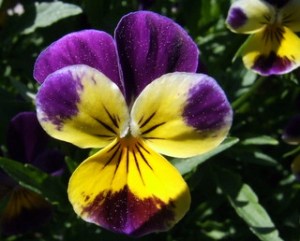
viola-johnny-jump-up-home-blackforestco-15jun07-lah-008These short-lived members of the violet family are not particular about soil, exposure, or water. However, for maximum bloom, grow them in full sun, and don’t let them get too thirsty. Skip the plant food, as too much fertility will encourage leaves at the expense of flowers. For a mid-summer repeat performance, trim back leggy plants. Prolific self-seeders, new plants quickly replace those that succumb to old age, and they will form a solid mat in a year or two.
Often used as edging plants, Johnny Jump-ups are perfect naturalized under trees or as a ground cover for spring-blooming bulbs. They also do well in containers.

(This article will appear in the Colorado Springs’ Gazette on 4/25/09; it is currently on their website.)

Starting Seeds: Pre-germination

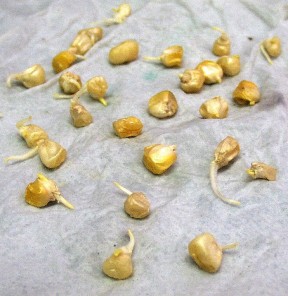
corn-germinating-on-towel-lah-1Vegetable seeds will germinate with or without soil. All they really need is an infusion of water to swell the seed coat, and sufficient warmth to signify spring. In fact, seeds for our most commonly grown food crops are among the easiest to start. They will begin their growth on a paper towel, a bed of agar, or even while still inside the fruit where they were formed! The home gardener can put this fertility to good use.
(more…)

Starting Seeds: Growing Transplants

Congratulations. You are the proud parent of a tray (or more) of baby plants. Remember, though, with parenting comes responsibility.

komatsuna-seedlings-needing-thinning-728-1
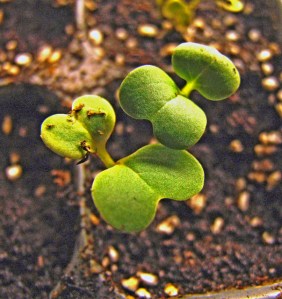
These are just the “seed leaves”

Once your seedlings are up and growing, they’ll require almost daily attention. If your potting mix did not contain fertilizer, you’ll need to start a feeding schedule. Wait until the first true leaves appear. (The initial “seed leaves” are the cotyledons, which contain plenty of food to get the baby off to a good start.) Use any liquid all-purpose fertilizer at half-strength, twice as often as the directions tell you.

And speaking of water, don’t let them dry out! At this stage, wilting is fatal, Even if your plants survive, they will suffer the effects of this trauma all their days. The ultimate crop yield will be smaller, and won’t taste as good, compared to plants that grew unchecked.  Continue to water from the bottom, using water that is room temperature or lukewarm. You don’t want to shock their little roots with ice water!

(more…)

Easter Lilies: Now What?

If you received a lily for Easter this year, you might be wondering what to do with it once it stops blooming. In warmer parts of the country, you can plant the finished bulb outside. Without being forced to bloom for Easter, the white flowers will appear in July. You’ll be enjoying your “Easter” Lily for many years to come.

Unfortunately, in most of Colorado, winters are too severe for these lilies. Unlike other varieties, trumpet lilies are only hardy to USDA zone 6. So, unless you have a very protected spot in your garden, you’ll have to buy a different kind of lily for outdoor growing.

To get the most from your gift plant, keep your lily in a cool, bright spot, but not in direct sunlight. Remember to water enough to keep the soil constantly damp, but not soggy. Removing any foil wrapping from around the pot will help excess water drain away from the roots.

Starting Seeds: Light

If you’ve ever tried growing seeds indoors, you may have ended up with tall and spindly plants, flopping over, adorned with pale leaves. When planted outside, these ungainly wisps quickly succumb to bright sunlight and the gentlest of breezes. What’s a gardener to do?

While overabundant food and water, coupled with too-warm temperatures, contribute to this problem, the primary culprit is insufficient light.

The crops most commonly grown in our veggie gardens all require full sun—at least eight hours per day. Likewise, bright light is essential for producing stocky seedlings with healthy green leaves.

(more…)

Starting Seeds: Soil and Water

Do not start your indoor seedlings in soil.

Does that surprise you? Yet, even good garden loam is not the best choice for growing transplants.

For one thing, soil is more than just dirt. It is full of micro-organisms such as nematodes, bacteria, and fungi. Out in the garden, they keep one another in check. Indoors, it’s another story. One of the most common causes of seedling failure, “damping off” is a disease causes by a fungus. Once infected, it is fatal to the baby plants. The only hope is prevention.

You do have the option of sterilizing your garden soil. You can bake it at about 250º F for several hours. That will kill all those nasty diseases. It will also create a stench in your home. If you want to stay on good terms with your housemates, this is not the best way to go.

(more…)