
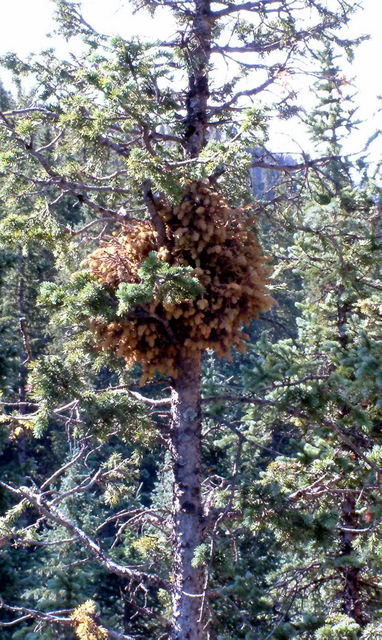
Mistletoe is a holiday tradition. We decorate our doorways with it, where tarrying under a spring might bring you a kiss. Unfortunately, the kind of mistletoe growing along Colorado’s Front Range isn’t so romantic. Five different species of dwarf mistletoe infest pines, spruces and firs. Given enough time, an infected tree will eventually die.
All mistletoes are flowering plants that have given up a life of self-sufficiency to become harmful parasites. Dwarf mistletoes lack leaves, so they have little ability to make their own food from sunlight. Instead of extending their roots into the soil, they have root-like structures that penetrate under the bark, where they siphon off both water and nutrients from the host tree.
The female mistletoe plant produces sticky seeds. When the seed capsules are ripe, usually in late summer, they explode, expelling their contents at speeds up to 60 mph! The seeds can travel up to 60 feet, although 30 feet is more common. Wherever the seeds hit, there they stick.

 The snowflakes are flying, but you can still have fresh crunchy greens for your salad and sandwiches. How? Homegrown sprouts are easy to produce right there on your kitchen counter.
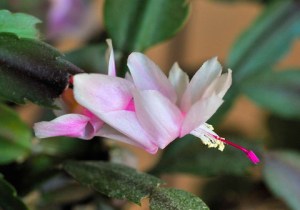 Small succulent-looking plants covered with huge, florescent red, pink or white flowers are featured prominently in many stores right now. Go ahead get one. You won’t regret it.
 There’s “only” 55 more days until Christmas. Catalogs are pouring into our mailbox. Most go straight into the recycling pile, but a few I set aside, saving them for a break in the holiday frenzy. I don’t keep the gift catalogs, or the home décor catalogs. I only save the important catalogs… the seed catalogs.
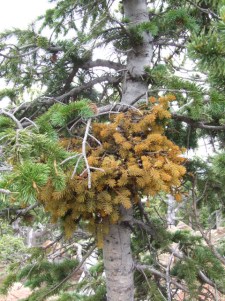 You won’t see them being ridden on Halloween, they’re no good for sweeping, and they aren’t caused by witches. Instead, witches’ broom is the term for a dense cluster of leaves or twigs growing haphazardly among the branches of a plant, usually a shrub or tree. At times, the appearance of the broom is strikingly different from normal growth, as in the example shown at left.
 Cold-resistant flowering cabbage takes the stage after tender annuals have succumbed to Fall’s first frosts. Flowering cabbage isn’t really a flower, but a loose head of large ruffled, fringed, or smooth leaves in vibrant combinations of cream rose, purple, and green. Although grown as an ornamental, flowering cabbage, also known as ornamental or flowering kale, is completely edible.
 “Mom, can you fix it?”
