
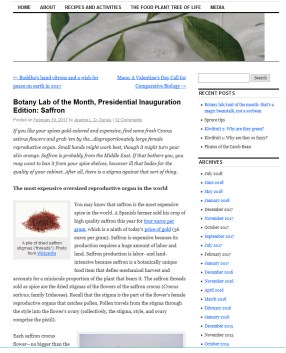
 Are you a gardener, or interested in gardening? How about going deeper and delving into a bit of botany? Do you like to cook? I find great satisfaction in planting a seed, nurturing the crop to harvest, then discovering the tastiest way to prepare the results. Plus, I want to understand the plant I’m eating. That’s why I was so excited to discover a new-to-me blog, The Botanist in the Kitchen. (I’ve added it to my list of links for your convenience.)
I immediately realized that the two authors, PhD biologists Katherine Preston and Jeanne Osnas, are my kind of people. In fact, it was blog-love at first sight.
 How’d you like to be able to see with your eyes closed? Wouldn’t it be handy? You wouldn’t get grit in your eyes during a dust storm. Your eyes would never turn red from swimming in a pool with too much chlorine. And you’d never get poked in the eye. If only we could see through our eyelids!
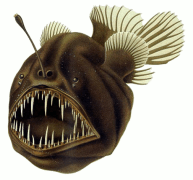 When I think of parasites, I typically think of creatures such as tapeworms, fleas, ticks, and leeches—nasty invertebrates that drain the life out of us humans. Then, I might recall that some higher animals can also be parasites, such as the deep sea anglerfish. You’ve likely seen pictures of anglerfish, with their huge, pointy teeth in a large head, followed by a tapering body. When these fish mate, the male permanently attaches itself to the female and lives off her bloodstream for the rest of his life, his sperm his only contribution. (See National Geographic’s
 I’m really not a fussy eater. While I draw the line at some animal parts (Rocky Mountain oysters, anyone?) and various invertebrates (no deep-fried scorpions in my diet!), I’m not nearly as fussy about dining on plants. Of course, I think some plants taste better than others—I’m a big fan of broccoli, artichokes, and papayas, for example, while I tend to avoid cucumbers and those bitter Italian greens—but for the most part, if it’s prepared well, I’ll eat it.
 How would you like to be stalked, captured, then shaken so hard that your neck breaks—and then impaled onto a spike and left to age like a side of beef before finally being torn apart and eaten? That sounds like material suitable for a Halloween thriller. Yet, that’s your likely fate if you’re a mouse or lizard unlucky enough to catch the eye of a shrike. Shrikes are ferocious predators. It’s a good thing for us that they’re only about as big as an American Robin.
 We humans like to think we’re pretty smart, and for good reason. Look at the amazing ideas people have had, leading to the most incredible inventions. I was reading some articles about the latest technologies, and I admit to being duly impressed.
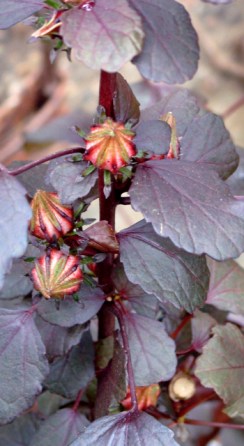
 Ask any 4-year-old what color leaves are, and they’ll confidently proclaim, “Green!” And green leaves are just fine, for the most part. We expect gardens to be basically green, from the verdant lawn to the tops of the trees (at least during the growing season). When it comes to plants, that glowing, chlorophyll-derived green implies life and health.
