Can you name this bird? The photo was taken in Colorado in April. I will post the uncropped photo on Saturday, giving you one more chance to identify this bird. The answer will appear at the end of next Monday’s post.
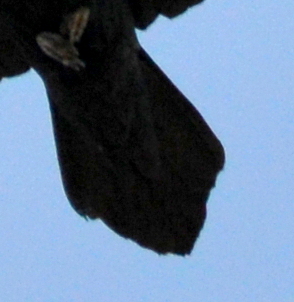

Can you name this bird? The photo was taken in Colorado in April. I will post the uncropped photo on Saturday, giving you one more chance to identify this bird. The answer will appear at the end of next Monday’s post.
 Do you like flowers? Are you passionate about purple? If so, you can’t miss out seeing the newest themed garden at Denver Botanic Gardens. Carved out of previously inaccessible space, this small but packed area is dominated by purple in all its glory. From mauve to plum, through violet to amethyst, every shade of purple is represented by the variety of flowers chosen.
When I asked at the information desk, I was astonished to learn that the plants have only been in the ground since August. You’d never guess. While the shrubs are still small, and obviously new, the annuals and perennials spill over rocks, fences, and one another in a profusion of blossoms.
 I was excited to finally be going to Michigan, my 48th state. While the trip wasn’t exclusively a birding trip—we also had people to see—it was new territory for me. I was sure to get at least one lifer, and hopefully many more. On the other hand, my expectations had been tempered by the less-than-spectacular birding at Magee Marsh a few days earlier. At this point, I just wanted to see birds, any birds.
 Green beans. Orange carrots. Red tomatoes. How normal. How boring. One of the joys of growing your own veggies is that you can have some fun and mix up the colors. Beans come in yellow and purple as well as green. Carrots can be white, yellow, orange, or purple. Tomatoes come in green (such as Green Zebra), purple, orange, yellow, or even sporting saucy stripes. Even fresh corn on the cob (as opposed to the dried stuff) now comes in fun colors. Why settle for growing what you can easily find at the market, when so many other options are waiting?

It was another hot day. Usually by now, the weather has moderated, but we’ve been in the middle of an unseasonable heat wave and I was completely wilted. I was yearning to go birding—my new job had kept me indoors far too much lately—but the only time available was from mid-morning through early afternoon—the hottest time of the day. As much as I wanted to get outside, I had to ask myself, why bother?
Often, I think the birds are smarter than the birders. When the heat gets oppressive, they don’t stand out in the sun with binoculars. No, they adapt. Most migrating birds fly at night, feed in the early morning hours and just before dark, and rest during the heat of the day. Birders know this, which is why most field trips start early. But sometimes, our schedule just doesn’t allow us to do what we know is optimal. We have to take what we can get and make the best of it.
Still, I thought, maybe I could emulate the birds, and manage to both enjoy nature and stay cool at the same time.
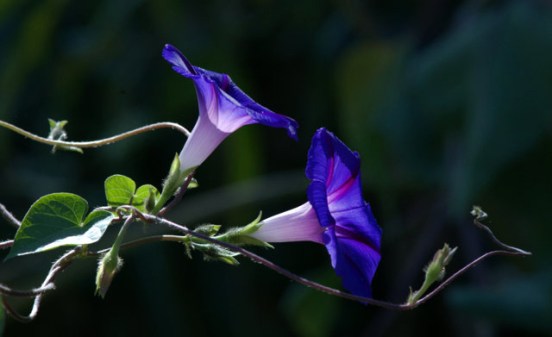
You’re growing morning glories? On purpose? Are you crazy? Those things will take over your garden! Our friends, who live in wet western Washington, were appalled. They couldn’t understand why I’d plant something so invasive.
Yet, I’ve grown morning glories for years, first in California’s benign climate, then here in Colorado. I’ve never found them to be at all invasive. True blue flowers are hard to find. I couldn’t understand why our friends, avid gardeners, wouldn’t want to grow something so lovely.
 The neighborhood where I live seems to be a magnet for door-to-door salespeople selling services. One company in particular has been particularly persistent in their marketing attempts—an exterminator.
The first time they rang the doorbell, I politely but firmly told the guy I did not want my yard sprayed. I consider a diverse arthropod population to be a sign of a healthy landscape. I particularly want insects around to feed the birds I feed. Moreover, I had just planted a pollinator garden, designed to attract bees, butterflies, moths, and other fascinating creatures;. The last thing I wanted was to kill my invited guests.
If you were stymied on Monday, now can you name this bird? The photo was taken in Colorado in April. The answer will appear at the end of next Monday’s post.

 Some gardeners plant the same varieties year after year, depending on past performance to guarantee future success. Why mess with something that works? Others, myself included, like to try the latest cultivars. We’re always searching for that new and improved flower or vegetable that will make this year’s garden the best ever.
When several of my seed catalogs proudly featured a new pole bean, Monte Gusto, I was eager to try it out. How would it compare to my usual choice, Emerite? (Emerite is an awesome bean—long, straight, early, prolific, and delicious!)
Then I discovered that my favorite catalog had discontinued Emerite. How could they? Not wanting to order elsewhere (I’d have to pay shipping for a single seed packet), I ordered Fortex, a variety that has received rave reviews in past years.
Can you name this bird? The photo was taken in Colorado in April. I will post the uncropped photo on Saturday, giving you one more chance to identify this bird. The answer will appear at the end of next Monday’s post.