(Make sure you also see the previous months’ Bird Quizzes!)
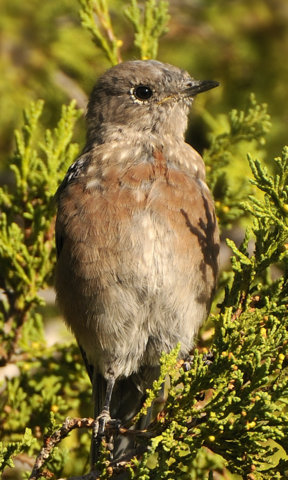
Can you identify this bird? The photo was taken Tucson, Arizona in March. And yes, this is exactly how I saw it! My answer will appear next Monday.
Appearance
Basket of Gold is a long-lived, low maintenance ground cover for small spaces. Gray, slightly fuzzy leaves are present year round, forming clumps 6 to 18 inches tall and 6 to 12 inches wide. In early Spring the plants are totally covered with masses of tiny cross-shaped flowers. Eye-catching colors range from soft yellow ‘Citrina’ or ‘Dudley Neville’ to the blindingly intense golden yellow of ‘Gold Dust.’ A similar species, Mountain Gold (Aurinia montanum) is more compact, with smaller leaves. Mountain Gold is also a bit harder to find at a garden center.
“Have you seen the Rose-throated Becard? It’s at Estero Llano.”
“You still haven’t seen a Pauraque? You’ve got to go to Estero Llano Grande.”
“The birding here is good, but the best birding is at Estero Llano Grande State Park.”
After hearing all the comment, we just had to go check it all out for ourselves.
Estero Llano Grande State Park (which means “large plain estuary”) didn’t exist when I was in Texas five years ago—it was still a sorghum field and dry lake bed. Since habitat takes time to return to its natural state, I wasn’t sure that reality could possibly live up to all the hype. I forget that plants grow faster in south Texas than they do in high, dry Colorado!
Last week we had nine hens. Six were young, prolific layers less than a year old. Three were old biddies past their prime. I’d been meaning to cull the three unproductive hens for a long time, but just couldn’t bring myself to actually follow through. Then I went to the feed store yet again, and realized that we were supporting three hens that were eating one third of my feed bill. That sealed their fate. So earlier this week I humanely dispatched three hens in their sleep and fed the local wildlife. I guess the local wildlife enjoyed the feast, because…
We got home late last night, and I headed out after dark to collect my half-dozen eggs. But instead of six, I found only five eggs—and five chickens. Alarmed, I searched the coop, but I couldn’t really see much in the moonlight. The five hens were perched on their roost, asleep, so I secured the coop and headed for bed.
When we think of non-native birds, the Big Three usually come to mind: Rock Pigeons, European Starlings, and House Sparrows. All three are major nuisances, threatening native species, eating our harvests, and causing millions of dollars in property damage every year. But these aren’t the only aliens among us. In fact, there are nearly one hundred imported bird species that have established breeding populations here in the United States.*

I was thumbing through a gardening supplies catalog, looking at the assortment of “things you can spend your money on that your plants will probably do fine without” when my eye was caught by an offer for “mycorrhizae.” The catalog was extolling the many virtues of this fungal spore mix—it would improve plant health, make the plants more drought resistant, increase yields, protect against diseases, reduce the need for fertilizer, and cure my great-aunt’s bunions, all for $16.95 per pound.
It sounded too good to be true, so naturally I was highly skeptical. (It also sounded pretty expensive until I learned that you apply it by the teaspoon. Phew, not so pricey after all!)
To refresh your memory, here again is the photo for Bird Quiz #2. Read no further if you still want to have a shot at identifying this bird.
I saw this bird in Santa Cruz, California in February. We were standing on the sea wall north of the pier, scanning the ocean for anything interesting. I took the photo through my scope in hopes of getting a better look, then pulled out the field guide.
Butterhead (aka bibb) lettuce, with its smooth, soft leaves and loose heads, is by far my favorite kind. It’s also rather pricey in the stores. I probably plant twice as much butterhead as I do all the other varieties combined.
I’ve been hunting for a butterhead that is big, holds for several weeks at maturity, resists tipburn (a problem with our hot, dry, windy weather), and is tender and flavorful—a pretty tall order. I finally came up with a winner, but let me first tell you about the also-rans.
(Make sure you also saw Bird Quiz #1 last month!)
Can you identify this bird? The photo was taken in Santa Cruz, California in February. This is exactly how I saw it from shore though my binoculars. The lower photo is cropped and enlarged in hopes of showing more detail. Sorry for the poor quality, but this is what I had to work with. My answer will appear next Monday.


If you ordered your seeds from a catalog, chances are those seed packets are beginning to arrive at your house—an entire garden, in one padded envelope! After you’ve opened the package and checked to make sure they included everything you ordered, (or if you’ve bought your seeds at your local garden center), what should you do with those seeds?
I used to just toss the packets into my seed-holding shoebox and hope I would remember to start them at the right time. Now I take a little time to get organized before spring planting really gets underway.