
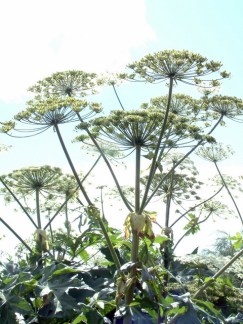
 What do carrots, cilantro, celery, and poison hemlock have in common? Think like a botanist. How do the leaves look? What shape is the root? What about the flowers? Yes, they’re all members of the Apiaceae (aka Umbelliferae) family of plants. So are caraway, anise, parsley, parsnips, and a whole host of other familiar species.
Members of this family are relatively easy to distinguish. The most obvious feature is in the way their flowers are arranged—like an umbrella, with a stalk and a cluster of flowers on stems all springing from a central point.
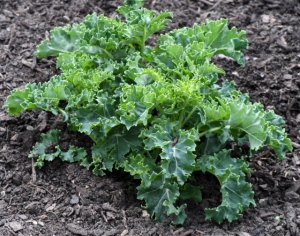 We were gone last fall, so I never got around to pulling out last summer’s freeze-killed veggies. It turns out that was a good thing. With no protection at all, my Starbor kale roots survived our Zone 4 winter, and new growth is appearing from a dead-looking stump. I expect the kale plants to bolt as soon as it warms up a bit more, but in the meantime, I’m harvesting kale now. I plan to include kale in my garden again this year, starting seeds inside and setting out plants in late June to mature in September and October, after frost sweetens the leaves. You can bet I’ll leave those plants in place next fall, maybe with a bit of mulch or a row cover, for yet another early harvest.
 Mountain Plover