
 With giant, trumpet-shaped flowers facing outward around a central stalk, a blooming amaryllis makes an eye-catching houseplant. Colors range from white through pink to red (and even almost black), as well as salmon-orange. Stripes or contracting edges are common. “African” amaryllis have more compact forms suited to indoor cultivation. Dwarf amaryllis are smaller in size but can produce more blooms.
Not surprisingly, these striking, easy-to-grow bulbs are popular holiday gifts; perhaps you received one this year. There’s even a bright red variety named “Merry Christmas”!

 Have you finished your Christmas shopping yet? Christmas is only two days away! Well, if you’re still scratching your head searching for ideas, I have just the thing for that hard-to-shop-for person on your list. And if you are done with your shopping, may I add one more person for you to shop for—someone you don’t know and will probably never meet?
 As we gather to give gifts to one another, it’s only natural for birders to offer special treats for the birds. There are lots of options.
 More expensive, but especially attractive to Pine Siskins, is Nyjer seed. These tiny black seeds (also called thistle) are imported from Africa. You’ll need a special feeder with smaller holes, or a fabric “sock” sold for the purpose. One advantage is that the seed is treated to prevent sprouting—you’ll have no Nyjer weeds to pull in the spring.
 It’s November. Bushes have bare branches, perennials are dead, dried stalks. Except for a few hardy groundcovers and various conifers (pines, junipers, and the like), the landscape is asleep. Except… wait! Are those daffodils in that flower bed? And does that window box really have bright red, white and blue flowers in it at this time of year?
 The sky is bright blue, the sun is shining, the predicted high is well above freezing, and it’s been like that for months. Sounds like perfect weather—but not if you’re a plant. As I look out my window at my dormant garden, I can hear the plants crying for water. Everything is so dry! Desiccating winds have drained the last vestiges of moisture from exposed leaves and branches, and even the so-called evergreens are shriveled.
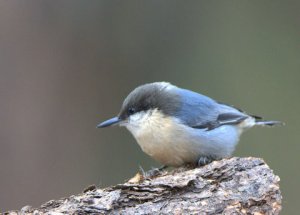 They’re adorable, with their short stumpy tails, tiny bodies and toddler-round tummies. They’re constantly active, hopping from branch to branch. Can you tell? Pygmy Nuthatches are one of my favorite birds! I love to watch them fly down to the feeder to grab a seed, then bolt back into safety before “hacking” (“nut hack” has become “nuthatch”) the sunflower shell open against a branch. Sure seems like a lot of work, especially compared to the finches who just sit there shelling and swallowing seeds as fast as they can.
 Mountain Plover