
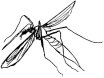
 Last month we learned that the so-called mosquito repellent plants don’t actually keep our yards pest free. Does that mean we have to suffer annoying, itchy welts? Thankfully, there are alternatives. We start by preventing mosquitoes from breeding.
Most of us know that mosquitoes lay their eggs in water. The eggs hatch into aquatic larvae. In as little as three day (depending on the temperature), those larvae become flying adults. The males leave us alone, but the females suck up a gut full of nutrient-rich blood to support egg-laying. And often, that blood comes from us.
 Some moms receive roses for Mother’s Day. Others are given chocolates, dinners out, or photos of their adoring children. While I did enjoy dinner in a restaurant on Mother’s Day, I wasn’t dining with my family. Rather, I spent the day—actually five days over a long weekend—attending the annual Colorado Field Ornithologists (CFO) convention, held this year in Lamar (almost to Kansas and Oklahoma), Colorado.
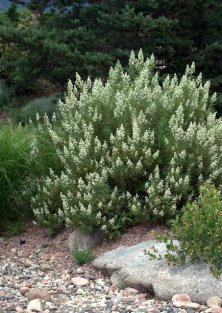 From a distance, a blooming fernbush (Chamaebatiaria millefolium) resembles a lovely white lilac bush, but no lilac would be in bloom at this time of year. Growing to seven feet high and wide, these shapely shrubs are covered in upright sprays of showy white flowers from June through August. Individual blossoms are reminiscent of single roses, and attract bees and butterflies. Come autumn, the flowers are replaced by russet seed heads.
 Brown Pelicans are saltwater birds, sticking to the coasts.
 Most landscapes look terrific in May and June. The leaves are fresh and new. From pink crabapples to purple lilacs, it seems as if everything is in bloom. The contrast with the lifeless browns and grays of winter is enough to send you cavorting across the glowing, emerald green lawn.
 Do carrots really love tomatoes? Do beans and onions hate one another? The internet (and my bookshelf) is full of anecdotal advice about which crops we should plant together, and which ones we should not.
 How do you plant a new tree? Most people know to dig a hole “twice as wide and deep as the root ball” (according to the label I found hanging from the branches), then stick in the tree, making sure the roots are well buried. Amend the backfill with plenty of compost, pile it over the roots and tamp it down firmly. Finally, securely stake the thin trunk so it won’t wiggle in the wind. Right?
 Mountain Plover