
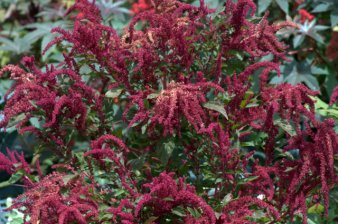
 Valentine’s Day is just around the corner, and what could be more appropriate than a post on a romance-themed flower: Love Lies Bleeding (Amaranthus caudatus). You have to wonder about this name, though. I get this mental picture of a jilted lover and a heartless ex. Which one of them did the stabbing?
Thankfully, the flower we call Love Lies Bleeding isn’t quite so melodramatic. It’s a member of the amaranth family from the Andes of South America, where it is known as kiwicha, and is now grown around the world.

 We all know what roots are—they’re the part of the plant that’s usually underground. If we have a mental image, it’s probably a mass of wiggly, white strings poking their way through the soil. We should pay more attention to roots. After all, they’re an essential part of a plant (as well as the only part remaining after some hail storms!). Knowing a little about how roots work will make us more successful gardeners.
 We interrupt this blog for an exciting, bird-related announcement. It seems incredible that an animal as large as a thrush could go unnoticed until now, but scientists have recently discovered a new species of thrush! It was separated from, and is similar to, the Plain-backed Thrush, shown here courtesy of Wikipedia.
 I was at the market picking out some grapes when a large woman ran up to me and grabbed my arm. “Don’t buy those!” She looked alarmed. “They’re not organic!”
 After weeks of subfreezing weather, Saturday morning dawned with a promise of warm sunshine and blue skies. As the sun rose, we were already on our way, heading out onto the short-grass prairies. Pikes Peak receded into the rear view mirror. Our focus was on the trees and telephone poles along the road. Seven of us had piled into two cars, bristling with binos and telephoto lenses. It was time to photograph raptors!
 January. The start of a new year. The start of a new garden. As I contemplate my empty veggie beds, I feel like a race car driver waiting at the starting line. “Gentlemen (gentlewomen?), start your engines!”

 Mountain Plover