Can you identify this bird? The photo was taken in Texas during the month of January. The answer will appear next week.
 Continue to see the answers from last week’s British birding terms quiz…

Can you identify this bird? The photo was taken in Texas during the month of January. The answer will appear next week.
Continue to see the answers from last week’s British birding terms quiz…

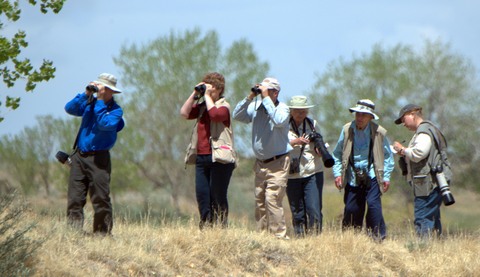 Are you a birder? Do you speak English? I would have answered “yes” to both questions, until I saw some lists of British birding terms. Apparently, I speak American, not English. I’m familiar with “twitcher” as a seriously (some say extremely) competitive birder who keeps a life list (and probably several others as well). And I’ve heard the word “jizz” (which comes from GISS, as in General Impression of Size and Shape) used to describe a way of quickly identifying birds. However, I had no idea what most of these words meant, at least in the context of birdwatching.
Yes, you guessed it. I have a list of a ten British birding terms. How many can you correctly define? I should add, “without using the internet”—no cheating! And before the complaints start pouring in, yes, I’m aware that some of these terms are no longer in general usage, although my sources online didn’t mention which ones are obsolete.
 Japanese Barberry (Berberis thunbergii) is one of those plants that seems to show up in every Colorado landscape. From parking lots to office buildings, highway medians to front yards, it’s everywhere you look. When a shrub is used that much, we tend to become jaded to its finer qualities. But the fact that it thrives everywhere while managing to keep its attractive appearance is exactly why we see it in so many places. I admit to being a bit of a plant snob, ignoring barberry in favor of more glamorous shrubs. It was only as I was scrolling through my photos that I realized just how pretty Japanese barberry is.
 It’s a good thing that barberry keeps to a modest size—plants can grow up to six feet in diameter but usually only reach half that size here in Colorado. Pruning them can be a nightmare, as the arching branches are covered with nasty thorns. Chain mail and gauntlets are required. Leaves are small, as befits a drought-tolerant species, and come in red or green. Rather inconspicuous yellow spring flowers turn into pretty red berries in the fall. As the leaves turn crimson and orange and then fall, the berries take center stage, adding color and interest when most plants are fading away.
 Barberry is one tough plant, a huge problem in the northeast where they’ve become invasive but a feature here in Colorado. They’re hardy in zones 4 through 8, and not fussy about soil or exposure. Cultivars with red leaves are more brilliant in full sun, but the plum red they turn in shade is just as pretty. Water regularly to get them established. After that, it’s all right to cut back a bit, although more water creates lusher growth and more berries. Shrubs will be much more attractive if allowed to develop their natural shape, pruned only to remove old, woody growth branches.
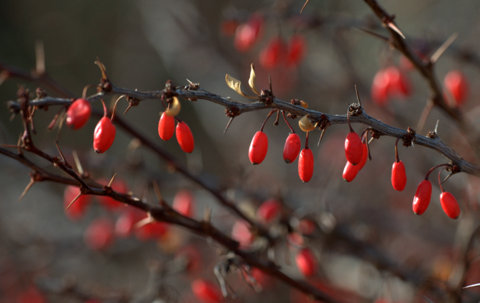 Even the thorns can be a benefit. Deer tend to avoid them while small birds appreciate this well-defended roost, munching on the berries in safety. Planting these shrubs under a window forms a formidable deterrent to would-be burglars.
Barberries are subject to a number of pests and diseases, including scale insects, mites, Japanese weevils, canker, dieback, fungal leaf spots, powdery mildew, root rot, Verticillium wilt, and rusts. However, these are quite rare in our dry climate. Just don’t plant them where Verticillium wilt has been a problem in the past, as it persists in the soil.
Japanese Barberry might be a bit overplanted, but after considering its many assets it’s easy to see why.
 As temperatures dipped into the negative numbers last week, I started wondering—how do wild birds, some no bigger than my fist, manage to stay warm in such frigid conditions? Of course, some bird avoid the problem by migrating, but plenty of birds winter right here in Colorado. I already knew that birds eat more when the weather is cold; my need to constantly refill the bird feeder is proof enough. The suet feeder, with all that high-calorie fat, empties even faster. But could a higher metabolism be enough to carry such seemingly fragile puffballs through a Colorado winter? I decided to find out.
 I know we live in Colorado, but it feels more like the arctic outside! As I write this, my thermometer is hovering around 2°F—and it’s been there all day! I’m glad I have a nice warm house to bundle up in, but my plants aren’t so privileged. Aside from the potted herbs that I hastily dragged indoors, my shrubs and flowers are stuck where they grow. I have a hunch they’re not all going to make it.
To make matters worse, this fall has been mild, at least until now. With highs in the 60s and even 70s and lows barely below freezing, many of my perennials still had green foliage. It takes gradually cooling temperatures for plants to properly harden for winter. These poor victims never saw it coming!
To refresh your memory, here is the photo from November’s Bird Quiz. It was taken in Colorado during the month of January. Don’t read any further if you want one last chance to identify this bird.
 Imagine that it’s wintertime. Anything verdant and green has long turned to brown. Limbs lie leafless. A few berries may yet hang on the shrubs. We’re already eager for spring, but the growing season is still months away. Wouldn’t this be the perfect time to enjoy bright red tulips, or the sweet aroma of blooming narcissus? If you want to enjoy these and other mid-winter flowers, now is the time to start forcing bulbs.
Pretty much any spring bulb can be forced. All we have to do is fool them into thinking that spring has arrived—in the middle of January. To do that, we have to plan ahead—up to 15 weeks ahead.
Can you identify this bird? The photo was taken in Colorado during the month of January. The answer will appear next week.

 One of my favorite plays is Little Shop of Horrors. It’s about a flower shop that inadvertently acquires a plant that murders people. It’s the perfect Halloween movie. Our kids were involved in their high school production; I can still see Audrey II licking her bloody lips!
Are there really plants like Audrey that need blood to survive? Well, perhaps not blood, exactly, but there are plenty of carnivorous plant species—and who knows what they do when we’re not looking?
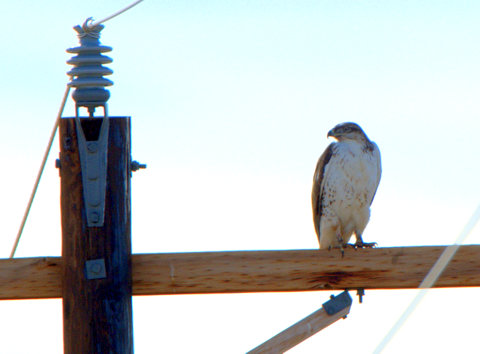
 Mountain Plover