Carrots All Winter

Now that the winter’s first hard freezes have arrived, fresh homegrown produce is in short supply. The season my be over for frost-tender summer squash, vine-ripened tomatoes, peppers and eggplant, but with some preparation, you can enjoy at least one crop that can be harvested from mid-summer through fall and winter, until the days start to warm again. There’s nothing like going out to the garden in December, brushing off some snow, carefully digging into the cold soil, and pulling up some crisp, bright orange carrots!

(more…)

Invasion of the Yellowjackets

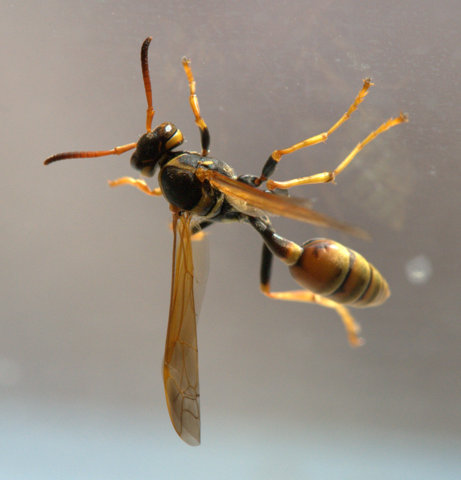
I’m sitting quietly at my desk as an unidentified insect makes an orbit around my head, buzzing aggressively. What in the…? It changes direction, aiming directly for my eyes. I want to flail at the bug, but realize that may not be a good idea, so I jump out of my chair and out of the way. Buzzzzzzz…. It finally lands on the wall and I get a good look. Yikes! It’s a yellowjacket!

Moments later, there are two wasps circling my screen, then three, and four. It seems that every yellowjacket in the neighborhood has somehow found a passage into my house, and they’re ganging up on me.

(more…)

Rare Bird? Read This!

I make it a point to generate my own material for this blog. I research and write the articles, I take most of the photos. However, once in a while I come across another blogger’s post that is so well done, and so helpful, that it makes no sense for me to try and do better.

In this case, Greg Gillson has written a post called How NOT to report a rare bird. This caught my attention because I have, in fact, had occasion to report a rare bird (although not as often as I could wish!) and I really had no idea what I was doing.

Please click on over to Birding is Fun and read Greg’s article. He is concise, informative, and entertaining.

Beyond Fall Foliage

Want to add autumn interest to your garden? Frost has arrived and flowers are finishing their season, but we don’t have to settle for a boring landscape. Even in Colorado, it’s possible to create a garden that is beautiful all year.

Colorful foliage is everywhere this time of year, but there’s more to fall than just leaves, no matter how spectacular they might be. Look for bright berries, persistent seedheads, and even colorful or thorny bark and branches.

(more…)

New Birds: A Proposal

Last August I posted my suggestion that we add inanimate objects to our life lists. For some reason, my idea didn’t meet with the enthusiasm I had hoped for. Still, I think it has merit. Birders love to catalog things, and think of all the different kinds of beer cans, water bottles, plastic bags, and similar items we can enjoy identifying and collecting.

In any case, I’m not giving up. Perhaps we balk at trash and rocks, but how about other living objects we might mistakenly perceive as birds? Surely we can consider such additions as…

(more…)

Virginia Creeper

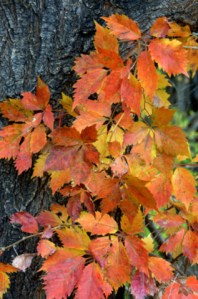
parthenocissus-quinquefolia_virginia-creeper_fcnc-co_lah_3565When we think of fall color, we usually think of trees—ash trees are bright yellow, aspen is gold, and oaks and maples are turning crimson. Or we might notice the incredible purple-orange-scarlet leaves on aptly named Burning Bush (Euonymus alata).  Not many people expect impressive fall color from a vine.
Virginia Creeper (Parthenocissus quinquefolia) is an import from the northeastern U.S., and grows well in Colorado; it’s hardy to zone 3. Three to seven-inch leaflets in sets of five turn a gorgeous red-orange in September and October, creating a pleasing backdrop for the small blue berries scattered throughout.

(more…)

Spinach

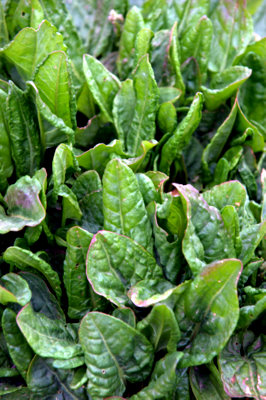
spinach_dbg_20100417_lah_2909True confessions… I am allergic to spinach. Very sad, I know. So, I don’t grow it. Everything I’m about to tell you about spinach cultivation I learned from such wise gardeners as David Whiting, Colorado State University professor and State Coordinator for the Colorado Master Gardener Program, and Diane E. Bilderback, one of my favorite garden writers (and, along with Dorothy Hinshaw Patent, author of my favorite veggie gardening book, Garden Secrets).

The first tricky thing about spinach is when to plant it. Being extremely day-length sensitive, it is sure to bolt when it receives 14 or more hour of daylight per day. You can squeeze in a crop as soon as the weather is warm enough (and thankfully, spinach is relatively hardy), or wait until days are getting shorter again and plant for a fall harvest.

(more…)