How to Grow a Houseplant: Containers & Repotting

pots-for-sale-santafegreenhouses-20089jun28-lah-132Note: This is Part 3 of a three-part series on How to Grow a Houseplant. Part 1 covered light & temperature requirements, Part 2 was about feeding and watering.

Containers
A bird has a cage and a gecko has a terrarium. Plants need a special places to live too.

You have a lot of latitude in choosing a container for your plant. Consider not only made-for-plants pots, but other bowls, cans, and even shoes. However, there are a few requisites. Drainage is paramount. If your chosen pot doesn’t have a drain hole, add one.

(more…)

Christmas is for Counting Birds

2008dec20-cbc-392rThis Saturday I’m heading out on Audubon’s annual Christmas Bird Count (CBC). I’ll be joining tens of thousands of other birders around the world in a tradition that is in its 110th year.

December isn’t exactly the best time to be outside birding. A few years ago, our group experienced blizzard conditions and a toasty high of six degrees F. (Amazingly, we saw over 200 American Robins in our count area that year! I kept expecting penguins.) Other years have been somewhat milder, but December in Colorado Springs is never for sissies. Why do we bundle into multiple layers of clothing and get up in the dark to spend most of the day outside counting birds?

The holiday season is also incredibly busy. Shopping, decorating, baking, parties—who has time to tally birds? Why use up a precious Saturday right before Christmas in order to take a bird census?

(more…)

What to Give a Gardener

tool-bucket-carnegielib-16apr07-lah-982Last time I wrote about what to give a birder for Christmas (or any time, for that matter). This time I’m focusing on gifts that will delight the gardener on your list.

Again, I’m not going to pick out the latest in gardening accouterments. Unlike birdwatching, gardening does require a pile of tools, seeds, gloves, compost, and the like, but there are already long lists of “perfect gardening gifts” in magazines and on websites.  Instead of finding places for you to spend your money, I’m suggesting ways you can give the gift of time.

(more…)

What to Give a Birder

dscf0371This is not another list of what to buy your favorite birder for Christmas. There are plenty of lists like that already; every birding magazine and website seems to have one. Most suggestions seem more helpful to the makers of the products featured than they are to the gift giver… or the recipient.

See, the problem is that birding doesn’t really require a lot of stuff. Sure, you spend your wad on good optics, and you need a field guide or two. But one of benefits of birdwatching is that you don’t need a lot of gear. Once you’re set, you can get on about the business of watching birds, which is really the point. Birders do not collect birds—they collect sightings of birds.

Not to miss an opportunity, many manufacturers have come up with “birding accessories”—things like special tote bags for your book and binos, many-pocketed vests, volumes on where to go birding, and journals with bird drawings on the cover. I’m sure all those are useful, but they’re certainly not regarded as must-haves. An old fanny pack, internet access, and a 99¢ notepad work just as well.

Instead of telling you what to buy for your gift list birder, I’m going to make a suggestion for a gift you can’t buy. No one ever said that gifts have to cost a lot of money.

(more…)

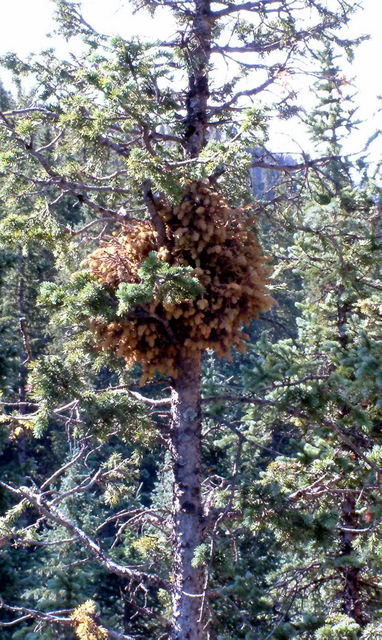
Dwarf Mistletoe is not for kissing

Sparse foliage and a witches' broom indicate a mistletoe infection.
Sparse foliage and a witches’ broom indicate a mistletoe infection.

Mistletoe is a holiday tradition. We decorate our doorways with it, where tarrying under a spring might bring you a kiss. Unfortunately, the kind of mistletoe growing along Colorado’s Front Range isn’t so romantic. Five different species of dwarf mistletoe infest pines, spruces and firs. Given enough time, an infected tree will eventually die.

All mistletoes are flowering plants that have given up a life of self-sufficiency to become harmful parasites. Dwarf mistletoes lack leaves, so they have little ability to make their own food from sunlight. Instead of extending their roots into the soil, they have root-like structures that penetrate under the bark, where they siphon off both water and nutrients from the host tree.

The female mistletoe plant produces sticky seeds. When the seed capsules are ripe, usually in late summer, they explode, expelling their contents at speeds up to 60 mph! The seeds can travel up to 60 feet, although 30 feet is more common. Wherever the seeds hit, there they stick.

(more…)

Living Christmas Trees

Photo: Judy Sedbrook, CSU Extension

With the surge in environmentalism, many people are trying to decide which is “greener,” a real Christmas tree or an artificial one. Both have their pros and cons. There is, however, a third alternative. You can decorate a still-living tree this year.

Most nurseries and garden centers sell potted Christmas trees. You bring them indoors for a brief spell (a week at most) during the holidays, then plant them permanently in the ground.

Still-living trees cost more. No one wants to pay a premium for a tree that still has roots, only to have it die after moving it outside. While planting a Christmas tree isn’t difficult, you should do the same research and preparation that you would do when choosing any tree for your yard.

First of all, make sure you have the right tree for the right place. Consider how the tree will fit into your overall landscape plan. Most evergreen trees get very large. That cute three-foot fir may have a mature height of 70 feet or more! Instead of trying to cram a giant into a small suburban yard, choose a dwarf specimen instead—or arrange to plant it elsewhere so it will have room to grow.

(more…)

Talking Turkey

turkey-gleneyrie-lahThere are turkeys, and then there are turkeys. One dictionary’s definitions include:

“A person considered inept or undesirable,” and “A failure, especially a failed theatrical production or movie.”Then there’s “talking turkey,” “cold turkey,” and “turkey trot.” Of course, as birders, we think of turkeys as yet another species to be found while out birding. But even this avian sort of turkey comes in two varieties. The birds we commonly consume at Thanksgiving have little in common with their noble ancestors.

Wild Turkeys are well adapted to life in North America. They have plumage that blends perfectly with the oranges and browns of autumn leaves. This makes them hard to spot as they forage for seeds and grubs in the underbrush. Additionally, their hearing and eyesight are both very sharp, alerting flocks to potential predators—and birders. Finally, if you do manage to spot a turkey, don’t scare it. When alarmed, they can flee at 25 mph, leaving us in the dust.

(more…)

Western Conifer Seed Bugs

coniferseedbug_home_20091004_lah_3025

You may have noticed some strange invaders in your house this fall, particularly if you have pine trees in your area. Don’t be alarmed, and don’t grab the bug spray. They look ferocious, but these insects won’t hurt anything.

Western Conifer Seed Bugs are about an inch long. Their black and red color scheme helps them hide in pine cones where they feed on the seeds, hence their name. They have long antennae. When folded, their wings create an “x” shape across their backs. Look closely at their hindmost legs, and you will notice the flat appendages, much like mud flaps, that give this group of insects its name: leaf-footed bugs.

In late summer, these bugs collect on the warm, southern side of your house. When the sun sets, they burrow into cracks and crevices for safety, often ending up inside the house. If they bother you, just scoop them up and put them outside where they belong.

Sprouting a Harvest

sprouts_lah_5506pThe snowflakes are flying, but you can still have fresh crunchy greens for your salad and sandwiches. How? Homegrown sprouts are easy to produce right there on your kitchen counter.

Alfalfa sprouts have been popular for decades, and are a good place to start, but there are many other options. Clover sprouts are delicious, reminding you of spring. Mung bean and lentil sprouts may be eaten raw or added to stir-frys. Broccoli and radish seeds have a decided zing to them, while onions will wake up your taste buds. Among the grains, wheat berries and rye are your best choices.
(more…)

The Clover and the Plover

clover

This is taken from a wonderful little book entitled How to Tell the Birds from the Flowers: A Manual of Flornithology for Beginners, by Robert Williams Wood. I’d urge everyone to get a copy, but it was originally published in 1907, and has long been out of print.

Happily, Google has digitized the entire book, so you can read it online. I hope everyone will take the time to do this!