
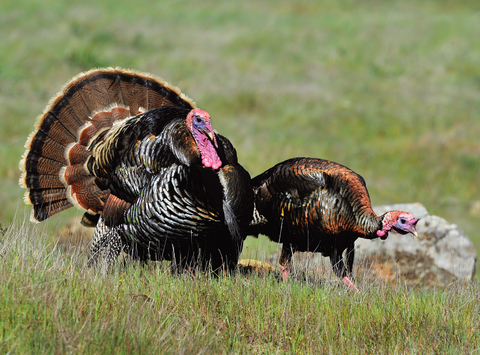
 Since most of us will become intimately acquainted with a turkey today, I thought you might enjoy some fascinating facts about Wild Turkeys.
Category: Bird Profiles
Species descriptions
Weavers
 Weavers! I was sure that the hanging nests of carefully woven grass belonged to some sort of weaver bird. After all, I’d seen such things in National Geographic. Now, here I was in southern Africa and the Jacaranda tree in front of me was decorated with dozens of these nests! Bluebird-sized birds fluttered around, and if I squinted, I could see them entering and leaving these cocoons through holes at the bottom.
As I mentioned last month, I recently returned from a trip to Swaziland. Fifteen people from my church were there to love on some AIDS orphans, and I was the team photographer. While my focus was on the kids, I couldn’t help but scan my surroundings for birds. After all—how often was I going to get to Africa?
Annual Sunflowers
 Sunflowers may resemble a huge yellow sun towering overhead, but their name comes from their ability to keep their “face” turned toward the sun. Everyone recognizes a conventional sunflower with its huge dark disk surrounded by yellow petals, set atop a sturdy stalk that may reach over eight feet in height. A quick tour of a seed catalog shows that this is just the beginning. Breeders have developed shorter plants (as low as two feet) and an expanded palette of hues ranging from mahogany through orange to lemon yellow, white, and even soft rose to wine-red. Many types sport more than one color.
It’s a Bird, It’s a Plane, It’s a Beer Bottle?
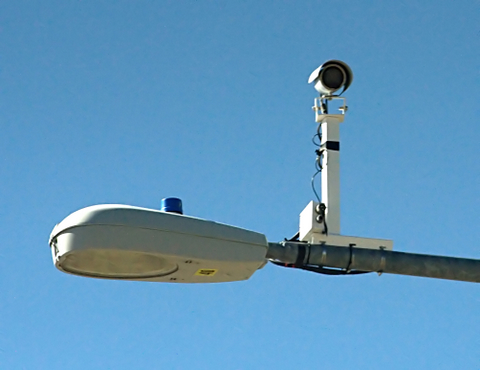 “Look! A Prairie Falcon!”
Eva was jumping up and down, pointing at a medium-sized light blob on a near-by lightpost.
“Wow, what a great bird to start our day!” she enthused. We had just met up to go birding, and hadn’t even left the parking lot yet. I grabbed my binos and squinted harder at the blob.
Flammulated Owls, Part 2
(Be sure to see Part 1, posted last week.)
 I was still smiling happily at the thought of having finally seen a Flammulated Owl—a new life bird for several of us that evening. Because the females spend every hour of daylight inside the nest with their young, you can only see them at night—flying around catching moths in the dark. Meanwhile, the males spend their days in a tall pine growing on top of a (usually inaccessible) ridge, roosting right up against the trunk on a high branch. As they sit motionless for hour after hour, they are nearly impossible to spot; their feathers are a perfect match for the reddish-brown Ponderosa bark.
If Brian hadn’t graciously allowed us to accompany him, it’s unlikely I ever would have checked this species off my life list.
Flammulated Owls, Part 1
 I’ve mentioned in the past how bad I am at spotting owls. (That might have something to do with my typical 8:30 pm bedtime.) Well, a couple of weeks ago a birding friend called, asking if I wanted to join her and some others for an evening with Colorado College researcher Brian Linkhart, who has been studying Flammulated Owls for the past 30 years. We’d be traipsing through the Manitou Experimental Forest (west of Colorado Springs) in the dark, accompanying Brian and his student researchers as they netted and banded the tiny owls.
Of course I said yes!
Valentine Finches
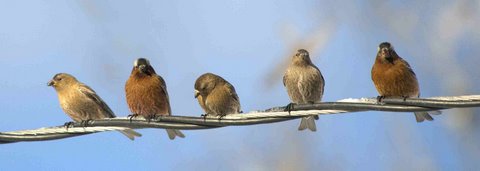
In honor of Valentine’s Day and all things pink, today’s post features Rosy-finches.
There are currently three species of Rosy-finch. The most widespread are Gray-crowned Rosy-finches (2nd and 5th in photo above), which winter in the inter-mountain west and breed throughout interior British Columbia, Alaska and the Yukon.
Next are Black Rosy-finches, which have a more restricted range, being found throughout the central Rockies from southern Montana to northern New Mexico, and east into Idaho and Nevada.
Then there are the Brown-capped Rosy-finches (Nos. 1, 3, and 4 above, and all 3 birds below), which are only found from southern Wyoming though Colorado to northern New Mexico.
I’m Thankful For…

I am thankful for… (more…)
Camp Robbers
 We had been camping at Turquoise Lake, near Leadville, Colorado, high in the Rockies. As it was lunchtime, we spread out a tablecloth, set out a bowl of chicken salad (with chicken, grapes, celery, and pecans), and went to find the plates and forks. But as I returned to set the table, the salad seemed to be missing something… the pecans were gone! Seems we’d been victims of the camp robber!
“Camp Robber” is an apt nickname for the Gray Jay. Familiar residents of campgrounds throughout the coniferous forests across Canada and southward along the Rockies, these small jays aren’t the least bit shy. The birds have a tendency to not only accept handouts, but to brazenly help themselves to anything on your plate that looks edible.
Blue Jays
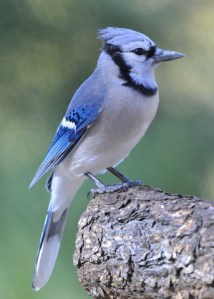 Honk, honk! When I first heard them, I thought I was hearing bicycle horns. A brand new birder, I was checking out Denver’s Cherry Creek State Park, and there were certainly bicyclists out enjoying the brilliant fall day. I wondered why they were honking so much, since they had their own bike paths, and there really wasn’t anyone to honk at.
A couple of weeks later, I heard the honking again. This time I was strolling around Fountain Creek Nature Center, south of Colorado Springs. No one else was around, and besides, cyclists aren’t permitted in the nature area. Now I was really confused.
 Mountain Plover