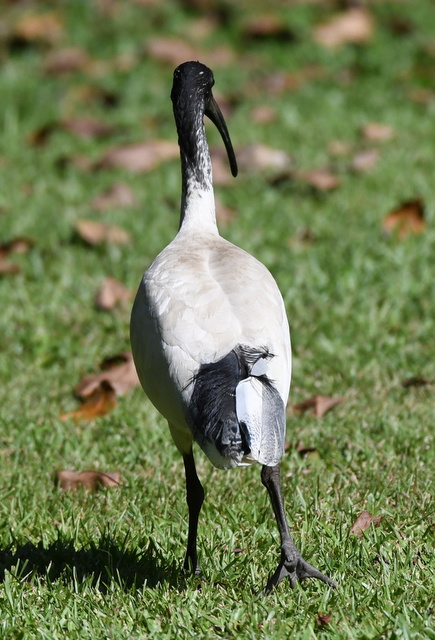
You can’t go to Australia and skip the beach. It would be unthinkable! That’s why, after spending a wonderful week in the Blue Mountains, we decided to drive north along the coast to Brisbane. Determined to allow plenty of time for birds and beach stops, we allocated three whole days. We could easily have spent a lot longer.
Category: Vertebrates
Carpool Etiquette
 The president of our local Audubon chapter, Risë Foster-Bruder, wrote a little article on carpool etiquette for our chapter newsletter. That started both of us thinking about all the aggravations that are associated with carpooling, as well as some helpful hints. I added them to what Risë wrote. The result this post.
Most birding clubs center around field trips. And, being the conservation-minded folks that we are, we meet somewhere to carpool. Why drive four vehicles when you can crowd into one? Besides, having too many cars frightens the birds. (more…)
January Bird Quiz: Uncropped Photo
If you were stymied on Monday, now can you name this bird? The photo was taken in Colorado in December. The answer will appear at the end of next Monday’s post.

January Bird Quiz
I’ve been posting my little bird quizzes for several years now, and it’s time for a change. This year, instead of showing you a bird and asking you to identify it, I’m going to show you part of a bird and ask you to identify it.
Aren’t I nice?
I’m just trying to be realistic. How often do you get to see an entire bird? Too many times the bird is hiding in the bushes, or on the wrong side of the tree, and all we get is a glimpse. This way, you’ll get practice in the practical challenges of birdwatching. See, I’m being helpful.
Here’s an example—can you name this bird?

Pursuing a Purple Sandpiper

Gelett Burgess may have avoided purple cows*, but a Purple Sandpiper is a different matter. During the last week of 2016, I was one of hundreds of birders who flocked to Dillon Reservoir, in the Colorado Rockies, for a glimpse of this misplaced bird. For a species that winters along the Atlantic coast and summers in far northern Canada and Greenland, an individual spending the holidays in Colorado was a bit out of the ordinary. Perhaps it was fooled by the unseasonable weather we had a month or so ago—or perhaps it simply got lost.
Parting Shots
As the year quickly passes into history, I traditionally post some “parting shots.” This year’s photos were all taken on our trip to Australia this fall. I hope they bring a smile as we finish 2016.
(You can see previous years’ pictures by typing “parting shots” into the search box in the upper right hand column.)
Merry Christmas
Here’s a cheerful Australian King Parrot all decked out in his holiday-colored plumage, coming to wish you a very Merry Christmas. May your season be blessed.

A Down Under Carol


We’re all familiar with French hens, turtledoves, and partridges in pear trees, but do you associate Christmas with bellbirds, friarbirds, and currawongs? You might, if you live in Australia!
Having just visited this amazing continent (and we barely got a taste in three weeks!), I am delighted to share this distinctly Aussie Christmas carol with you. It was written by William Garnet James and John Wheeler, is sung by Bucko & Champs, and was posted to YouTube by Shirley Wookie.
Carol of the Birds
Make sure your sound is on. I’m afraid the quality is rather poor, so don’t make the screen too big. And for the record, “orana” means welcome in an Aboriginal tongue.
_____
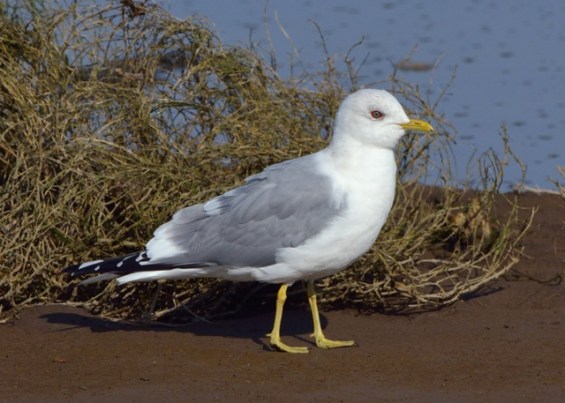
At top: Currawong (Faulconbridge, NSW, left), and Helmeted Friarbird (Daintree, QLD).
Cold Brrrrrds! (a rerun)
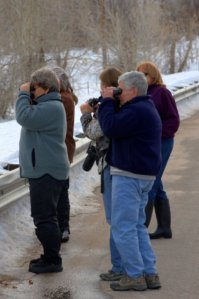 Here it is noon on Saturday, and it’s currently -5 outside. Everyone is talking about the weather—especially because yesterday the temperature soared to 60 degrees. The entire country is shivering. Adding to the discussion is the fact that today is our local Christmas Bird Count. Hardy birders are out counting even hardier birds. Brrrr!
While the frigid conditions outside seem unusual for our area, an arctic cold front isn’t actually all that rare. Please go back to 2013 and see what I had to say then about Cold Brrrrrds! I think it is appropriate for today as well.
December Quiz: Answer
To refresh your memory, here is the photo from December’s Bird Quiz. The bird was seen in Washington during the month of March. Don’t read any further if you want one last chance to identify this bird.