Mistletoe

Dwarf mistletoe on Ponderosa

“You don’t want to buy that lot—the trees have mistletoe!” Our realtor pointed at a shrubby mass growing among the branches high in the Ponderosa pine.

It didn’t look anything like the mistletoe I was familiar with, coming from California. There, the live oaks often support huge masses of mistletoe. And neither plant resembled the old plastic “mistletoe sprig” I inherited from my parents, that we hung in our doorway at Christmastime to encourage kissing. Curious, I did some research. It turns out that there are hundreds, if not thousands of barely-related species of parasitic plants called mistletoe.

(more…)

Why Colorado Loves Japanese Barberry

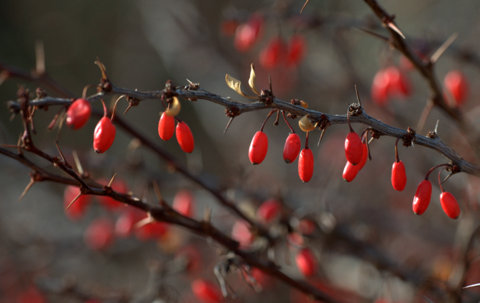
Berberis thungergii_Japanese Barberry_DBG_LAH_6490Japanese Barberry (Berberis thunbergii) is one of those plants that seems to show up in every Colorado landscape. From parking lots to office buildings, highway medians to front yards, it’s everywhere you look. When a shrub is used that much, we tend to become jaded to its finer qualities. But the fact that it thrives everywhere while managing to keep its attractive appearance is exactly why we see it in so many places. I admit to being a bit of a plant snob, ignoring barberry in favor of more glamorous shrubs. It was only as I was scrolling through my photos that I realized just how pretty Japanese barberry is.

Berberis thunbergii atropurpurea_Red Leaf Japanese Barberry_DBG_LAH_0620It’s a good thing that barberry keeps to a modest size—plants can grow up to six feet in diameter but usually only reach half that size here in Colorado. Pruning them can be a nightmare, as the arching branches are covered with nasty thorns. Chain mail and gauntlets are required. Leaves are small, as befits a drought-tolerant species, and come in red or green. Rather inconspicuous yellow spring flowers turn into pretty red berries in the fall. As the leaves turn crimson and orange and then fall, the berries take center stage, adding color and interest when most plants are fading away.
Berberis thunbergii - Japanese Barberry_DBG_10200118_LAH_7051.nefBarberry is one tough plant, a huge problem in the northeast where they’ve become invasive but a feature here in Colorado. They’re hardy in zones 4 through 8, and not fussy about soil or exposure. Cultivars with red leaves are more brilliant in full sun, but the plum red they turn in shade is just as pretty. Water regularly to get them established. After that, it’s all right to cut back a bit, although more water creates lusher growth and more berries. Shrubs will be much more attractive if allowed to develop their natural shape, pruned only to remove old, woody growth branches.

Berberis thunbergii - Japanese Barberry_DBG_10200118_LAH_7048Even the thorns can be a benefit. Deer tend to avoid them while small birds appreciate this well-defended roost, munching on the berries in safety. Planting these shrubs under a window forms a formidable deterrent to would-be burglars.

Barberries are subject to a number of pests and diseases, including scale insects, mites, Japanese weevils, canker, dieback, fungal leaf spots, powdery mildew, root rot, Verticillium wilt, and rusts. However, these are quite rare in our dry climate. Just don’t plant them where Verticillium wilt has been a problem in the past, as it persists in the soil.

Japanese Barberry might be a bit overplanted, but after considering its many assets it’s easy to see why.

Frozen

2014-11-12 16.09.46I know we live in Colorado, but it feels more like the arctic outside! As I write this, my thermometer is hovering around 2°F—and it’s been there all day! I’m glad I have a nice warm house to bundle up in, but my plants aren’t so privileged. Aside from the potted herbs that I hastily dragged indoors, my shrubs and flowers are stuck where they grow. I have a hunch they’re not all going to make it.

To make matters worse, this fall has been mild, at least until now. With highs in the 60s and even 70s and lows barely below freezing, many of my perennials still had green foliage. It takes gradually cooling temperatures for plants to properly harden for winter. These poor victims never saw it coming!

(more…)

Act Now for Mid-winter Flowers

Crocus_XG-CO_LAH_6312Imagine that it’s wintertime. Anything verdant and green has long turned to brown. Limbs lie leafless. A few berries may yet hang on the shrubs. We’re already eager for spring, but the growing season is still months away. Wouldn’t this be the perfect time to enjoy bright red tulips, or the sweet aroma of blooming narcissus? If you want to enjoy these and other mid-winter flowers, now is the time to start forcing bulbs.

Pretty much any spring bulb can be forced. All we have to do is fool them into thinking that spring has arrived—in the middle of January. To do that, we have to plan ahead—up to 15 weeks ahead.

(more…)

Blood-thirsty Plants

Audrey LSOHOne of my favorite plays is Little Shop of Horrors. It’s about a flower shop that inadvertently acquires a plant that murders people. It’s the perfect Halloween movie. Our kids were involved in their high school production; I can still see Audrey II licking her bloody lips!

Are there really plants like Audrey that need blood to survive? Well, perhaps not blood, exactly, but there are plenty of carnivorous plant species—and who knows what they do when we’re not looking?

(more…)

Quiz: Garden Jargon

Garden Bed?
A Garden Bed?

How well do you know your gardening terms? As with most groups of people with a specific hobby or occupation, those who garden have a specialized vocabulary—our garden jargon. We often use words that other people might not understand—or will they?

I have an interesting little quiz for you today. I’ve taken a series of gardening terms that have other meanings not related to gardening. For example, a bed can be a place we sleep—or a landscaped area, often filled with flowers.

I’ve picked ten such words plus an extra-tricky bonus word. They have a “normal” meaning, and also a specific, garden-related definition. I’ve given you the definitions that don’t pertain to plants. Can you come up with the garden-related word? Extra points if you know what it means in a garden context. The answers will appear Monday at the end of the article.

(more…)

Fabulous Fall Grasses

What do we plant for fall color? Most of us would quickly list off maples and crabapples, or perhaps a burning bush (aka winged euonymus). But what about grasses? Some ornamental grasses have impressive fall foliage, and it lasts all winter.

Ornamental grasses are everywhere. What was once a fairly obscure group of landscape plants have emerged into the spotlight, and their popularity shows no sign of fading. That’s not surprising, considering how much they have going for them—flowing leaves, towering seed heads, a fountain shape unlike that of shrubs or perennials that adds contrast and texture to the garden.

(more…)

Presenting Autumn, Starring Rabbitbrush!

Chrysothamnus nauseosus_Rabbitbrush_Cylindropuntia_Cholla_ChicoBasinRanch-CO_LAH_2989-001With intense sulfur-yellow flowers covering its gray-green foliage, blooming Rabbitbrush demands to be noticed. In fact, the prairies of eastern Colorado are almost blanketed with it—something we never notice until it blooms. Interspersed with prickly cholla cactus and some perennial range grasses, it forms the essence of western landscapes. But it’s not just for the wide open spaces. Rabbitbrush is an excellent performer in the garden as well.

(more…)

A Plant by Any Other Name…

Blue Columbine - Aquilegia caeruleaHow do you pronounce Gomphocarpus physocarpus? What is it? And how can we ever remember how to spell it? What’s Aquilegia caerulea? You might know it as Colorado’s native Blue Columbine (right). Or how about Symphyotrichum novae-angliae? Isn’t it simpler just to say New England Aster? Scientific names are enough to drive gardeners crazy, so why in the world do we need to bother with them?

Scientific names, also called Latin names, can be annoying, but they serve a valuable purpose. We owe a huge thank you to Carl von Linné, the Swedish biologist who, back in the 1700s, invented what we now call binomial nomenclature. He also had the bright idea to use Latin, or at least to Latinize the words from another language, in order to avoid giving preference to any nationality. Scientists all around the world use the same Latin name to designate a particular species.

(more…)

Two Pestos You’ll Love

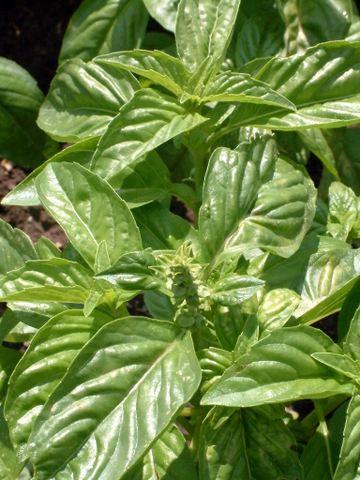
Basil @DBG LAH 175Summer is ending. For the past month, my potted basil plants have been doing their best to flower. I know that if I let them go to seed, they would die, so I’ve been pinching off the buds. However, now our nights are dipping into the 40s—too cold for these tropical annuals. Even if they don’t freeze, the chill turns the leaves black—not very appetizing. I’ve hauled the plants inside, but I can’t postpone the inevitable. It’s time to make pesto.

There’s no aroma quite like that of freshly made pesto, and that’s exactly what my kitchen smells like right now. I have two favorite pesto recipes, and I’d like to share them with you so your kitchen can smell this amazing too.

(more…)