
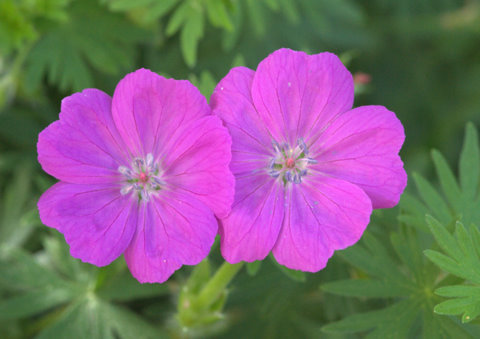
 We’re all familiar with the iconic red geranium in a window box or flowerpot. While they live on indefinitely in warmer climates, a hard freeze turns the succulent stems into mush. However, there is a whole group of other geraniums that are completely hardy here in Colorado. Not only are they perennials, they’re also well-behaved, drought tolerant, have neat, attractive, compact foliage, and beautiful flowers. Interested?
Category: Plant Profiles
All about specific plants.
Hardy Ice Plant
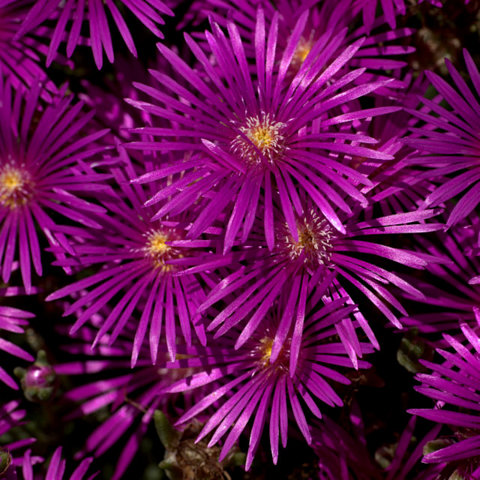 Covering the ground with a solid mass of eye-searing fuchsia-purple flowers, Hardy Ice Plant (Delosperma cooperi) demands a second look. The succulent green leaves glimmer in the sun, giving the plant its common name, while the flowers have glistening thin petals surrounding a yellow center.
Waves of bloom carpet the foliage from late spring until late summer. The show even continues in winter, when plants turn a deep burgundy-red. Other species of Delosperma, with yellow or salmon-pink flowers, are also now available. Some have earned PlantSelect® honors.
Plant Some Spring Sunshine
 Just when you don’t think you can stand another minute of bare branches or dead, brown-gray foliage, spring heralds its arrival in a burst of dazzling yellow. All over town, forsythias reassure us that the growing season really is at hand.
Originally from eastern Asia, where they have been cultivated for centuries, forsythias were collected for western gardens in the early 1800s. Most current garden varieties are hybrids of two species, Forsythia suspensa and F. viridissima. The problem is that the resulting cultivars aren’t reliably hardy in much of Colorado.
My Favorite Plant for Colorado Gardens
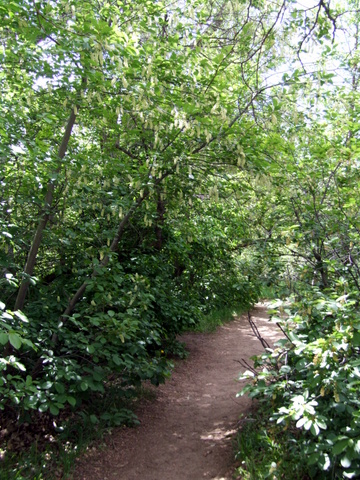 If I could create one perfect plant for the Pikes Peak region, what would it be like?
Of course, I’d want it to be attractive. It should adorn itself with cheerful spring flowers, good-looking foliage, and intense fall color. I’d add persistent fruit or berries to feed the birds and provide winter interest.
My perfect plant should be easy to grow; I’d want it to thrive in our native soils with little or no supplemental water. It must be hardy to at least 8,000 feet, and still handle summer heat waves.
Beyond Roses
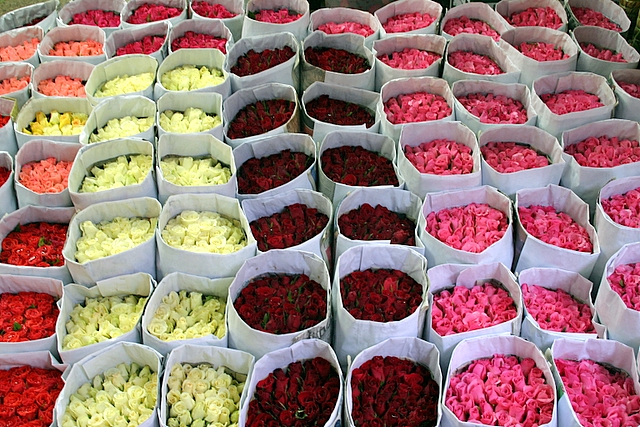 Heading to the store to buy a dozen red roses for Valentine’s Day? How cliché! Everybody gives roses. Unless you know your sweetie is a rose aficionado, don’t follow the herd—dare to be different! Break out of your routine and expand your horizons. There are a lot of other flowers out there feeling pretty unappreciated right now.
Carnations
 I admit, I really don’t care that much for roses. I would much prefer a bouquet of carnations. They last twice as long—or longer. I think they smell better, too. And there’s something… unassuming about a dozen humble carnations in a plain white vase that appeals to me. (My husband is delighted I like carnations, as they’re much cheaper, too.) You can go for red, pink, white, or a combination perfect for Valentine’s Day, but they come in yellow and orange too. Other colors (green is popular around St. Patrick’s Day) are artificially induced. Placing a white flower in a vase of colored water does the trick.
Ponytail Palms: Almost Foolproof
 How would you like a houseplant that isn’t fussy about food, water, light, or much of anything else, is ignored by pests, and looks good year round? If that seems too good to be true, then you haven’t met the Ponytail Palm. Granted, I have yet to see flowers, but with all its good points, who cares about flowers?
While “Ponytail Palm” is the most widely used common name, you might also see these plants labeled as Elephant’s Foot, Monja, or Bottle Palm. This is a case where the botanical name (Beaucarnea recurvata) comes in very handy. At least that way we know which plant we’re talking about!
Pretty Poinsettias
 Everywhere we turn, we see red. Poinsettias decorate our homes, churches, businesses and stores. How did a tropical plant become such a pervasive symbol of Christmas? Are poinsettias poisonous? And what should I do with my plants once the holidays are over?
With their bright red color (although they also come in salmon and white now), it’s not surprising that we like to brighten a dreary winter landscape with poinsettias. It’s too bad they’re only available during the holidays; they’ll live for years given the right care.
Thanksgiving Mums
 Happy Thanksgiving! The table is set and the aroma of roasting turkey fills the air. You hear the doorbell and go to answer it. Sure enough, your dinner guests have arrived bearing pumpkin pies, hearty appetites… and a potted chrysanthemum.
Familiar as corsages and potted gift plants, chrysanthemums are the iconic fall bloomer. Available in a wide range of colors, from white through yellows to reds, pinks and purples, there is a shade for every garden. Orange, russets and golds are particularly appropriate for this time of year. Forms vary just as much. Spider mums have long petals forming shaggy heads, while others resemble simple daisies. Most garden varieties have double flowers such as the ones pictured here. All in all, the US National Chrysanthemum Society recognizes thirteen bloom types. The flowers are supported by stiff stems approximately two feet high and adorned with elongated heart-shaped gray-green leaves with uneven edges.
Virginia Creeper
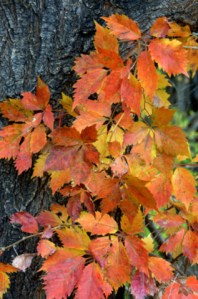 When we think of fall color, we usually think of trees—ash trees are bright yellow, aspen is gold, and oaks and maples are turning crimson. Or we might notice the incredible purple-orange-scarlet leaves on aptly named Burning Bush (Euonymus alata). Not many people expect impressive fall color from a vine.
Virginia Creeper (Parthenocissus quinquefolia) is an import from the northeastern U.S., and grows well in Colorado; it’s hardy to zone 3. Three to seven-inch leaflets in sets of five turn a gorgeous red-orange in September and October, creating a pleasing backdrop for the small blue berries scattered throughout.
New England Asters
 Everyone loves daisies, so it’s no wonder that New England Asters (Symphyotrichum novae-angliae) are so popular. Bright purple (or pink or white) daisies with contrasting golden yellow centers adorn these shrubby perennials from August until October. Growing to four feet high and wide, the plants tend to sprawl unless staked, especially in very fertile soil or partial shade. Stems bear long, lance-shaped leaves of dull green.
 Mountain Plover