
 Sunflowers may resemble a huge yellow sun towering overhead, but their name comes from their ability to keep their “face” turned toward the sun. Everyone recognizes a conventional sunflower with its huge dark disk surrounded by yellow petals, set atop a sturdy stalk that may reach over eight feet in height. A quick tour of a seed catalog shows that this is just the beginning. Breeders have developed shorter plants (as low as two feet) and an expanded palette of hues ranging from mahogany through orange to lemon yellow, white, and even soft rose to wine-red. Many types sport more than one color.
Category: Plant Profiles
All about specific plants.
Ewww, What’s That?
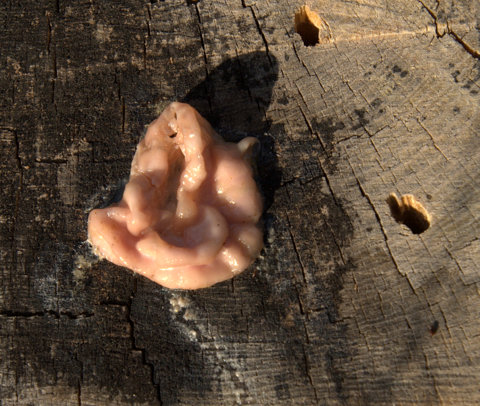 They’re not exactly beautiful. At first glance, you might guess that your neighbor’s dog has vomited on your lawn, but don’t go knocking on their door quite yet. These flattened slimy or spongy masses are actually living organisms known as slime molds.
Growing up to two feet in diameter, slime molds may be white to yellow, pink or tan. Although they look slimy, they are actually fairly resilient when prodded. Unlike plants, slime molds can travel several feet a day. And despite their name, they are not at all related to molds or other fungi. Rather, they’re considered members of the Protista. If you want more detail than that, let’s just say it’s complicated.
‘Red Rocks’ Penstemon

An inconspicuous, low-growing mound of evergreen leaves for most of the year, ‘Red Rocks’ takes center stage in mid-summer, with 18-inch spikes of bright pink, bell-shaped flowers. The first penstemon chosen for inclusion in the PlantSelect® program, ‘Red Rocks’ was added in 1999. It’s a cross between a showy Mexican species and a hardy Colorado native, combining the best features of both its parents. ‘Red Rocks’ is named after the park west of Denver.
Calibrachoa (gesundheit!)
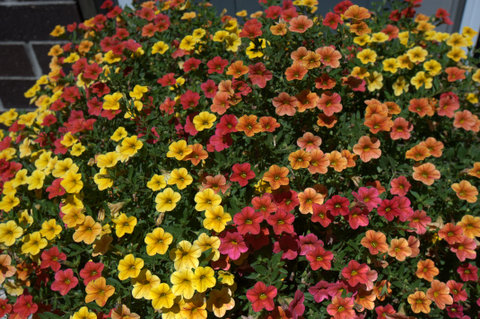 Imagine a petite petunia with intensely-colored, trumpet-shaped blossoms in shades such as magenta, violet, or copper. Flowers smother the slightly fuzzy, gray-green leaves from late spring until the first hard frost. Prolific flowering means that new flowers quickly replace those damaged by hail, a major asset in our area. Mature plants reach about eighteen inches in width and are less than a foot high. A relative newcomer on the garden scene, Calibrachoa has already gained a place of honor among annual flowers.
Whitetop (aka Hoary Cress)
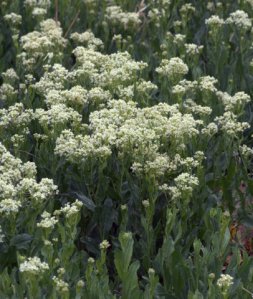 Spring flowers are finally filling the fields. Milk vetch, penstemons, wild onions and marsh marigolds all caught my eye as I hiked though the towering cottonwoods along Fountain Creek, at the base of the Rockies here in central Colorado. I was particularly impressed by huge swaths of a foamy white flower I didn’t immediately recognize.
Counting the petals—each tiny flower had four—and examining the foliage led us to conclude the plants were Crucifers, members of the mustard family. Sure enough, we were enjoying the pretty flower heads of Whitetop (Cardaria draba), an aggressive import from Europe and Asia that is listed as a noxious weed here in Colorado (List B). Oh dear.
Another Easter Flower
 Can you name a plant that has short stems and showy purple flowers at this time of year? Now add eye-catching seed heads, and the fact that it’s native to Colorado (and other cold-winter areas in both North America and Europe). This cultivated wildflower is Pasque Flower (or), named after its Easter time bloom.
Appearance
Besides the lilac wildflowers, other purple shades are available in cultivated strains, from a deep purple-red to, rarely, white. Gray-green leaves appear after the flower buds, and may be more or less finely divided. They’re covered with silvery fuzz, giving a soft appearance that makes you want to pet them.
Basket of Gold (Aurinia saxatilis)
Appearance
 Basket of Gold is a long-lived, low maintenance ground cover for small spaces. Gray, slightly fuzzy leaves are present year round, forming clumps 6 to 18 inches tall and 6 to 12 inches wide. In early Spring the plants are totally covered with masses of tiny cross-shaped flowers. Eye-catching colors range from soft yellow ‘Citrina’ or ‘Dudley Neville’ to the blindingly intense golden yellow of ‘Gold Dust.’ A similar species, Mountain Gold (Aurinia montanum) is more compact, with smaller leaves. Mountain Gold is also a bit harder to find at a garden center.
Do You Have a Bleeding Heart?
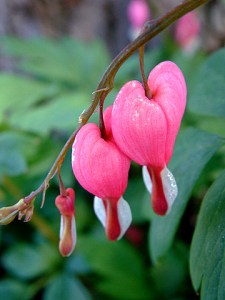 Has the fat little cherub with the bow and arrow left you lonely this Valentine’s Day? If no one will be sending you roses, why not buy yourself a Bleeding Heart?
Bleeding Heart (Dicentra spectabilis) is an old-fashioned perennial aptly named for the row of heart-shaped flowers that dangle along each wiry flower stalk. Airy leaves in sprays reminiscent of a coarse fern appear in early spring, rising on stems that form a clump that can reach two to three feet, given the right conditions.
Ho, Ho, Holly
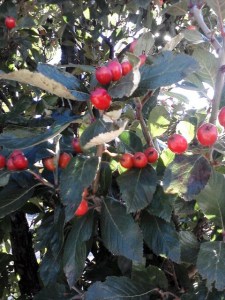 “Deck the balls with boughs of holly” might work well in Merry Olde England, or even in the eastern U.S., but it’s not very practical at my house, just north of Colorado Springs, Colorado. We have too much sunshine, the air and soil is too dry, and our soils are too lean and too alkaline. Holly won’t survive winter’s dessicating winds. At least, that’s what I learned when we moved here.
So imagine my surprise a couple of weeks ago when I was out for a walk in a near-by subdivision, and there were two bushes, covered with green leaves and red berries, planted in the strip of soil between the sidewalk and the street. Could it be?
My Favorite Herbs
 While most of my garden lies dormant for the winter, I’m still picking fresh herbs to use in my cooking. Last year I planted thyme, oregano, rosemary, basil, and sage in large pots, and this fall I hauled them into a sunny spot indoors. The plants are thriving.
As I snipped some rosemary for last night’s dinner, I started thinking—while my in-ground herb garden is spacious, I only have room for a limited number of pots. So, which herbs do I consider essential? And which cultivars do I like the best?
 Mountain Plover