Starting Seeds: Containers

I first posted this about ten years ago. Since my husband had unexpected bypass surgery today, I don’t have the time (or the concentration!) to write a new post. I hope you find this flashback to be a helpful reminder as we start our seeds for the upcoming growing season.


Seed trays_LAH_9674

Raise your hand if you remember starting seeds in elementary school. Perhaps they sprouted in the cells of a cardboard egg carton. Sound familiar? Now, did your seedlings grow and thrive? Hmm, thought so. Granted, you probably forgot to water them, or you dropped the whole shebang on the way home from school. But it wasn’t all your fault. Egg cartons make awful seed starting containers.

What should you use to start those little seedlings? There are a number of excellent choices. Suitable containers share several attributes.
(more…)

Meet the Apiaceae

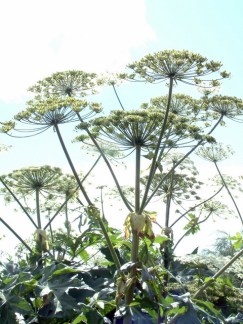
Heracleum sphondylium ssp montanum - Cow parsnip_DBG LAH 058What do carrots, cilantro, celery, and poison hemlock have in common? Think like a botanist. How do the leaves look? What shape is the root? What about the flowers? Yes, they’re all members of the Apiaceae (aka Umbelliferae) family of plants. So are caraway, anise, parsley, parsnips, and a whole host of other familiar species.
Members of this family are relatively easy to distinguish. The most obvious feature is in the way their flowers are arranged—like an umbrella, with a stalk and a cluster of flowers on stems all springing from a central point.

(more…)

Turquoise Sunflowers, Fuchsia Daffodils?

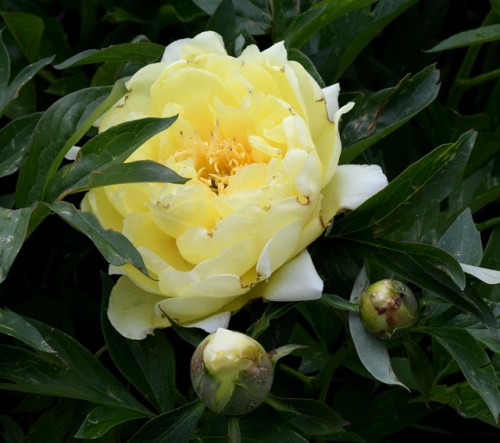
Paeonia hyb_Peony_DBG-CO_LAH_8488

Why do we always seem to gravitate toward things that are rare? Precious stones, one-of-a-kind art objects, limited edition car models—we always seem to want most what’s hardest to find.

Gardeners aren’t exempt. We’re  continually on the lookout for unique cultivars, with odd shapes or unusual colors. While lots of flowers are yellow, peonies usually come in shades of white, pink, and red. Yet, I have a good friend who paid a lot of money to get a yellow peony. Why? She thought it was “interesting.”

(more…)

Amaranthaceae

Family Amaranthaceae has a lot of members—over 2,000 species. You will likely recognize many of them. Some are ornamental—think of the garden annuals Gomphrena, Ptilotus, and Love-lies-bleeding (Amaranthus caudatus). The Celosias are also amaranths—you might know some of them as the old-fashioned flower Cock’s Comb.

(more…)

Gorgeous Ginger

dbg_lah_2899

I love Asian cooking, or at least the American version of it. (I didn’t recognize anything on the buffet at the hotel in Bangkok!). Anything with plenty of onions, garlic, and ginger makes my mouth water. I’ve grown onions and garlic before, when I had more room for such things. But living in the cold part of Zone 5, any ginger I planted would have to be in a pot so I could bring it in for the winter. And at the rate I use ginger, it just didn’t seem to be worth the trouble.

(more…)

Common Mullein

plants in snow_castlewoodcynsp-co_lah_7289

After the storm earlier this week, snow blankets the fields, hiding most signs that anything ever grew there. But interspersed with the even white blanket and occasional dried grass leaves are spikes, sticking up like posts in the empty landscape. We’re finally noticing the dead and dried flower/seed stalks of Common Mullein (Verbascum thapsus).

(more…)

Going Seedless

vitis labrusca - grapes @tacomawa 14oct07 lah 004I sat munching my seedless grapes, enjoying the sweet juices. I bit one in half, and focused on the tiny, immature lumps that would have been seeds in another variety. I’ve always taken seedless grapes for granted, but now I wondered—why didn’t the seeds develop in this cultivar? It clearly goes against a plant’s nature to grow fruit without seeds.

And what about watermelon? Is the same process involved? And those name brand tangerines we just polished off didn’t have seeds either. These days, even bananas are seedless. I miss the little black dots that used to decorate my banana bread. Then there are seedless tomatoes and cucumbers, two more fruits, at least from a botanist’s perspective. I had never stopped to consider how many seedless fruit crops are now available.

(more…)

A “Living Coral” Garden

In case you haven’t yet heard, the 2019 Pantone color of the year is Living Coral. According to Pantone, Living Coral is an “animating and life-affirming coral hue with a golden undertone that energizes and enlivens with a softer edge.” Coral has always been one of my favorite colors. I think it’s pretty (and I like this shade much better than last year’s Ultra Violet, described as a “blue-based purple that takes our awareness and potential to a higher level”).

(more…)

All in the Family

karin, leslie and willow_everett-wa_lah_3765Did you know that plants come in families?

You may remember learning taxonomy in your high school biology class. Way back when, I taught my classes of 15-year-olds the seven levels of classification: kingdom, phylum, class, order, family, genus, and species. (Since that time, scientists have been busy, and we now have domains, which precede kingdoms.) All these can have super- and sub- added to their names, as well. If you’re talking about plants, “phylum” is replaced by “division” and “order” is sometimes replaced by “series,” just to keep things as confusing as possible. (more…)

A Garden Retrospective

NewSantaFeTrl-COS-CO_LAH_2657

How did your garden grow this past year? Did everything flourish? Did you make mistakes? What do you intend to keep on doing, and what will you change for the future? Occurring as it does in the coldest part of the year, New Year’s is an excellent time to review last year’s garden and then apply the knowledge gained to this coming growing season.

(more…)